

Key Takeaways
Option A
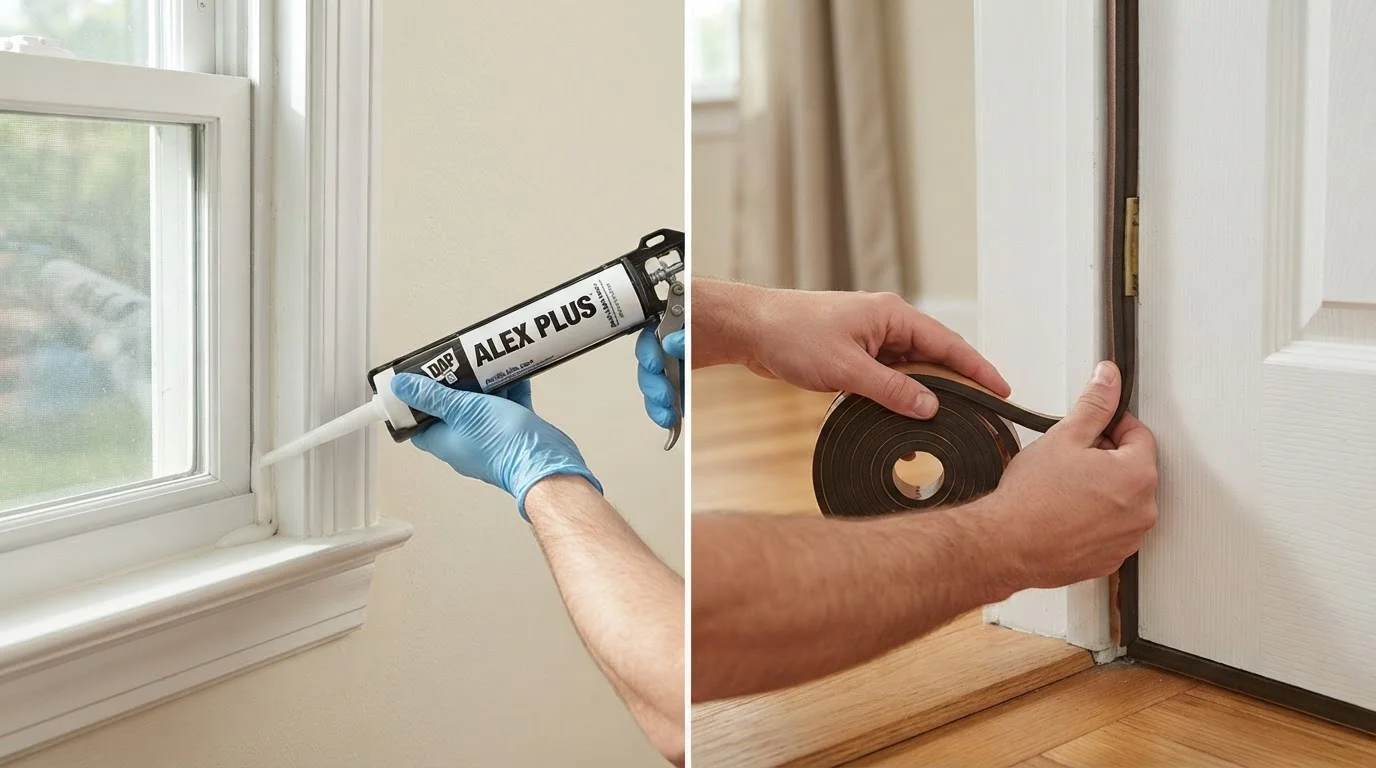
Caulk
The permanent, flexible sealant for stationary gaps.
Best for: Best for sealing fixed cracks and gaps around window frames, door frames, baseboards, and other non-moving surfaces.
Option B
Weatherstripping
The compressible barrier designed for surfaces in motion.
Best for: Best for sealing the moving edges of doors and operable windows where surfaces open and close repeatedly.
If you're sealing a fixed crack along a window frame or door casing
Caulk
Stationary joints need a rigid-once-cured, flexible sealant that bonds permanently to surfaces. Caulk fills irregular gaps and adheres to wood, masonry, and vinyl without compressing.
If you're stopping drafts around a door that opens and closes daily
Weatherstripping
Weatherstripping compresses and rebounds each time the door moves, maintaining a consistent seal without breaking down. Caulk applied here would crack within weeks.
If your drafty window is a fixed picture window with gaps at the frame
Caulk
Fixed windows have no moving parts, so a permanent flexible sealant applied along the frame perimeter is the correct and long-lasting solution.
If you want to address both the door slab edges and the surrounding door casing
Both
Apply weatherstripping to the door stop and slab edges, then run a bead of caulk along the exterior door casing where it meets the siding or wall. Each product serves a distinct role.
If you're a first-time homeowner doing a quick weekend weatherization project
Weatherstripping
Weatherstripping is forgiving, repositionable during installation, and delivers immediate, noticeable results on drafty doors with minimal tools and experience required.
Why Choosing the Wrong Product Wastes Your Effort
Both caulk and weatherstripping seal air leaks - but the mechanics behind how they work are completely different. Apply the wrong one and you'll find yourself redoing the job within a single season. The key distinction comes down to one question: does the surface move?
Caulk is a flexible compound that cures into a semi-rigid seal. It bonds to stationary surfaces and bridges gaps permanently. Weatherstripping, by contrast, is a compressible material - foam, felt, vinyl, or rubber - designed to create a seal by being repeatedly squeezed between two surfaces each time a door or window closes.
When caulk is applied to a door's moving edge, the constant flex cracks the bead and gaps reopen almost immediately. When weatherstripping is used on a fixed crack in a wall or frame, it can't bond properly and won't fill irregular surfaces. Matching the right product to the right location is the single most important step in effective draft sealing.
| Criterion | Caulk | Weatherstripping |
|---|---|---|
| Best surface type | Stationary, non-moving joints | Moving edges and operable surfaces |
| Typical locations | Window frames, door casings, baseboards | Door stops, sashes, door bottoms |
| How it seals | Bonds and cures into flexible solid | Compresses and rebounds with each use |
| Durability | 10-20 years (silicone); 5-10 years (latex) | 2-10 years depending on material and use |
| Ease of installation | Moderate - requires clean, dry surface | Easy - most types peel-and-stick |
| Paintable | Yes (latex); No (silicone) | Generally no |
| Failure mode | Cracks if applied to moving surfaces | Compresses permanently; loses spring |
When to Reach for Caulk
Caulk belongs on any joint or gap where two stationary surfaces meet. Common locations around doors and windows include:
- The exterior door casing where it meets siding or brick
- Window frame perimeters on both interior and exterior sides
- The gap between the window sill and wall
- Baseboards and interior trim that have pulled away from the wall
For exterior applications exposed to moisture and temperature swings, silicone caulk generally holds up longer than other formulations. For interior work where you plan to paint over the seal, acrylic latex caulk is easier to apply, clean up, and finish. Always clean and dry surfaces before application - caulk will not bond to dirty or wet substrates.
Up to 30%
Home heating and cooling lost to air leaks
The U.S. Department of Energy estimates that air leaks around windows, doors, and other openings can account for up to 30% of a home's heating and cooling energy loss.
$0.50-$10
Typical cost per linear foot of weatherstripping
Weatherstripping ranges widely in price depending on material - foam tape sits at the low end, while EPDM rubber and silicone bulb strips are more expensive but more durable.
A common mistake is caulking the bottom exterior threshold of a door. That area experiences direct foot traffic and compression, which requires a door sweep or threshold seal - both forms of weatherstripping - not caulk.
When Weatherstripping Is the Right Call
If a surface opens and closes, weatherstripping is almost certainly what you need. Typical locations include:
- The door stop - the thin strip of wood the door closes against inside the frame
- The top and side edges of exterior door slabs
- The bottom of doors, using a door sweep or automatic door bottom
- Operable window sashes - both double-hung and casement windows
Weatherstripping comes in several types. V-strip (tension seal) is durable and works well along the sides of door frames and window channels. Foam tape is the easiest to install and suits light-duty applications like cabinet doors or rarely used entryways. EPDM rubber or silicone bulb strips offer the best longevity for frequently used exterior doors.
To check whether existing weatherstripping needs replacing, close a door on a piece of paper. If you can pull the paper out without resistance, the seal has failed and replacement is overdue.
Permits and Professional Help
Applying caulk and weatherstripping are straightforward DIY tasks that generally don't require permits. However, if your drafts stem from structural gaps, damaged window frames, or failing door frames rather than surface-level sealing issues, consult a qualified contractor. Structural repairs may require permits depending on your local building codes.
A Practical Room-by-Room Approach
Rather than buying one product and applying it everywhere, walk through your home systematically. On a windy day or with a lit incense stick, move along window and door perimeters and watch for smoke movement - that's your draft map.
At each location, ask: Does this surface move? If yes, plan for weatherstripping. If no, plan for caulk. In many cases - particularly at exterior doors - you'll use both: weatherstripping on the door stop and sweep, caulk on the fixed casing outside.
For most homeowners, a single exterior door and two or three windows can be fully sealed in a few hours with minimal cost. Start with the leakiest openings first for the greatest immediate comfort improvement, and work outward from there. Consistent, correct sealing - not just patching visible cracks - is what produces lasting energy efficiency results.