

Key Takeaways
Why High-Interest Debt Demands a Dedicated Plan
High-interest debt - most commonly credit card balances carrying APRs in the range of 20% or higher - grows faster than almost any savings vehicle can offset. Paying the minimum on a $5,000 balance at 22% APR can take well over a decade to clear and cost thousands in interest alone. That compounding works powerfully against you every month you delay.
The tension many people face is deciding whether to pay down debt or put money into savings. In most cases, high-interest debt should take priority - because the guaranteed "return" from eliminating a 22% APR debt outpaces what a typical savings account or conservative investment is likely to earn. For a fuller look at that trade-off, see whether to pay off debt or build savings first.
A structured approach matters because willpower alone rarely wins against compound interest. A clear sequence of steps - inventory, buffer, prioritization, execution - turns an overwhelming problem into a series of manageable actions.
This Is General Information, Not Personal Advice
This article provides general financial education only and does not constitute personalized financial, tax, or legal advice. Every financial situation is different. Consult a qualified financial professional before making significant decisions about debt repayment or savings.
What You'll Need Before You Start
Gathering the right information and resources upfront keeps the process from stalling. Here's what to have ready:
What you will need
List of all debts (balances, rates, minimums)
Forms the foundation of your repayment plan and helps you prioritize correctly.
Monthly budget or spending tracker
Identifies how much cash you can redirect toward debt each month beyond minimums.
Spreadsheet or free debt payoff calculator
Projects payoff timelines and total interest under different payment scenarios.
Small emergency fund (typically $500-$1,000)
Prevents a single unexpected expense from forcing you back into debt mid-plan.
The Step-by-Step Payoff Framework
Follow these steps in order. Skipping ahead - for instance, going straight to aggressive repayment without a small emergency fund - often backfires when the first unexpected expense arrives.
Build a complete debt inventory
Write down every debt you carry: credit cards, personal loans, medical bills, and any other balances. For each one, record the current balance, the annual percentage rate (APR), and the minimum monthly payment. Seeing the full picture in one place is often uncomfortable - but it's essential. You cannot build an effective plan around numbers you're avoiding.
Build a starter emergency fund
Before aggressively targeting debt, set aside a small cash cushion - commonly in the range of $500 to $1,000 - in a liquid savings account. Without it, one unexpected expense (a car repair, a medical copay) can push you right back onto credit cards, undoing your progress. Once this buffer is in place, you can redirect all available extra cash toward repayment.
Find your extra monthly payment capacity
Review your monthly income and spending to identify how much you can put toward debt beyond your required minimums. Look for recurring expenses that can be temporarily reduced - subscriptions, dining out, or discretionary shopping. Even an extra $50 to $100 per month, applied consistently, meaningfully shortens your payoff timeline and reduces total interest paid.
Choose a repayment strategy
Two widely used methods offer different advantages:
- Debt Avalanche: Direct extra payments toward the debt with the highest APR first, while paying minimums on the rest. This approach minimizes total interest paid over the life of your debt.
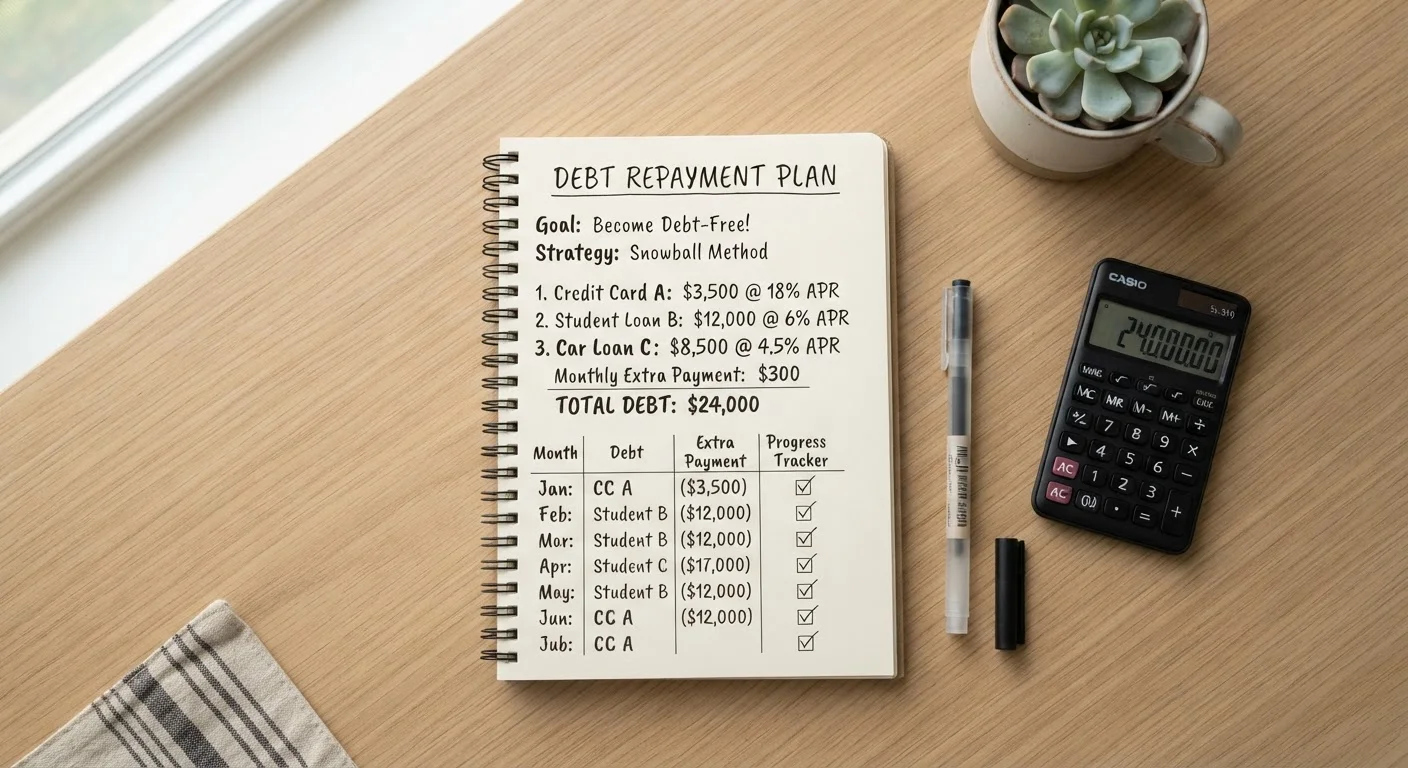
- Debt Snowball: Target the smallest balance first regardless of rate. When that's paid off, roll that payment into the next smallest. This method creates quicker early wins that reinforce motivation.
Neither is universally superior - the right choice depends on your psychology and situation. See how the avalanche and snowball methods compare for a deeper breakdown of each approach.
Execute consistently and track progress
Apply your extra payment to the target debt every month without exception. As each debt is eliminated, roll its minimum payment into the next target - this is the core mechanic that accelerates repayment over time. Review your inventory every one to three months to confirm balances are declining as projected and adjust if your income or expenses change.
Don't Skip Your Minimum Payments
Missing minimum payments triggers late fees, penalty interest rates, and credit score damage that can make your debt problem significantly worse. Always pay at least the minimum on every account, even while focusing extra funds on a priority debt.
Automate to Protect Your Progress
Set up automatic payments for at least the minimum on every account. Then schedule an additional automatic transfer toward your target debt each payday. Automation removes the temptation to spend those funds elsewhere and keeps your plan on track without requiring willpower every month.
Considering Additional Options Along the Way
Once your plan is in motion, two additional strategies are worth understanding - though both carry important caveats.
Debt consolidation rolls multiple balances into a single loan, ideally at a lower interest rate, simplifying payments and potentially reducing interest costs. However, it doesn't reduce the amount owed and can extend your repayment period if not handled carefully. Learn how debt consolidation works and when it makes sense before pursuing this path.
Saving while repaying is also possible in some situations - particularly if your employer offers a retirement match, which is effectively a guaranteed return on contributed dollars. Explore how to save and pay down debt simultaneously for a practical framework on allocating limited income across both goals.
For a comprehensive view of how savings and debt interact across different financial situations, the full picture on saving and debt covers the underlying principles in depth.
This article is for general informational and educational purposes only and does not constitute personalized financial, investment, tax, or legal advice. Consult a licensed financial professional for guidance specific to your circumstances.