

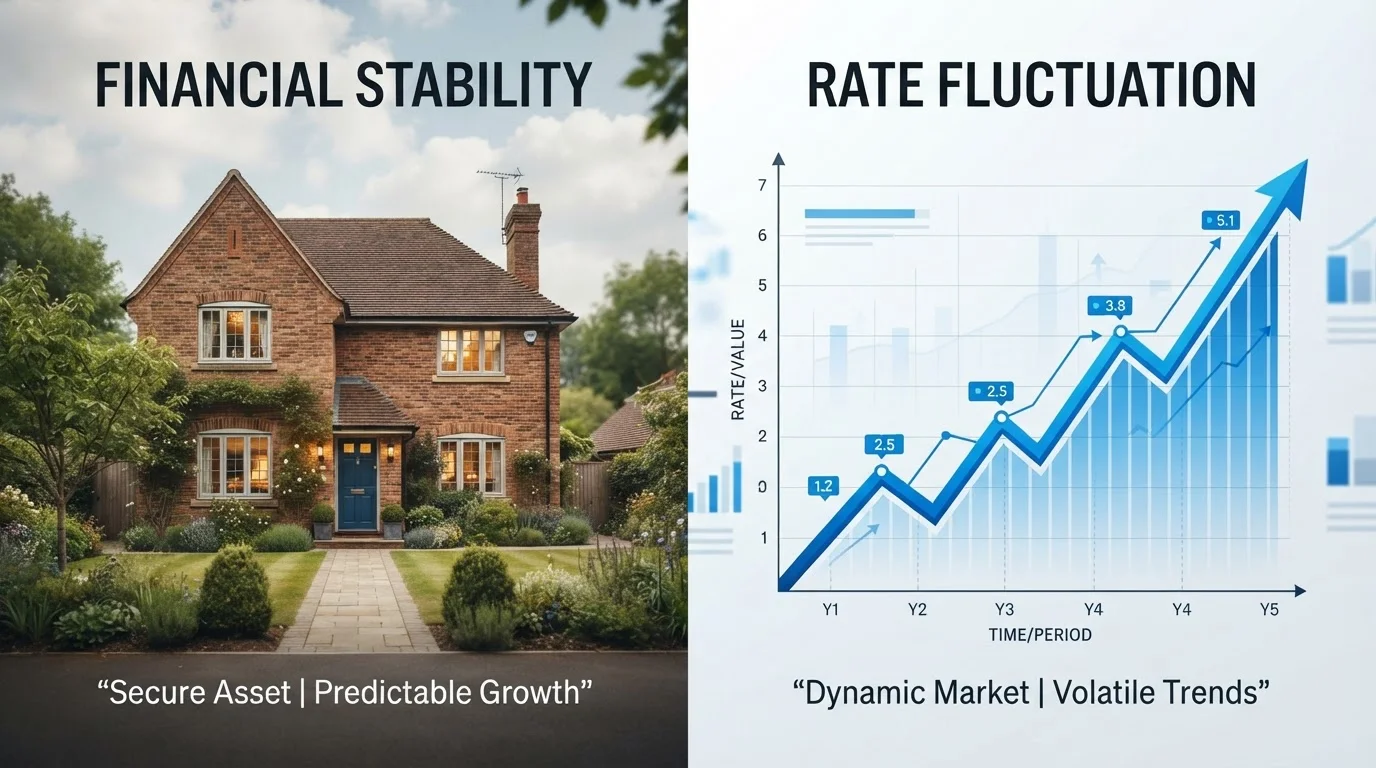
Key Takeaways
Option A
Fixed-Rate Mortgage (FRM)
The predictable, long-term stability choice.
Best for: Buyers who plan to stay in their home for many years and want consistent monthly payments regardless of market conditions.
Option B
Adjustable-Rate Mortgage (ARM)
The flexible, potentially lower-cost alternative.
Best for: Buyers who expect to move or refinance within a few years and can tolerate some payment variability in exchange for a lower initial rate.
If you plan to stay in the home long-term (7+ years)
Fixed-Rate Mortgage (FRM)
Locking in a rate eliminates exposure to future rate increases, giving you budget certainty over decades of payments.
If you expect to sell or refinance within 5-7 years
Adjustable-Rate Mortgage (ARM)
The lower introductory rate can meaningfully reduce interest costs if you exit the loan before the adjustment period begins.
If you have a tight monthly budget or limited income flexibility
Fixed-Rate Mortgage (FRM)
A stable payment protects you from financial strain if rates rise - unpredictable costs are harder to absorb on a fixed income.
If you're buying during a period of historically high interest rates
Adjustable-Rate Mortgage (ARM)
An ARM's lower initial rate may offer short-term relief, with potential to refinance into a fixed rate if rates fall later.
How Each Mortgage Type Works
A fixed-rate mortgage (FRM) carries the same interest rate - and therefore the same principal-and-interest payment - for the full loan term, typically 15 or 30 years. What you see on closing day is what you pay on the final month.
An adjustable-rate mortgage (ARM) begins with a fixed introductory rate for a set period - commonly 5, 7, or 10 years - then resets periodically based on a benchmark index such as the Secured Overnight Financing Rate (SOFR). The common shorthand tells you both periods: a 5/1 ARM holds its rate fixed for five years, then adjusts once per year afterward.
ARMs include built-in rate caps that limit how much the rate can move at each adjustment and over the life of the loan. However, within those caps, your payment can rise substantially depending on market conditions at the time of each reset. Understanding how much that ceiling could cost you - not just the teaser rate - is essential before signing.
| Criterion | Fixed-Rate Mortgage | Adjustable-Rate Mortgage |
|---|---|---|
| Interest Rate | Locked for full loan term | Fixed initially, then periodic resets |
| Initial Monthly Payment | Typically higher | Typically lower |
| Payment Predictability | Completely stable | Variable after intro period |
| Rate Reset Risk | None | Present after fixed window ends |
| Ideal Time Horizon | 7+ years | 5-7 years or less |
| Rate Cap Protections | Not applicable | Yes - periodic and lifetime caps |
| Best Rate Environment | Low prevailing rates | High prevailing rates with expectation of decline |
The Core Trade-Off: Certainty vs. Cost
The fundamental question is how much predictability is worth to you relative to potential short-term savings. Fixed-rate loans price in stability - lenders charge a premium for assuming the interest-rate risk on your behalf. ARMs transfer some of that risk to the borrower in exchange for a lower starting rate.
The gap between initial ARM rates and comparable fixed rates varies with broader market conditions. When that gap is wide, the savings during an ARM's fixed period can be substantial. When the gap narrows, the risk-reward calculation shifts toward the fixed option.
5/1
Most common ARM structure in the U.S.
A 5/1 ARM fixes the rate for five years then adjusts annually - widely used when buyers anticipate moving or refinancing within that window.
30 years
Standard fixed-rate mortgage term
The 30-year fixed-rate mortgage remains the most prevalent home loan product in the United States, according to Freddie Mac survey data.
2%/5%
Typical ARM rate cap limits
Many ARMs carry a 2% per-adjustment cap and a 5% lifetime cap above the initial rate, limiting - but not eliminating - payment shock risk.
This dynamic is why your time horizon matters more than almost any other factor. If you sell or refinance before the adjustment period begins, you capture the lower rate without ever facing a reset. If life circumstances change and you stay longer than planned, you absorb the full variability risk. As a helpful companion to this decision, consider reading about the broader financial context in our article on the difference between fixed and variable expenses - the same conceptual framework applies to your housing costs.
Key Factors to Weigh Before Choosing
No single mortgage structure is universally superior - the right choice depends on your individual circumstances. Consider these dimensions:
- Length of stay: If there is any real possibility you will remain in the home beyond the ARM's initial fixed window, model what your payment would look like at the rate cap - not just the teaser rate.
- Rate environment: Fixed rates look more attractive when rates are low and ARMs are relatively more attractive when fixed rates are elevated, assuming you have a defined shorter-term horizon.
- Income stability: Variable-payment risk is more manageable when your income is likely to grow or if you have financial reserves to absorb higher payments.
- Refinancing feasibility: Some borrowers plan to refinance out of an ARM before it adjusts - a reasonable strategy, but not a guarantee. Refinancing involves costs and requires qualifying again under the conditions at that time.
If you're still weighing whether homeownership itself is the right move, our analysis of renting vs. buying a home covers the broader financial and lifestyle trade-offs. And if market timing is a concern, the piece on renting vs. owning during a hot housing market addresses how price surges affect the math on both sides.
This article is for general educational purposes only and does not constitute personalized financial or mortgage advice. Consult a licensed mortgage professional or financial adviser to evaluate options appropriate to your individual financial situation.