

Key Takeaways
Option A
Pre-Qualification
The quick, informal first step in gauging your buying power.
Best for: Buyers in early exploration who want a rough sense of what they may be able to borrow before committing to a full application.
Option B
Pre-Approval
The verified, lender-backed signal that you're a serious buyer.
Best for: Buyers ready to make offers who need documented proof of their borrowing capacity to compete credibly in the market.
If you're just starting to explore homeownership and want a ballpark figure
Pre-Qualification
Pre-qualification requires minimal documentation and no hard credit inquiry, making it a low-stakes way to gauge affordability before you're ready to shop seriously.
If you're actively touring homes and preparing to make offers
Pre-Approval
Pre-approval signals to sellers that a lender has verified your financials, giving your offer substantially more credibility - especially in competitive markets.
If you're buying in a seller's market with multiple competing offers
Pre-Approval
In fast-moving markets, sellers routinely dismiss offers lacking pre-approval. A verified letter can be the deciding factor in a multiple-offer situation.
What Each Term Actually Means
The words pre-qualification and pre-approval are sometimes used interchangeably in casual conversation, but they represent meaningfully different stages of the mortgage process - and confusing the two can cost you time, credibility, and in competitive markets, the home itself.
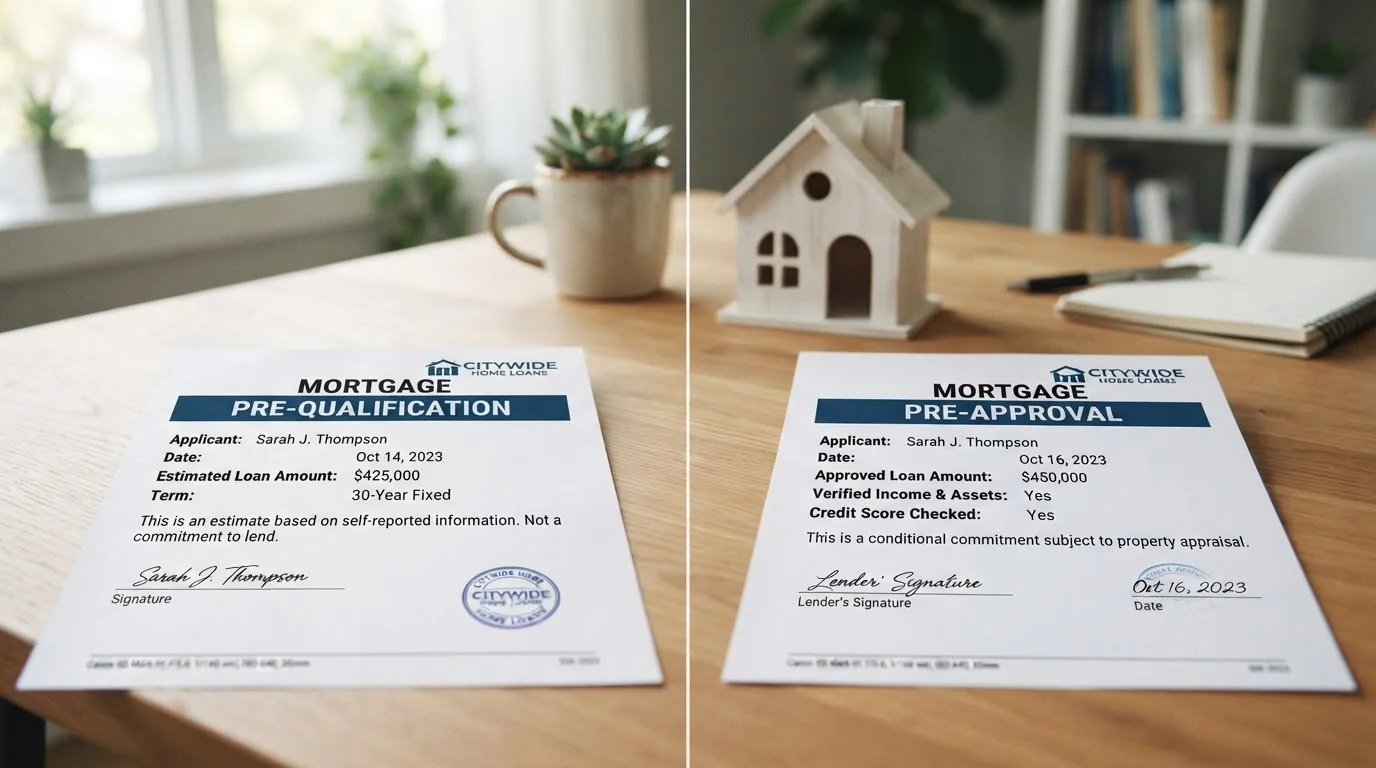
Pre-qualification is typically a brief, informal assessment. A lender asks you to self-report income, assets, debts, and employment status, then offers an estimate of how much you might be able to borrow. No documents are verified, and in most cases, no hard credit inquiry is conducted. Think of it as a financial snapshot based on your word alone.
Pre-approval goes considerably further. The lender collects and verifies actual documentation - pay stubs, W-2s, tax returns, bank statements - and runs a hard credit inquiry. Based on this review, they issue a conditional commitment letter stating the loan amount you qualify for, subject to a satisfactory appraisal and final underwriting. That letter carries real weight because it represents a lender's informed, documented assessment, not just a rough estimate.
Before diving into either process, it helps to have a clear picture of what you actually need from a home and what your financial boundaries are. See our needs-first framework for guidance on defining priorities before any major decision.
Side-by-Side: Key Differences at a Glance
The table below highlights the practical distinctions between the two processes across the dimensions that matter most to home buyers.
| Criterion | Pre-Qualification | Pre-Approval |
|---|---|---|
| Documentation required | Self-reported figures only | Verified pay stubs, tax returns, bank statements |
| Credit inquiry type | Soft inquiry or none | Hard inquiry (affects credit score slightly) |
| Lender commitment level | Informal estimate | Conditional commitment letter |
| Time to complete | Minutes to a few hours | Several days to over a week |
| Seller credibility | Low - unverified | High - lender-verified |
| Suitable market phase | Early exploration | Active offer-making |
One point worth emphasizing: neither pre-qualification nor pre-approval is a loan guarantee. Both are conditional assessments. Final approval depends on the property appraisal, title review, and full underwriting - a process that happens after an offer is accepted. Understanding this distinction protects buyers from overconfidence during the shopping phase.
Pre-Approval Expiration Dates Matter
Most pre-approval letters are valid for 60 to 90 days, after which the lender will require updated documentation and a new credit review. If your home search extends beyond that window, plan to renew your pre-approval before submitting offers. Starting the search too early relative to when you intend to buy can mean juggling expiration timelines alongside an already complex process.
How Market Conditions Shape Which You Need
The type of documentation a seller expects from a buyer depends significantly on local market dynamics. In a seller's market versus a buyer's market, the stakes shift considerably.
In a seller's market - characterized by low inventory and multiple competing offers - pre-qualification alone is often insufficient. Listing agents routinely advise their clients to reject or deprioritize offers that aren't accompanied by a pre-approval letter. A seller reviewing three offers simultaneously has little incentive to take on the risk of a buyer whose finances haven't been verified.
In a softer buyer's market, sellers may be more willing to negotiate and less likely to discard an offer simply because it comes with pre-qualification rather than pre-approval. Even so, moving forward with pre-approval strengthens your negotiating position and demonstrates seriousness regardless of market conditions.
74%
Buyers who obtained pre-approval before shopping
According to the National Association of Realtors' Profile of Home Buyers and Sellers, the majority of recent buyers secured pre-approval prior to making an offer.
60-90 days
Typical pre-approval validity window
Most lenders issue pre-approval letters that expire within this range, requiring buyers to renew if their search extends beyond it.
Your real estate agent can help you read local conditions and advise on what documentation is standard practice in your area. See our questions to ask a real estate agent before you begin working together.