

Key Takeaways
Why Shopping Myths Are Hard to Shake
Retail pricing is designed by professionals whose job is to make spending feel rational, even rewarding. That's not a conspiracy - it's commerce. But it does mean that many of the mental shortcuts shoppers rely on to identify a good deal were, at some point, shaped by the same environment they're meant to navigate. The beliefs below are not fringe ideas; they're widely held and frequently reinforced by marketing language, store layouts, and the structure of loyalty ecosystems. Understanding where they go wrong is the first step toward making decisions based on actual value rather than perceived savings.
Myth
Buying in bulk always saves you money per unit, so stocking up is the smart move.
Fact
Bulk buying only saves money if you use the entire quantity before it spoils, expires, or becomes obsolete - otherwise, the savings evaporate with the waste.
The per-unit math on bulk items often looks favorable at the shelf, but the true cost calculation has to include what you actually consume. Perishable goods bought in larger quantities than a household can realistically use result in waste that cancels any unit-price advantage. The same logic applies to non-perishables that get stored indefinitely: money tied up in unused inventory is money that isn't working elsewhere. Before buying in volume, consider storage space, realistic consumption rates, and whether the item has a shelf life - expiry date or otherwise.
Myth
Loyalty program points and rewards are essentially free money that always pay off.
Fact
Loyalty programs are designed to increase spending frequency and basket size, and many members never redeem enough points to recoup meaningful value.
Consumer behavior research consistently shows that loyalty program enrollment tends to increase overall spending at that retailer, which is precisely the intended effect. Points often expire, carry redemption thresholds that require significant accumulation before any value can be accessed, and are frequently devalued or restructured by the issuing retailer. A shopper who buys something they did not need specifically to earn points has not saved money - they've spent it. Loyalty programs can offer genuine value to high-frequency shoppers who would make those purchases anyway, but the mechanics deserve scrutiny rather than automatic trust. See our guide to deal-hunting habits that undermine real savings for a closer look at loyalty tunnel vision.
Myth
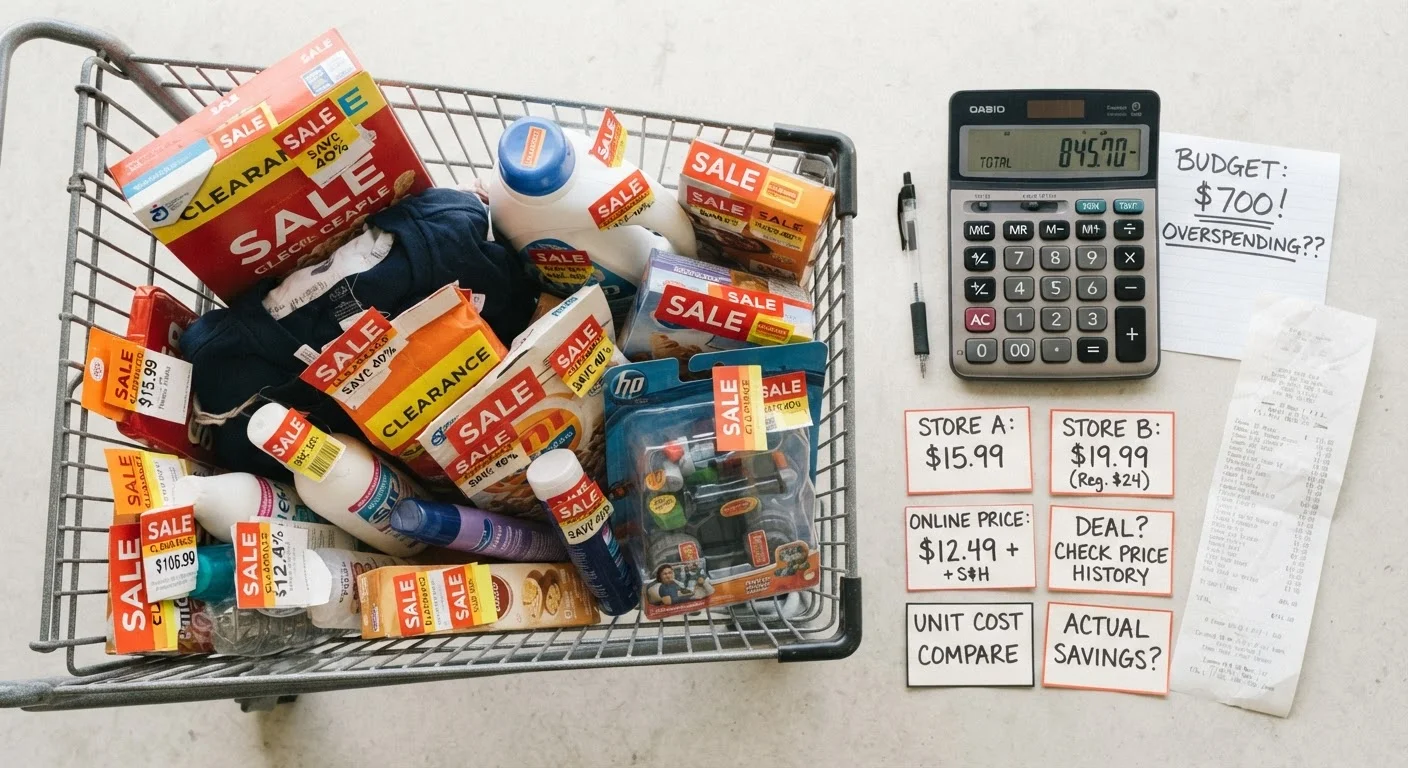
Clearance items are always priced below what you'd pay at other stores.
Fact
Clearance tags signal that a retailer is reducing its own prior price - they do not guarantee the item is cheaper than comparable products elsewhere.
A clearance sticker means one specific thing: this retailer has marked the item down from what they previously charged. It does not mean the resulting price is competitive with other retailers, and it does not mean the item represents good value for your needs. A quick price check on a smartphone before purchasing clearance merchandise takes under a minute and can reveal whether the markdown is genuinely advantageous or simply a return to a normal market price that was always available elsewhere.
Myth
A high original price shown next to a sale price proves you're getting a significant discount.
Fact
Reference pricing - displaying a high "was" price alongside a lower "now" price - is a well-documented retail tactic that does not always reflect what the item actually sold for at that higher price.
Regulators in several U.S. states have pursued enforcement actions against retailers for displaying artificially inflated reference prices that products rarely or never sold at in any meaningful volume. The Federal Trade Commission has issued guidance on deceptive pricing, noting that a comparison price is only meaningful if the item was genuinely offered at that price for a substantial period. When evaluating a "sale," focus on the actual price relative to comparable products from multiple sources - not on the size of the markdown percentage. This is also where myths that distort how people compare products become relevant: the assumption that a higher original price signals quality compounds the confusion.
Myth
Using a coupon always means you're paying less overall.
Fact
A coupon on a product you wouldn't have otherwise purchased results in spending money, not saving it - the net effect is negative regardless of the face value of the discount.
Coupons are a marketing tool that drive trial and purchase, and they work partly because the framing of "saving" activates a sense of gain even when cash is leaving the buyer's wallet. The genuine savings calculation is simple: if you would have bought the item at full price anyway, a coupon reduces cost. If the coupon prompted the purchase, there are no savings - only a discounted expense. Additionally, coupon codes and automatic discounts don't always stack, and assuming they do can lead to checkout surprises. Our breakdown of coupon codes vs. automatic discounts explains how each mechanism actually works.
Building a More Reliable Deal-Evaluation Framework
The common thread across these myths is that they all shortcut the real question: compared to what? A bulk price is only good relative to what you'd spend buying smaller quantities that you actually use. A loyalty reward is only valuable relative to what you spent to earn it. A clearance price only makes sense relative to what the same item costs elsewhere. Anchoring every purchase decision to that comparative baseline - rather than to a retailer's framing - is the practical habit that separates genuine savings from the feeling of savings.
~40%
Of loyalty program points that go unredeemed
Industry analysis of loyalty program data has consistently found that a large share of earned points expire without redemption, meaning the perceived reward never translates into actual value for the consumer.
1 in 3
Bulk purchases that result in waste
Consumer research examining household purchasing behavior suggests that a significant proportion of bulk or oversized purchases are partially or fully wasted, particularly for perishable categories.
Subscription-based discounts deserve the same scrutiny. The ongoing discount looks attractive in isolation, but subscribe-and-save trade-offs include commitment periods, cancellation friction, and the risk of accumulating more product than you need. Evaluate the full cost and flexibility before treating the recurring discount as automatically advantageous.
Finally, if comparing products across retailers, be aware that inflated reference prices aren't the only thing that can skew perception. The Safe Online Shopping hub covers how to verify retailer legitimacy before assuming a price is real and a deal is genuine.
This article is for general informational and educational purposes only. It does not constitute personalized financial or consumer advice. Consult a qualified professional for guidance specific to your circumstances.