

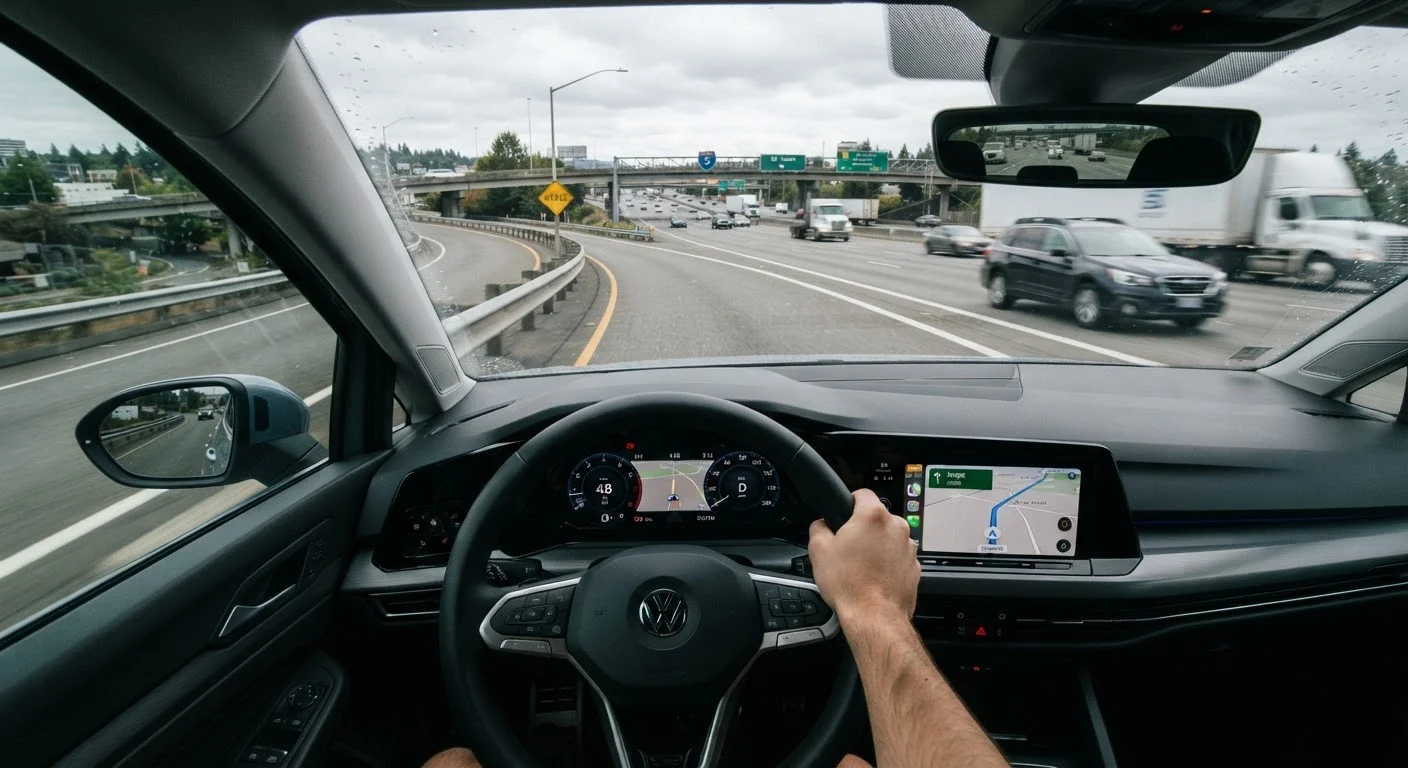
Key Takeaways
Highway On-Ramp Merging
Merging onto a highway means transitioning your vehicle from a low-speed on-ramp onto a high-speed travel lane occupied by existing traffic. The goal is to match the speed of highway traffic and find a safe gap before entering the flow - not to force other drivers to yield or slow down. Most states legally require on-ramp drivers to yield to traffic already on the highway.
The 'acceleration lane' - the paved area between the ramp and the travel lane - is specifically designed to let merging drivers reach highway speed before completing the merge. It is not a parking zone or a place to stop and wait.
Why Merging Feels Harder Than It Should
For many drivers, the on-ramp is where confidence evaporates. You're accelerating up a curve, checking your mirrors, watching a wall of vehicles at highway speed, and trying to find a gap - all at once. The anxiety is understandable, but most merge errors trace back to a handful of misunderstandings about what merging actually requires.
The core principle is straightforward: reach highway speed, identify a gap, signal, and commit. Merging is not about squeezing in or hoping someone slows down - it's a coordinated transition that works best when both the merging driver and highway traffic understand their respective roles.
Hesitation is the hidden culprit behind most merge conflicts. Drivers who slow or stop on the acceleration lane force themselves into an impossible situation: they're now trying to accelerate from near-zero into 65+ mph traffic, with limited space and vehicles stacking up behind them. This kind of hesitation can also set off the chain-reaction braking that makes tailgating so dangerous for everyone nearby.
The Legal Framework: Who Yields and Why
The law is fairly consistent across U.S. states: the merging driver yields to highway traffic. This makes logical sense - vehicles already in the travel lane have established speed, position, and right of way. The on-ramp is an entry point, not a forcing mechanism.
That said, the legal picture has nuance. Some state codes and highway designs do expect highway drivers to facilitate safe merges where possible - for example, by moving left or adjusting speed - but this is widely considered a courtesy, not a legal obligation. The merging driver bears primary legal responsibility for the safety of the maneuver.
Knowing this matters in a practical way: if a merge-related collision occurs and a driver was entering from an on-ramp, they will likely face scrutiny first. Understanding your legal position helps you make better decisions rather than assuming the highway will simply accommodate you.
State Laws Vary - Know Yours
Traffic laws governing merging can vary by state and may be updated over time. Always consult your state's current driver handbook or department of motor vehicles for the rules applicable to your jurisdiction. When driving in unfamiliar states, assume the on-ramp driver bears yield responsibility unless signage indicates otherwise.
Traffic laws governing merging can vary by state and may be updated over time. Always consult your state's current driver handbook or department of motor vehicles for the rules applicable to your jurisdiction.
The Zipper Method and Speed Matching Explained
Two techniques stand out as the most effective tools for safe merging in any traffic condition.
Speed Matching
Before you reach the end of the acceleration lane, your vehicle's speed should closely match the prevailing speed of highway traffic. This minimizes speed differential - the difference in velocity between you and surrounding vehicles - which is one of the primary factors in merge-related collisions. Check your speedometer, glance at traffic, and use the full length of the acceleration lane to reach that speed. Do not brake and wait for a gap to appear; accelerate into one.
The Zipper Merge
When two lanes funnel into one - whether at a construction zone or a lane reduction - many drivers instinctively move over early, leaving the merging lane underused and creating a longer backup. Research from transportation agencies consistently shows this is less efficient and more dangerous than the zipper method: both lanes use their full length, and drivers alternate - one from each lane - at the merge point.
The zipper merge reduces overall congestion, cuts rear-end crash risk, and is the approach advocated by multiple state departments of transportation. The key behavioral requirement is simple: each driver takes one turn, without blocking or cutting. Those common assumptions about who should go first are exactly what causes friction at merge points.
Use the Full Acceleration Lane
Many drivers begin scanning for a gap too early and end up coasting or braking instead of accelerating. Start checking your mirrors and blind spot about halfway down the ramp, but keep your foot on the accelerator and use every foot of the lane available to you. Arriving at highway speed gives you far more usable gap options than arriving at 40 mph.
What Highway Drivers Can Do
Merging is a two-way dynamic. Highway drivers who understand on-ramp mechanics can reduce conflicts significantly. When you spot a vehicle accelerating up an on-ramp, a few adjustments help:
- Move left if it's safe: Creating space in the rightmost lane gives the merging driver room without requiring precise timing.
- Adjust speed to open a gap: A slight reduction or increase in speed can make the difference between a smooth merge and a conflict - especially when the ramp geometry is short.
- Avoid aggressive acceleration to block merges: Speeding up specifically to prevent a merge contributes to dangerous speed differentials and is the kind of behavior associated with aggressive driving.
Sharing the road competently extends beyond your own vehicle. The same awareness that helps you navigate around large trucks' blind spots - as covered in our guide on sharing the road with large trucks - applies on-ramps: anticipate what others around you need, and adjust proactively.
A driver approaches a short on-ramp during rush hour and sees a gap in traffic roughly 400 feet ahead. Instead of braking to 'wait for a better gap,' she accelerates steadily and enters at 62 mph - matching the flow.
During a highway construction zone with two lanes merging into one, a driver in the right lane stays in his lane until the marked merge point, then takes his turn after a left-lane vehicle passes - one in, one in.
A highway driver in the right lane spots a car accelerating up a busy on-ramp with limited space. She checks her mirrors and safely moves to the center lane, giving the merging driver a clear path.
A new driver freezes on the acceleration lane, slowing to nearly 30 mph before attempting to enter a 65 mph highway, causing vehicles behind him on the ramp to brake hard.