

Key Takeaways
Tailgating
Tailgating means following another vehicle so closely that you don't have enough space and time to stop safely if it brakes suddenly. It's one of the most common - and preventable - causes of rear-end collisions. The term applies regardless of speed: even at 25 mph, an insufficient gap can mean a crash.
Traffic safety professionals typically measure safe following distance using the 'three-second rule' - the minimum time gap recommended under normal driving conditions for passenger vehicles.
The Physics Behind Following Distance
Every vehicle needs two things to stop: time and distance. These aren't negotiable - they're governed by physics. When a driver tailgates, they eliminate the buffer that covers both.
Total stopping distance has two components. Reaction distance is how far the car travels while the driver perceives a hazard and moves their foot to the brake. At highway speeds, that alone can be 100 feet or more. Braking distance is how far the vehicle continues traveling once the brakes are applied. Add them together and the numbers are sobering.
At 60 mph under normal conditions, a passenger car may need over 200 feet to stop completely. A driver following at one car length - roughly 15 feet - has no realistic chance of avoiding a collision if the car ahead brakes hard.
~29%
Of all U.S. traffic crashes that are rear-end collisions
According to the National Highway Traffic Safety Administration (NHTSA), rear-end crashes consistently rank among the most frequent crash types on American roads.
1.5 sec
Average driver reaction time before braking begins
Transportation research commonly cites 1.5 seconds as a typical perception-reaction time, meaning a car at 60 mph travels roughly 132 feet before braking even starts.
2x+
Increase in stopping distance on wet pavement
Wet roads can more than double the distance needed to stop compared to dry conditions, according to general highway safety engineering guidelines.
Road conditions compound the problem. Wet pavement, worn tires, or a heavy vehicle load all extend braking distance significantly. See our guide to tire pressure and tread depth to understand how tire condition directly affects your stopping ability.
Why Drivers Tailgate - and Why the Logic Is Flawed
Most tailgating isn't malicious. It stems from a few common misconceptions that feel reasonable in the moment but don't hold up under scrutiny.
- "I have fast reflexes." Reaction time research consistently shows that average drivers take 1.5 seconds or more to respond to a sudden event - and that doesn't improve significantly with experience. Fatigue, distraction, or stress can stretch it well past two seconds. For more on how impairment affects judgment behind the wheel, see our article on driver fatigue and reaction time.
- "I'm just keeping up with traffic." Closing the gap between cars does nothing to improve traffic flow. In fact, research in traffic engineering suggests that large following gaps help smooth out stop-and-go waves rather than worsen congestion.
- "The car ahead is going too slowly." Frustration doesn't change physics. Tailgating a slow driver applies pressure without reducing risk - it simply means less time to react if anything changes.
Use a Landmark to Check Your Gap
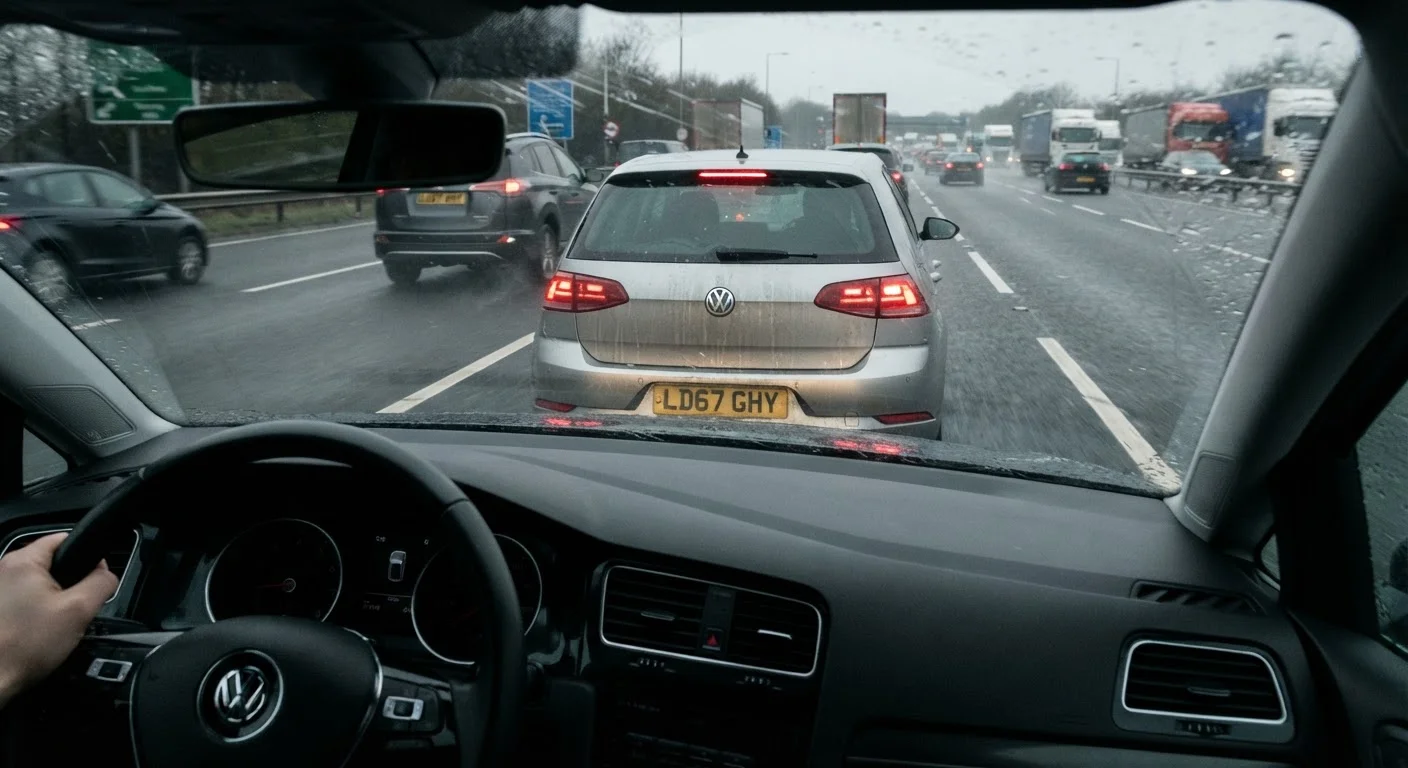
Instead of guessing following distance by eye, use the three-second rule with a fixed roadside object as your reference point. It works at any speed and takes only seconds to check. Make it a habit every time you settle into highway cruising speed.
These assumptions are part of a broader pattern covered in our piece on habits drivers think are safe but aren't.
Applying the Three-Second Rule - And When to Extend It
The three-second rule is the most practical tool drivers have for maintaining safe following distance. It works at any speed: as your speed increases, three seconds automatically translates into more feet of buffer.
Here's how to use it: when the vehicle ahead passes a fixed landmark - a sign, a shadow line on the road, an overpass support - start counting. If you reach that same point before you finish counting to three, you're too close. Ease off the accelerator until the gap widens.
Three seconds is a minimum. These conditions call for more space:
- Rain, ice, or snow: Wet pavement can double stopping distance; icy roads can multiply it several times over.
- Towing or carrying heavy loads: Added weight increases momentum and extends braking distance.
- Following a large truck: You need extra visibility clearance and additional stopping room. Our guide on sharing the road with large trucks explains why trucks stop very differently than cars.
- Night driving or low visibility: Your hazard perception window shrinks, so your following gap needs to compensate. See our night driving hazards guide for more on managing visibility.
Building adequate following distance into every drive - not just when conditions are bad - is a hallmark of defensive driving.
What to Do When You're Being Tailgated
Being on the receiving end of tailgating creates genuine risk, and the temptation to respond with frustration is understandable. But the safest response is deliberate and calm.
Create space ahead of you. Gradually ease off the gas to widen the gap between you and the car in front. If the tailgater hits you, that extra space reduces the chance of a chain-reaction collision pushing you into the vehicle ahead.
Move right when it's safe. On multi-lane roads, signaling and moving to the right lane allows the tailgater to pass without confrontation. This is both safer and, in most states, legally required - keeping right except to pass is a standard traffic law.
Avoid retaliatory braking. Brake-checking - tapping your brakes to startle a tailgater - is dangerous and in many states constitutes reckless driving. It escalates the situation and dramatically increases crash risk for everyone involved.
Staying predictable, calm, and focused on your own driving is always the right call. That mindset applies across a range of road hazards - it's the same logic that underlies avoiding distracted driving in all its forms.