

Key Takeaways
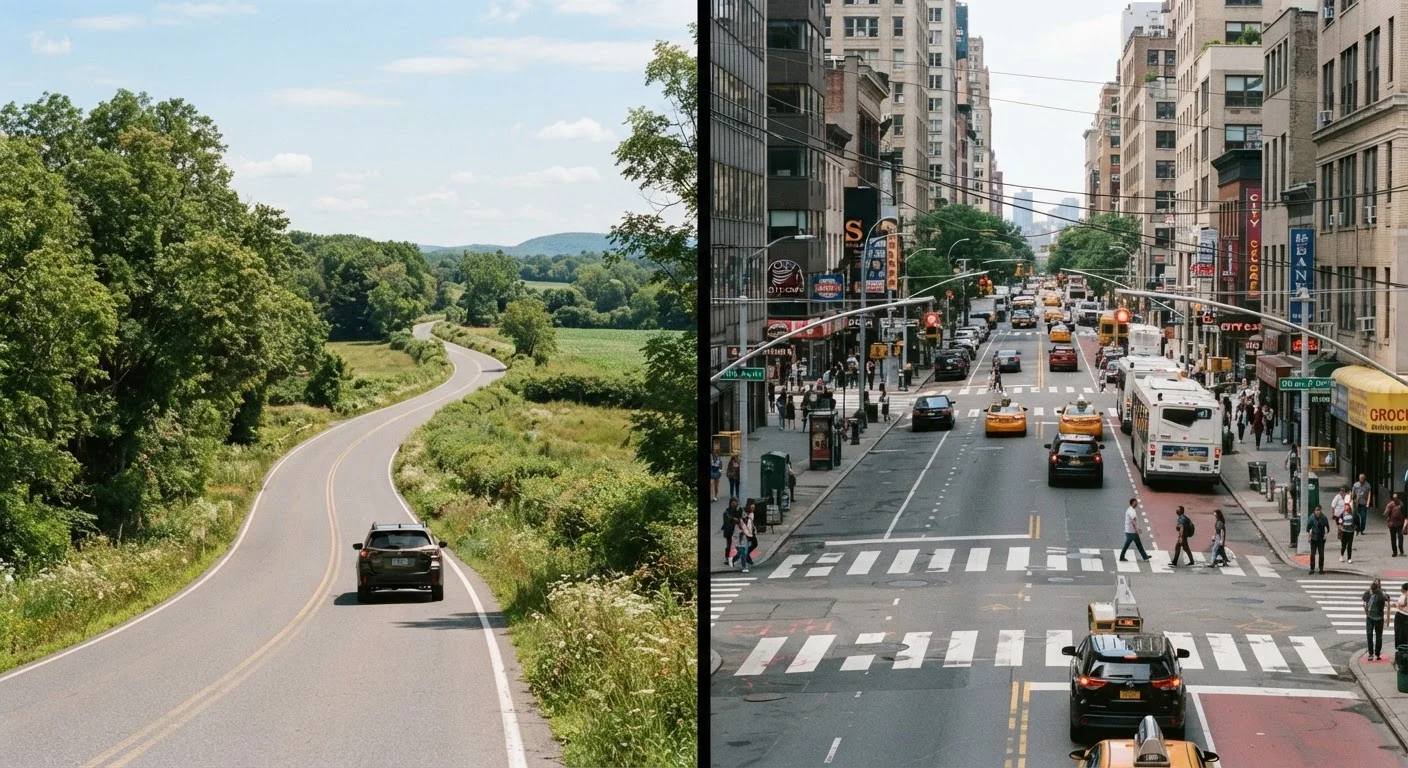
Option A
Rural Roads
High-speed, low-margin environments where isolation amplifies every mistake.
Best for: Drivers who understand that open roads require just as much vigilance as congested ones - arguably more.
Option B
Urban Streets
Dense, unpredictable environments where constant awareness is the core skill.
Best for: Drivers who can manage frequent stops, erratic pedestrian movement, and complex intersections with patience and precision.
If you drive frequently on two-lane rural highways
Rural Roads strategy
Prioritize expanded following distance, reduced speed on curves, and constant scanning for wildlife and oncoming headlights - especially after dark.
If most of your driving is in city centers or dense suburbs
Urban Streets strategy
Focus on pedestrian right-of-way, intersection scanning before proceeding on green, and predictable lane discipline to reduce conflicts with cyclists and other drivers.
If you regularly switch between rural and urban environments
Context-switching habits
Consciously reset your mental model each time the environment changes - the habits that keep you safe on an open road can become liabilities in stop-and-go traffic, and vice versa.
Why the Crash Profiles Are So Different
Many drivers assume rural roads are safer because there's less traffic. The data consistently says otherwise. According to the National Highway Traffic Safety Administration (NHTSA), rural roads have historically accounted for roughly half of all U.S. traffic fatalities despite carrying a minority of total vehicle miles traveled. The reasons are structural: higher speeds, fewer safety barriers, longer emergency response times, and roads that were often designed before modern safety standards.
Urban streets, by contrast, generate more frequent low-severity crashes - fender-benders, sideswipes, and pedestrian conflicts - but the physics of city traffic (lower speeds, frequent stops) tend to reduce the likelihood of fatalities per crash event. That doesn't make city driving relaxed; it makes it a different kind of demanding. Understanding which environment you're in - and what it specifically requires of you - is the foundation of adaptive safe driving.
For a closer look at how everyday assumptions quietly raise crash risk in both settings, see common habits drivers think are safe but aren't.
| Criterion | Rural Roads | Urban Streets |
|---|---|---|
| Primary fatality driver | High speed, limited barriers | Pedestrian/cyclist conflicts |
| Crash frequency | Lower frequency, higher severity | Higher frequency, lower severity |
| Key unpredictable hazards | Wildlife, unmarked intersections | Pedestrians, cyclists, bus stops |
| Speed management focus | Curves, stopping distance | Signal compliance, school zones |
| Following distance needed | Greater (higher speeds) | Shorter but more dynamic |
| Emergency response time | Often 20+ minutes | Typically faster |
| Fatigue risk | High (monotonous terrain) | Lower (high stimulation) |
| Intersection complexity | Low (but often unsigned) | High (multi-phase, roundabouts) |
Rural Roads: What Makes Them Genuinely Dangerous
The illusion of safety on an open road is one of its greatest hazards. With no other cars visible for a mile, it's easy to let speed creep up or attention drift. Rural-specific risks include:
- Wildlife crossings: Deer, livestock, and other animals appear suddenly, often at dusk or dawn. Scanning the road edges continuously - not just straight ahead - is essential.
- Limited shoulders and guardrails: A small correction error on a rural road can take a vehicle into a ditch or tree line with no buffer.
- Unmarked intersections and driveways: Cross traffic may enter from farm lanes or private roads that aren't signed.
- Fatigue: Monotonous landscapes reduce stimulation, and drowsy driving risk is significantly higher on long rural stretches.
- Reduced emergency access: A crash on a rural road may mean a 20-30 minute wait for first responders. Seatbelt compliance and avoiding rollover-prone maneuvers becomes even more consequential.
Speed is the amplifying factor. At 65 mph, stopping distance increases dramatically compared to 35 mph city traffic. Curves that look gentle on a map can require significant speed reduction to navigate safely - especially in wet or icy conditions. Night driving on rural roads compounds all of these risks substantially.
~50%
Rural share of U.S. traffic fatalities
NHTSA data consistently shows rural roads account for approximately half of all U.S. traffic deaths despite lower total miles traveled.
2x
Fatality rate per mile: rural vs. urban
Research from the Insurance Institute for Highway Safety indicates rural roads have roughly twice the fatality rate per mile compared to urban roads.
30%
Urban pedestrian share of traffic fatalities
Pedestrians represent a significant portion of urban traffic deaths, underscoring the need for heightened crosswalk awareness in city environments.
Urban Streets: Managing Density and Unpredictability
City driving is less about speed management and more about information management. At any given moment, a driver in an urban environment may need to track pedestrians stepping off curbs, cyclists filtering between lanes, buses pulling into traffic, and signal timing - all simultaneously.
Key urban hazards include:
- Pedestrian and cyclist conflicts: Crosswalk violations by both drivers and pedestrians are a leading cause of urban fatalities. Always check for pedestrians before turning, even on green.
- Intersection complexity: Multi-phase signals, dedicated turn lanes, and roundabouts require precise lane discipline and clear yield behavior.
- Dooring risk near parked cars: Give parked vehicles extra clearance in case a door opens suddenly.
- Blind spots in dense traffic: Frequent lane changes by other drivers mean your mirrors need constant updating, not just a glance before your own moves.
- Distracted driving: Urban driving generates more in-vehicle distractions - navigation recalculation, searching for parking, responding to stop-and-go congestion mentally.
Large commercial vehicles add another layer of complexity. Sharing city streets with large trucks requires understanding their wide turn radii and extended blind zones, which are just as relevant in an urban environment as on the highway.
Adjusting Your Habits When You Switch Environments
The most vulnerable moment for many drivers isn't deep into either environment - it's the transition between them. A driver coming off two hours on a rural interstate and entering a city grid may still be running highway-speed mental habits: longer looks ahead, less frequent mirror checks, less expectation of pedestrian movement. That lag is a real risk.
Practical resets when transitioning:
- Rural to urban: Consciously reduce following distance, increase mirror check frequency, and shift attention from road edges to crosswalks and sidewalks.
- Urban to rural: Accept that speed limits will rise but your reaction window will not. Add following distance, lower your interior lighting at night to reduce glare, and plan rest stops proactively to counter fatigue.
Neither environment rewards autopilot driving. Treating each road type as its own operating context - with its own threat profile and its own required skill set - is what separates consistently safe drivers from drivers who are simply lucky.
This article is for general informational purposes only. Driving laws, road conditions, and safety standards vary by state and locality. Always follow posted signs, local regulations, and the guidance of qualified driving safety professionals.