

Key Takeaways
Why Roundabouts Have a Reputation Problem in America
For most of the 20th century, the signalized intersection - with its four-way stops and left-turn arrows - was the dominant design on American roads. Roundabouts were rare, and driver education largely ignored them. That gap in familiarity explains why so many drivers feel uneasy approaching one, even today.
The discomfort is understandable but not well-founded. Research consistently shows that roundabouts reduce injury crashes compared to traditional signal-controlled intersections, largely by eliminating the most dangerous conflict types: high-speed right-angle and head-on collisions. The crashes that do occur at roundabouts tend to happen at lower speeds and involve sideswipe contact rather than direct impacts.
The confusion usually isn't about competence - it's about unfamiliarity. Drivers who encounter roundabouts frequently report that anxiety fades after just a few repetitions. Understanding the logic behind the design helps accelerate that process. Roundabouts are built around one central principle: keep traffic moving in one direction at moderate speed, removing the conditions that make traditional intersections deadly. That same principle is what makes rural and urban driving environments feel so different - the road design shapes driver behavior.
Practice Builds Confidence Fast
If roundabouts make you anxious, find a low-traffic one in your area and drive through it several times deliberately. Muscle memory for the yield-enter-signal-exit sequence develops quickly. Anxiety around unfamiliar intersections is a documented contributor to the kinds of crash-causing assumptions that catch even experienced drivers off guard.
Before You Enter: What to Do
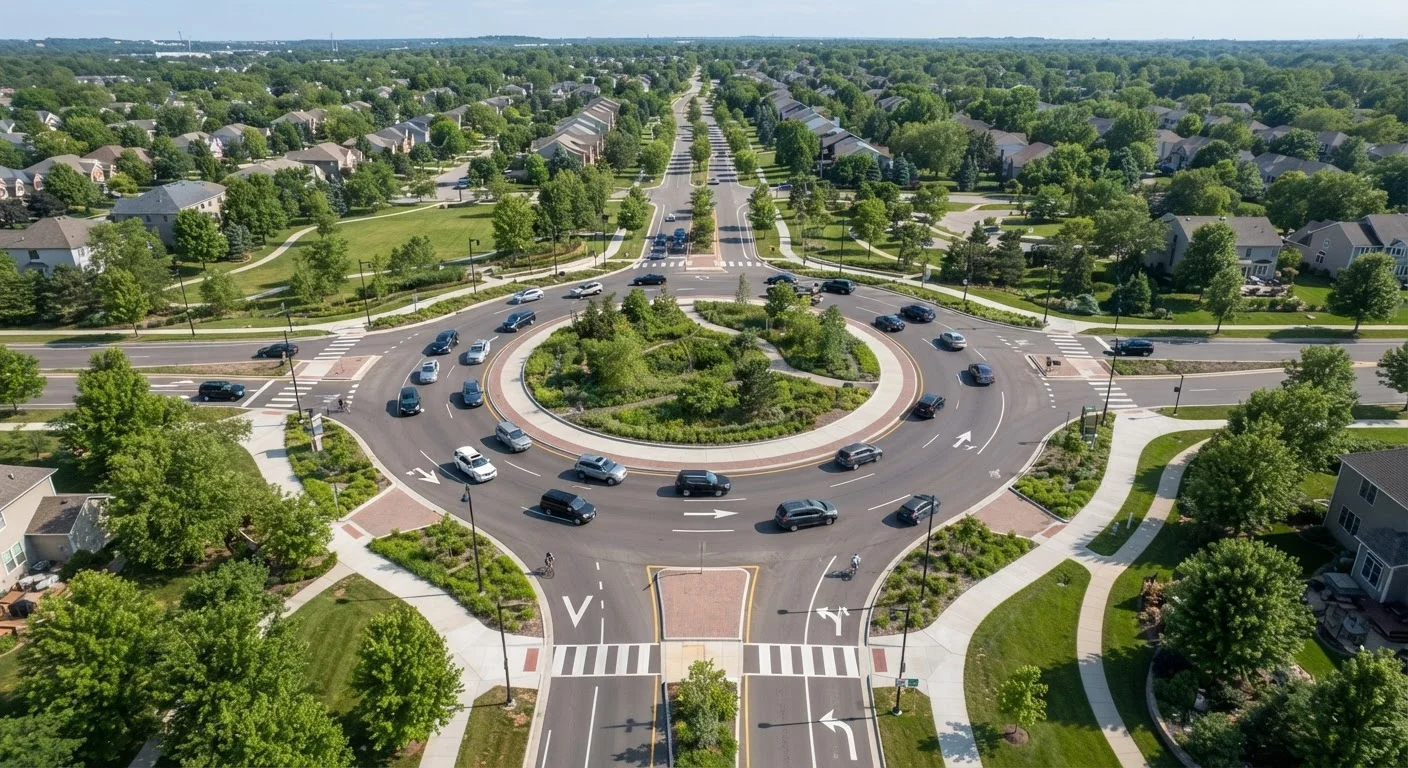
Most roundabout errors happen before the driver reaches the yield line. Preparation - not reaction - is what makes roundabout navigation reliable. Follow the steps below to build a consistent approach.
What you will need
Slow down and read the signs before you arrive
Roundabout warning signs appear well in advance of the intersection. Begin reducing speed as soon as you see them. Look for directional signs listing which exit leads where - these are posted before the yield line, not inside the circle. Deciding your exit before you enter is the single most important habit to build.
Choose the correct entry lane
At multi-lane roundabouts, lane selection happens before the yield line. A general rule: use the right lane for right turns or straight-ahead exits within the first half of the circle; use the left lane for exits that require traveling more than halfway around. Pavement markings and overhead signs confirm the correct lane - follow them, not instinct.
Yield to circulating traffic - then enter smoothly
At the yield line, check for vehicles already moving inside the roundabout from your left. If the circle is clear, enter at a steady, controlled speed - typically 15-25 mph depending on the roundabout's design. You do not need to stop unless traffic requires it. Unnecessary full stops disrupt flow and can contribute to rear-end collisions behind you.
Stay in your lane while circling
Once inside, track the curve of the lane markings and maintain your position. Keep your steering smooth - sharp corrections are a sign you entered too fast. Do not attempt to exit from the inside lane; merge outward only when your exit approach is clear and you have space to do so safely.
Signal and exit at the right moment
Activate your right turn signal just before your exit - not earlier. Signaling too soon misleads pedestrians and other drivers about which exit you're taking. As you approach the exit, check for pedestrians in the crosswalk, yield to them, and exit at a controlled speed. Cancel your signal once you're clear of the roundabout.
Common Mistakes and How to Avoid Them
Even drivers who understand the rules make predictable errors under pressure. The most frequent are: stopping unnecessarily when the circle is clear (causing rear-end risk), signaling too early and misleading other drivers, and failing to check for pedestrians at exit crosswalks.
Multi-lane roundabouts add complexity. The instinct to drift outward mid-circle - especially when unsure of exit position - is dangerous. Commit to your lane at entry, just as you would when merging onto a highway. Both situations reward advance planning and penalize last-second adjustments.
Wrong-Way Entry Is a Serious Risk
Always enter a roundabout by turning left - counterclockwise flow is standard in the United States. Drivers unfamiliar with roundabouts occasionally enter turning right, driving directly into oncoming traffic. If you miss your exit, continue around the circle and exit on the next pass. Never reverse inside a roundabout.
Large Vehicles Need Extra Space
Trucks, buses, and vehicles towing trailers may legally use both lanes or straddle lane lines inside a roundabout to complete their turning radius. If you see a large vehicle entering or circling, give it extra clearance and do not try to pass alongside it.
If you miss your exit, the correct response is to continue around the circle and exit on the next pass. This adds a few seconds to your trip and causes no hazard. Braking abruptly, stopping mid-circle, or reversing are all significantly more dangerous than completing an extra loop.