

Key Takeaways
Stress, Anxiety, and Burnout
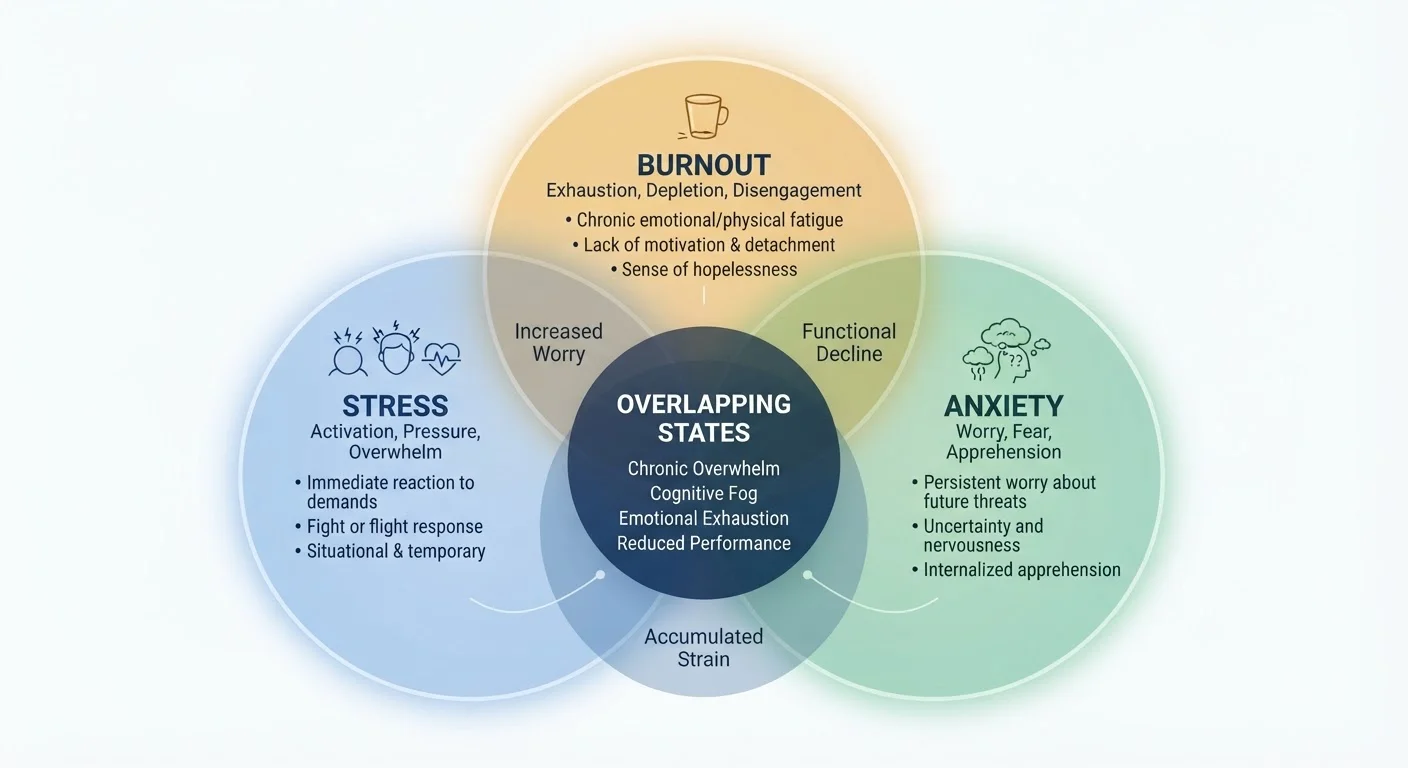
Stress, anxiety, and burnout are three distinct psychological and physiological states that often occur together or in sequence. Stress is typically a response to an external demand or pressure. Anxiety is a persistent feeling of worry or dread that may continue even when no clear stressor is present. Burnout is a state of deep exhaustion - emotional, physical, and cognitive - caused by prolonged exposure to overwhelming demands.
In clinical settings, anxiety disorders are classified diagnosable conditions under the DSM-5, while burnout is recognized by the World Health Organization as an occupational phenomenon. Stress, by contrast, is generally considered a normal physiological response rather than a disorder.
Why These Three States Are So Easily Confused
Stress, anxiety, and burnout share a considerable amount of surface-level overlap. All three can produce irritability, disrupted sleep, difficulty concentrating, and physical tension. Because the symptoms look alike from the outside - and often from the inside too - many people cycle through self-diagnoses without landing on a clear picture of what they're actually experiencing.
The confusion matters for a practical reason: the most helpful responses to each state are somewhat different. Pushing through with productivity strategies, for instance, tends to worsen burnout even as it might temporarily reduce acute stress. Understanding the distinctions gives you a more accurate map for deciding what kind of support - whether self-care, lifestyle adjustment, or professional help - makes the most sense for your situation.
If you're new to thinking about mental health concepts generally, our mental wellness beginner's guide covers foundational ideas and when professional help is worth considering.
77%
Workers who report physical symptoms of stress
According to American Psychological Association surveys, a substantial majority of American adults report experiencing physical symptoms they associate with stress.
~1 in 5
U.S. adults experiencing an anxiety disorder annually
The National Institute of Mental Health estimates that roughly 19% of U.S. adults experience an anxiety disorder in any given year, making them among the most common mental health conditions.
~67%
Workers reporting burnout at least sometimes
Gallup workplace research has consistently found that a majority of employees report experiencing burnout with at least some regularity, with a notable share describing it as very often or always.
Stress: A Normal Response to External Demands
Stress is the body and mind's reaction to a perceived demand or threat. It activates the nervous system, elevates cortisol and adrenaline, and sharpens focus - a biological response that evolved to help humans handle immediate challenges. In moderate amounts, stress can be motivating and functional.
The defining feature of stress is its relationship to an identifiable source: a project deadline, a relationship conflict, a sudden financial pressure. When that stressor is removed or resolved, the stress response typically subsides. This is what distinguishes it from anxiety.
Problems arise when stressors accumulate faster than they resolve, or when a person has insufficient recovery time between demands. Chronic stress - sustained over weeks or months - begins to wear down physiological and psychological resources, laying the groundwork for both anxiety and burnout.
A project manager faces a tight product launch deadline. She works longer hours, feels on edge, and struggles to sleep - but once the launch concludes, her tension lifts and she returns to her normal rhythm within days.
A college student finishes his exams but continues to feel a persistent, low-level worry about his grades, his future, and whether he said the wrong thing in a conversation weeks ago - even during a holiday break.
A nurse who has worked understaffed shifts for over a year begins to feel emotionally detached from patients, stops caring about outcomes she once found meaningful, and struggles to get out of bed even after days off.
A parent managing a demanding job, a family member's illness, and financial strain simultaneously reports feeling both wired with anxiety and profoundly depleted - unable to relax but also unable to engage.
Anxiety: When Worry Outlasts the Trigger
Anxiety shares stress's physiological signature - racing heart, muscle tension, heightened alertness - but differs in a critical way: it persists even when no clear external threat is present. The worry becomes self-sustaining, often attaching to new concerns once old ones resolve. It can feel like a background hum of dread that doesn't switch off.
Anxiety exists on a wide spectrum. Situational anxiety - nerves before a job interview, for example - is part of normal human experience. At the more significant end of that spectrum, anxiety disorders involve persistent, often disproportionate worry that meaningfully disrupts daily life. Distinguishing between the two is something a qualified mental health professional is best positioned to help with.
It's worth noting that anxiety and stress frequently co-occur, and chronic stress can contribute to the development of anxiety that then takes on a life of its own. Emotional experiences like grief can also interplay with anxiety in complex ways - our overview of grief and loss explores some of those patterns.
Burnout: The Exhaustion of Chronic Overload
Burnout is what happens when sustained demands - whether from work, caregiving, or ongoing life pressures - deplete a person's emotional, physical, and cognitive reserves beyond their ability to recover. The World Health Organization characterizes it through three dimensions: overwhelming exhaustion, increased mental distance from or cynicism about one's responsibilities, and reduced effectiveness or productivity.
Unlike stress, which feels acute and heightened, burnout often presents as a flattening - emotional numbness, chronic fatigue, and a creeping sense that effort is pointless. People in burnout may stop caring about things that used to matter, not from choice but from depletion. This detachment is sometimes mistaken for depression, with which burnout can co-occur and which requires separate professional evaluation.
Burnout doesn't arrive overnight. It builds gradually through repeated cycles of insufficient recovery, making early recognition valuable. Financial pressures are a frequently underrecognized contributor - if you've noticed that money-related stress is a consistent drain, our related article on signs debt may be affecting your wellbeing may provide useful context.
“Burnout is not a personal failing. It is the result of structural conditions that exceed the individual's capacity to cope - and understanding that distinction is the first step toward addressing it effectively.”
— Christina Maslach, Professor Emerita of Psychology and leading burnout researcher, University of California, Berkeley
What Helpful Responses Tend to Look Like
Because these three states have different roots, the most supportive responses differ in emphasis. For acute stress, addressing or reducing the source of pressure - where possible - combined with recovery strategies like adequate sleep and physical activity tends to be effective. The body's stress response is designed to switch off once the demand passes; helping it do so is the goal.
For anxiety, especially when it is persistent or disruptive, professional support is often the most evidence-backed path. Approaches such as cognitive behavioral therapy (CBT) have a strong research base for anxiety-related concerns. Lifestyle factors - particularly sleep, exercise, and nutrition - also play a meaningful supporting role, as covered in our article on how physical health shapes mental state.
For burnout, recovery typically requires more than a weekend off. Rest is necessary but rarely sufficient on its own. Addressing the structural conditions driving overload - workload, boundaries, support systems - is generally essential. If you're unsure what type of professional support might help, our plain-language breakdown of therapy, counseling, and psychiatry explains what each role involves.
This article is for general informational and educational purposes only. It is not medical or mental health advice, and it is not a substitute for evaluation or treatment by a qualified healthcare or mental health professional. If you are experiencing symptoms that concern you, please consult a licensed professional.