

Key Takeaways
Option A
Zero-Based Budgeting
The meticulous, dollar-by-dollar approach.
Best for: People who want granular control over every spending decision each month.
Option B
The 50/30/20 Rule
The streamlined, percentage-driven framework.
Best for: People who want a simple structure without tracking every expense category.
If you have irregular income or variable monthly expenses
Zero-Based Budgeting
Rebuilding your budget from scratch each month lets you adapt allocations to actual income, which is critical when paychecks fluctuate.
If you're new to budgeting and want to start quickly
The 50/30/20 Rule
Three broad categories are easy to learn and apply immediately, lowering the barrier to getting started.
If you're aggressively paying down debt or building an emergency fund
Zero-Based Budgeting
Deliberate line-item planning makes it easier to find and redirect money toward a specific financial goal.
If you have a stable salary and solid baseline spending habits
The 50/30/20 Rule
Predictable income makes percentage-based targets reliable, and you avoid the overhead of detailed monthly re-planning.
If you want a method you can sustain long-term with minimal effort
The 50/30/20 Rule
Its simplicity makes it easier to maintain consistently, and consistency matters more than precision over the long run.
How Each Method Works
Understanding the mechanics of each approach is the starting point for choosing between them.
Zero-Based Budgeting
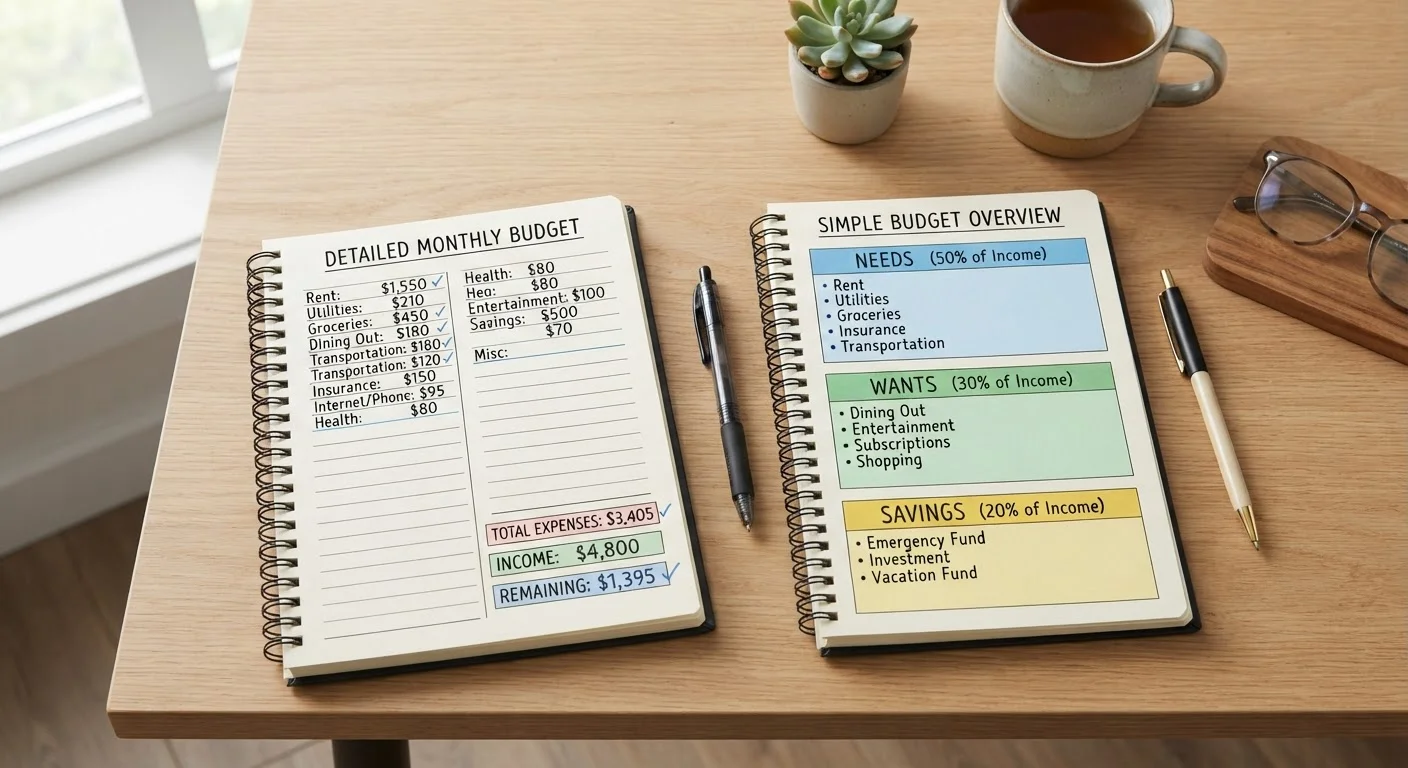
With zero-based budgeting (ZBB), you start each month with your total expected income and assign every dollar to a specific category - housing, groceries, transportation, savings, debt payments, and so on - until the remaining balance reaches exactly zero. The goal isn't to spend everything; it's to give every dollar a deliberate purpose, including dollars directed to savings or an emergency fund. At the start of each new month, you rebuild the budget from scratch rather than carrying last month's plan forward.
The 50/30/20 Rule
The 50/30/20 rule divides your after-tax income into three broad buckets: 50% toward needs (rent, utilities, groceries, minimum debt payments), 30% toward wants (dining out, subscriptions, entertainment), and 20% toward savings and debt repayment. For a deeper breakdown of what belongs in each category, see our full 50/30/20 explainer. Because it uses percentages rather than line items, you don't need to enumerate every expense - just keep spending within the three bands.
| Criterion | Zero-Based Budgeting | 50/30/20 Rule |
|---|---|---|
| Core concept | Assign every dollar a job | Split income into three percentages |
| Setup time | High - rebuilt each month | Low - set targets once, monitor |
| Tracking detail | Line-item categories | Three broad buckets |
| Best income type | Variable or irregular income | Stable, predictable income |
| Flexibility | High - adapts monthly | Moderate - percentages are fixed |
| Learning curve | Steeper for beginners | Gentle - easy to start |
| Visibility into spending | Very detailed | Broad-level only |
Trade-Offs Worth Knowing
Both methods have real advantages and genuine drawbacks. Matching those trade-offs to your situation matters more than picking the "correct" method.
Neither Method Requires a Perfect Month
Both zero-based budgeting and the 50/30/20 rule are planning tools, not scorecards. Going over in one category doesn't mean the method failed - it means you have data to work with. The value comes from reviewing what happened and adjusting, not from executing a flawless plan every month. Consistency over time matters far more than accuracy in any single month.
Zero-Based Budgeting trade-offs
- Time investment: Creating a fresh budget monthly takes significant effort, especially at first.
- Precision payoff: Detailed tracking makes it easier to spot waste and redirect money toward goals.
- Friction with irregular expenses: Annual or quarterly bills (insurance premiums, car registration) require deliberate planning to avoid surprises.
50/30/20 Rule trade-offs
- Low maintenance: Three categories are easy to monitor and don't require detailed tracking tools.
- Less visibility: You may miss overspending within a category because the buckets are broad.
- High-cost-of-living challenge: In expensive metros, needs can easily exceed 50% of income, making the framework hard to apply without adjustment.
For a broader comparison of these and other approaches, see our guide to popular budgeting methods.
Putting Either Method Into Practice
Choosing a method is only step one. Execution determines whether a budget actually changes your finances.
For zero-based budgeting, begin by listing all income sources for the coming month, then list every spending category you expect - fixed costs first, then variable, then savings and debt. Adjust amounts until income minus all allocations equals zero. Free budgeting apps and spreadsheet templates can reduce the manual work significantly. At month's end, review what actually happened and use those numbers to inform next month's plan. A monthly budget reset checklist can make that review process faster and more consistent.
For the 50/30/20 rule, calculate your after-tax monthly income, then multiply by 0.50, 0.30, and 0.20 to set your targets. Review your last two to three months of bank and credit card statements to see where you currently land in each bucket. Gaps between your targets and actual spending reveal where to focus first. If you're unsure how to classify a particular expense, our spending categories reference offers clear guidance.
Regardless of method, the fundamentals remain the same: track honestly, revisit regularly, and adjust without self-judgment. Common budgeting myths often discourage people before they find a rhythm - don't let perfectionism be the reason you don't start.
This article is for general informational and educational purposes only and does not constitute personalized financial advice. For guidance specific to your financial situation, consider consulting a qualified financial professional.