

Key Takeaways
What Actually Happens When Someone Checks Your Credit
Every time a lender, employer, landlord, or you yourself pull your credit file, that access is recorded as an inquiry. But there are two fundamentally different kinds - and confusing them leads to some of the most persistent myths in personal finance.
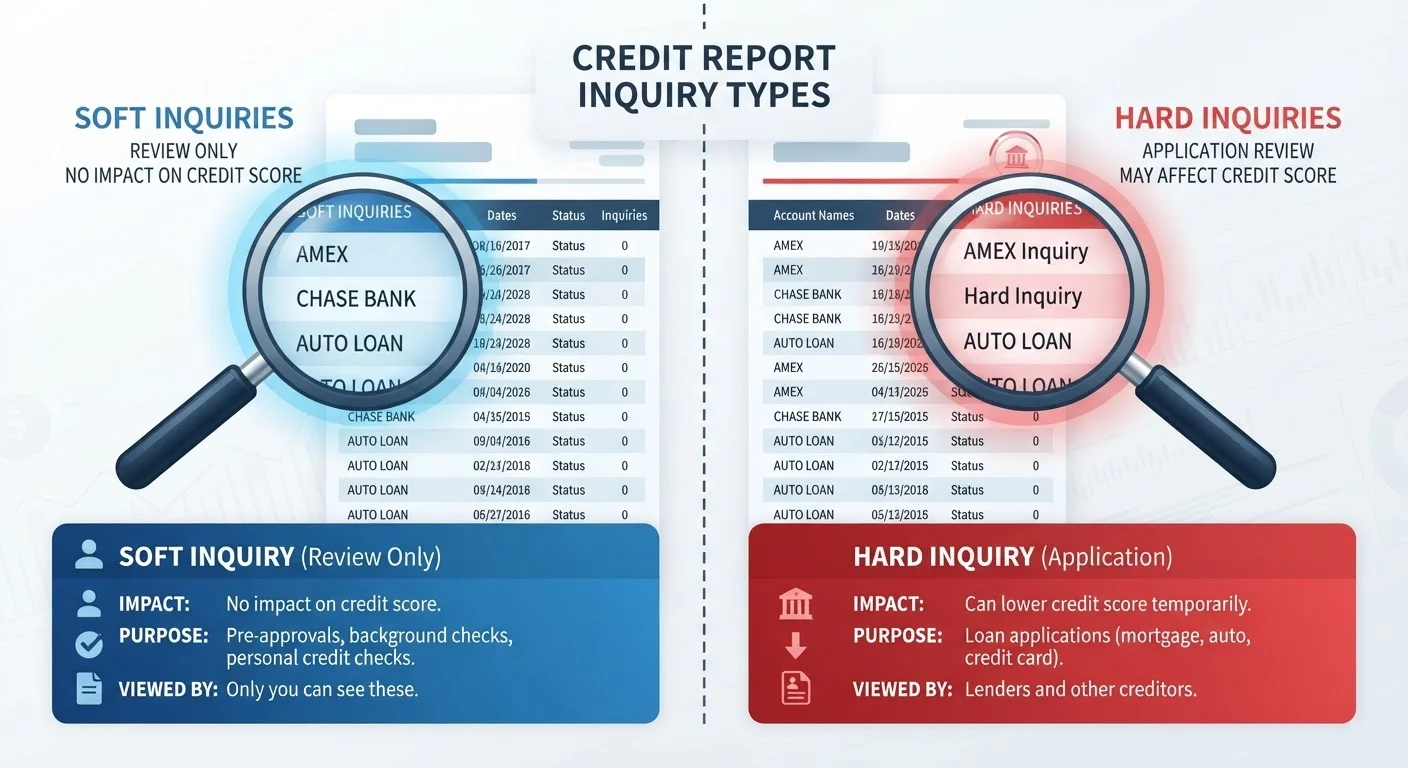
A soft inquiry (also called a soft pull) occurs when credit is checked for informational purposes rather than a lending decision. Examples include pre-approval screenings, background checks by employers, a landlord verifying your file, or you checking your own score. Soft pulls are visible to you on your credit report but are not visible to lenders and have zero effect on any credit score.
A hard inquiry (or hard pull) happens when you formally apply for new credit - a credit card, mortgage, auto loan, or personal loan. The lender reviews your full credit file to make a lending decision. This type of inquiry is visible to other lenders and can affect your score, though the impact is often smaller and shorter-lived than most people assume.
Understanding this distinction is the foundation for making smarter borrowing decisions. For a deeper look at the difference between your credit file and your actual score, see how your credit report and credit score differ.
Myth
Checking your own credit score will lower it.
Fact
Checking your own credit is always a soft inquiry and has no effect on your score whatsoever.
This myth keeps many people from monitoring their own credit - which is one of the healthiest financial habits you can build. When you access your credit report through a bureau, a credit-monitoring service, or your bank's app, the system records it as a consumer-initiated soft pull. Lenders never see it, and no scoring model penalizes it. You can check your own score as often as you like without any consequence.
Myth
Any hard inquiry will cause significant, lasting damage to your credit score.
Fact
A single hard inquiry typically reduces a score by fewer than five points and stops affecting scoring calculations after about 12 months.
Hard inquiries do appear on your credit report for two years, but their influence on your score diminishes well before they disappear. According to credit-scoring frameworks like FICO, new credit accounts for roughly 10% of your score - and a single inquiry is just one piece of that slice. For most consumers with an established credit history, the drop is small and temporary. Applying for credit when you genuinely need it is rarely the financial catastrophe people fear.
Myth
Shopping around for a mortgage or auto loan will rack up multiple hard inquiries and crush your score.
Fact
Credit-scoring models treat multiple loan inquiries of the same type within a short window as a single inquiry for scoring purposes.
This rate-shopping protection exists specifically because lenders want to encourage consumers to compare terms. FICO models generally consolidate auto, mortgage, and student loan inquiries made within a 45-day window into one. Older FICO versions use a 14-day window. VantageScore models work similarly. The practical takeaway: gather competing loan offers within that window freely. You won't be penalized for being a diligent borrower.
Myth
Pre-approval offers and lender rate quotes require a hard pull, so you should avoid them.
Fact
Pre-qualification and pre-approval screenings for marketing purposes use soft pulls and do not affect your score.
The pre-screened offers you receive in the mail - and many online rate-quote tools - rely on soft inquiries to assess whether you fit a lender's criteria. No formal application has been submitted, so no hard pull occurs. A hard inquiry only happens when you complete a full credit application and give a lender explicit permission to access your file for a lending decision. Exploring your options before applying is not only safe - it's smart financial practice.
Myth
Once you have too many hard inquiries, there's nothing you can do but wait for them to fall off.
Fact
Hard inquiries lose most of their scoring impact within 12 months, and building positive credit behaviors meanwhile can more than offset any residual effect.
If you've gone through a period with several applications - say, after moving and needing a new apartment, a car loan, and a credit card in quick succession - the inquiries do stack. But they are among the fastest-fading elements of a credit score. Paying down balances to improve your utilization rate and continuing to make on-time payments will typically have a far greater positive effect than any cluster of inquiries has a negative one. See how credit utilization shapes your score for a clearer view of which lever to pull first.
Putting Inquiry Impact in Perspective
Even when a hard inquiry does ding your score, it rarely operates in isolation. Your score is shaped by several factors simultaneously - payment history, amounts owed, length of credit history, credit mix, and new credit. Inquiries fall into that last category and generally carry the least weight of all.
~5 pts
Typical score drop from one hard inquiry
FICO estimates that a single hard inquiry lowers most consumers' scores by fewer than five points, with little or no impact for those with long credit histories.
10%
Weight of 'new credit' in FICO scoring
New credit - which encompasses hard inquiries and recently opened accounts - accounts for approximately 10% of a FICO score, making it the least influential of the five main scoring factors.
45 days
Rate-shopping window for mortgage and auto loans
Under current FICO scoring models, multiple mortgage or auto loan inquiries within a 45-day window are counted as a single inquiry for score calculation purposes.
That context matters. If your credit utilization ratio is already low and your payment history is clean, a single hard inquiry is unlikely to move your score into a materially different range. Conversely, if you're already carrying high balances, an inquiry on top of that signals more financial pressure to lenders.
A useful mental model: think of your score as a long-running average, not a fragile number that shatters with one application. One thoughtful credit application - especially if approved - can strengthen your profile over time by diversifying your credit mix or lowering your overall utilization. The short-term dip from the hard pull is often outweighed by the longer-term benefits of responsibly managing the new account. Review patterns that gradually erode credit health to see what really moves the needle over time.
Never Avoid Necessary Credit Applications Out of Fear
Refusing to apply for credit you genuinely need - a mortgage, an auto loan, or a secured card to build credit history - because of inquiry anxiety can do more long-term harm than the inquiry itself. A temporary dip of a few points is typically far less costly than missing a financing opportunity or remaining credit-invisible. If you're building or repairing credit, consider reading about how secured credit cards work as a structured starting point.
This article is for general informational and educational purposes only and does not constitute personalized financial or credit advice. Consult a qualified financial professional for guidance specific to your situation.