

Key Takeaways
Option A
Debt Avalanche
The mathematically optimal approach to minimizing interest costs.
Best for: People who want to pay the least total interest and are comfortable staying disciplined without quick wins.
Option B
Debt Snowball
The psychologically driven method that builds momentum through early wins.
Best for: People who need motivational milestones and find it easier to stay on track when they can eliminate individual debts quickly.
If you want to minimize total interest paid
Debt Avalanche
By targeting high-interest balances first, the avalanche method reduces the amount of interest that accrues over the life of your debts - often saving hundreds or thousands of dollars compared to other approaches.
If you need early wins to stay motivated
Debt Snowball
Eliminating smaller balances quickly provides a tangible sense of progress. Research in behavioral economics suggests this kind of milestone-based feedback helps many people maintain long-term commitment.
If you have several high-interest debts of similar size
Debt Avalanche
When balances are comparable, the interest rate becomes the dominant factor. The avalanche approach directly attacks the accounts costing you the most each month.
If you have many small debts creating mental clutter
Debt Snowball
Eliminating individual accounts simplifies your financial picture and reduces the number of payments to track, which can lower stress and reduce the chance of missed payments.
If you've struggled to stick with debt payoff plans in the past
Debt Snowball
The motivational structure of the snowball method is specifically designed for people who benefit from frequent reinforcement - making it more likely you'll see the plan through to completion.
How Each Method Works
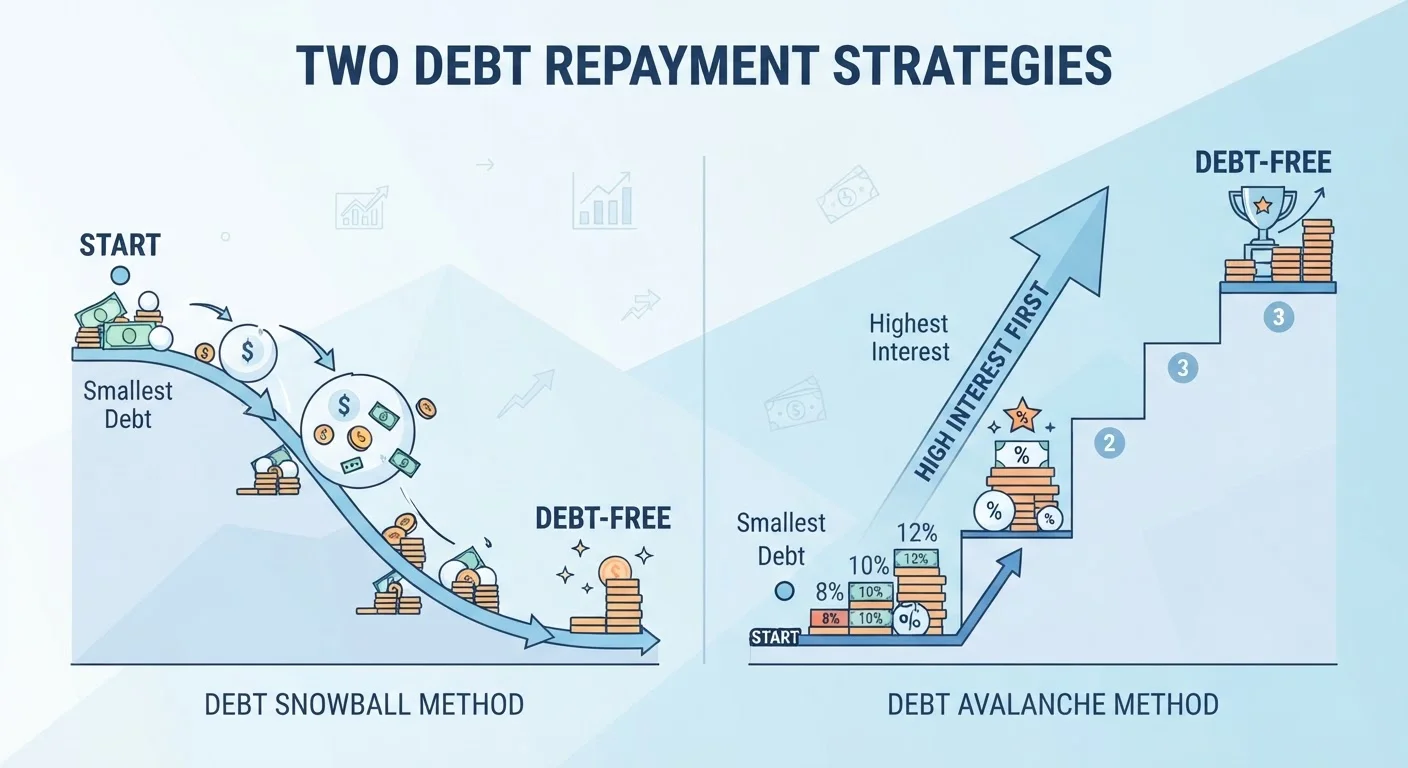
Both the debt avalanche and debt snowball share the same core mechanic: you make minimum payments on every debt you owe, then direct any remaining available money toward one target account each month. The difference lies entirely in how you choose that target.
Debt Avalanche: You rank your debts from highest to lowest interest rate. The account with the highest rate gets your extra payment dollars first. Once that balance reaches zero, the money you were sending there rolls to the next-highest-rate debt, and so on. Because you're attacking the most expensive debt first, the total interest you pay over time is lower than with any other sequencing approach - assuming you stay the course.
Debt Snowball: You rank your debts from smallest to largest balance, ignoring interest rates. Your extra dollars go to the smallest balance first. When that account is paid off, its payment amount gets added to what you're sending to the next-smallest balance. The "snowball" metaphor captures how each payoff adds momentum to the next.
Neither method requires you to increase your total monthly payment - though paying more whenever possible will accelerate results under either approach. See our structured guide to tackling high-interest debt for a step-by-step framework you can layer on top of either strategy.
| Criterion | Debt Avalanche | Debt Snowball |
|---|---|---|
| Ordering principle | Highest interest rate first | Smallest balance first |
| Total interest paid | Lower (mathematically optimal) | Potentially higher |
| Time to first payoff | Longer (if highest-rate debt is large) | Shorter (smallest balance clears first) |
| Motivational structure | Requires sustained discipline | Frequent milestone wins |
| Best financial profile | High-rate debts with large balances | Many small accounts creating mental load |
| Complexity | Requires knowing all interest rates | Only requires knowing balances |
The Real Trade-Off: Math vs. Motivation
On paper, the avalanche wins every time. If you have a credit card charging 24% APR and a personal loan at 9% APR, paying the credit card first reduces the interest accruing each month. Over years of repayment, that difference compounds meaningfully.
But personal finance is only partly about math. Studies in behavioral economics - including research published by academics at Northwestern and Kellogg - have found that debt repayment completion rates are meaningfully higher when people use a balance-based sequencing approach. The reason: human motivation responds strongly to the feeling of finishing something. Crossing an account off the list creates a psychological reward that pure interest calculations don't account for.
~$1,000+
Potential interest savings with the avalanche method
The exact savings vary by debt mix, but consumer finance educators commonly illustrate that targeting high-interest balances first can save hundreds to thousands of dollars over a typical repayment timeline.
Higher
Completion rates linked to balance-based payoff order
Academic research in behavioral economics has found that paying off smaller accounts first - regardless of interest rate - is associated with higher overall debt elimination rates.
This means the "best" method depends on honest self-assessment. If you have a history of abandoning financial plans before they pay off, the snowball's built-in motivation system may produce a better real outcome - even if you pay slightly more interest. If you're highly disciplined and can sustain effort without frequent milestones, the avalanche's mathematical efficiency is genuinely worth pursuing.
It's also worth noting that these aren't permanent choices. Some people begin with the snowball to eliminate a few small accounts, then switch to the avalanche once they feel confident and their debt list has shrunk. That hybrid approach won't be mathematically perfect, but it reflects how real motivation works. For the broader context of managing savings and debt together, the full picture on saving and debt provides a useful framework.
Putting Either Method Into Practice
Regardless of which method you choose, the implementation steps are similar:
- List every debt - creditor, current balance, interest rate, and minimum payment.
- Sort the list - by interest rate (avalanche) or by balance (snowball).
- Calculate your available extra payment - the amount you can consistently direct beyond all minimums. Even a small consistent amount accelerates payoff significantly.
- Automate minimums - set up automatic payments on all accounts to avoid late fees and credit score damage.
- Direct extra dollars manually or automatically - toward your target account each month.
- Roll payments forward - when one account reaches zero, add its former payment to the next target.
Good budgeting is the foundation that makes either method sustainable. The budgeting basics hub covers how to find and protect that extra monthly payment within your spending plan.
If you're also weighing whether to direct extra funds toward savings rather than debt, that trade-off is addressed in our companion piece: should you pay off debt or build savings first. And if managing multiple accounts feels unmanageable, debt consolidation is a separate strategy worth understanding before deciding.
What About Debt Consolidation?
If you have many accounts with varying interest rates, consolidating them into a single loan can simplify repayment and may reduce your average rate. However, consolidation changes the structure of your debt rather than the repayment strategy itself. You can still apply avalanche or snowball logic afterward if you have remaining accounts. Understand the full mechanics before pursuing this path - not every consolidation arrangement reduces total cost.
This article provides general financial information for educational purposes only. It is not personalized financial or legal advice. For guidance specific to your situation, consult a licensed financial advisor or certified credit counselor.