

Key Takeaways
Option A
Prepaid Phone Plans
The flexible, no-commitment option.
Best for: Individuals who want cost control, no credit checks, and the freedom to switch carriers without penalties.
Option B
Postpaid Phone Plans
The full-featured, credit-backed choice.
Best for: Households and individuals who prioritize network priority, device financing, and bundled family lines.
If you want predictable spending with no credit involvement
Prepaid Phone Plans
Prepaid charges you upfront for exactly the service you select, so there are no surprise overages or credit inquiries involved.
If you need to finance a high-end device through monthly installments
Postpaid Phone Plans
Carrier installment plans are almost exclusively tied to postpaid accounts, making postpaid the practical path to spreading out device costs.
If you travel internationally or need consistent data speeds
Postpaid Phone Plans
Postpaid subscribers generally receive network priority during congestion and more robust international roaming options than prepaid tiers.
If you want flexibility to switch carriers without penalty
Prepaid Phone Plans
No contracts or early termination fees mean you can move to another carrier the moment your current cycle ends.
If you manage multiple lines for a household
Postpaid Phone Plans
Postpaid family plans often include multi-line discounts and consolidated billing that can reduce the per-line cost significantly.
How Each Plan Type Actually Works
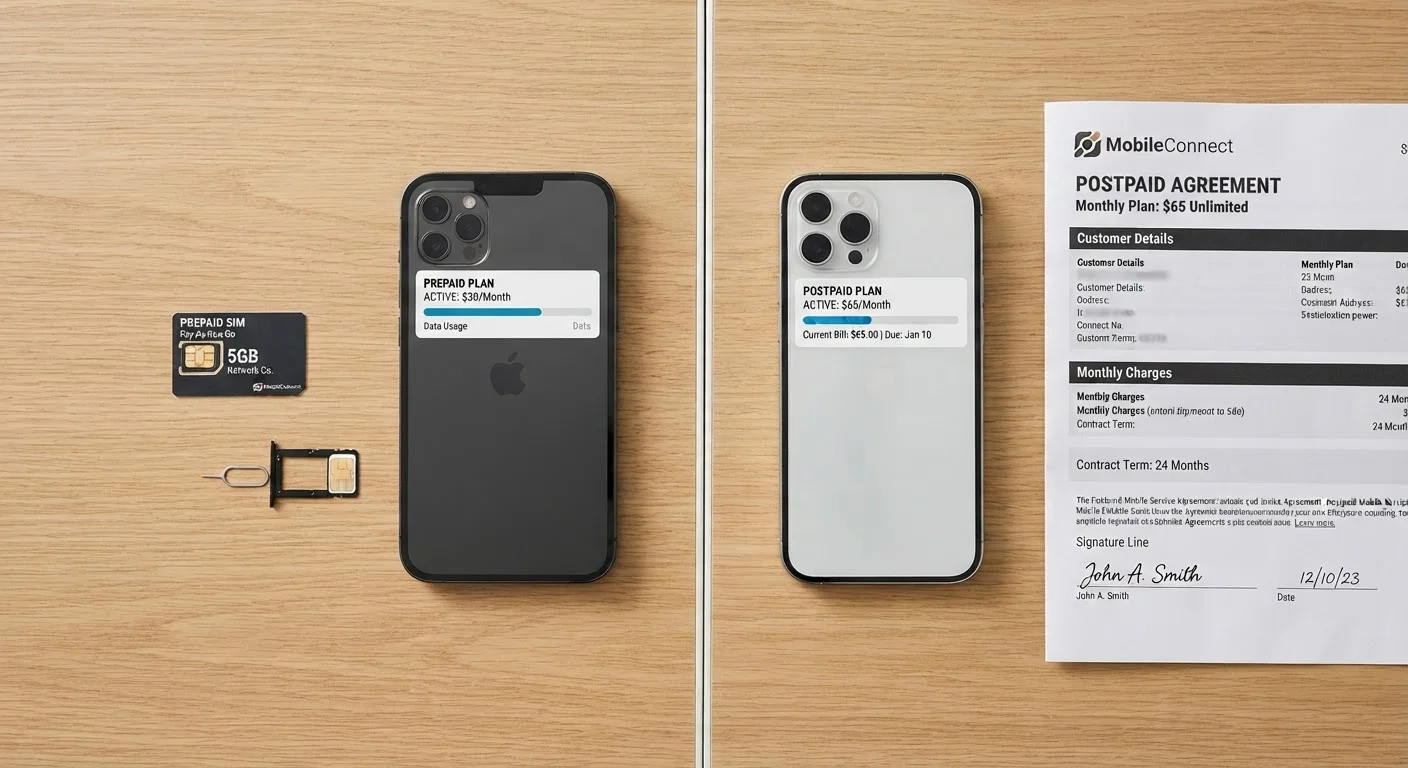
The core distinction between prepaid and postpaid is timing: prepaid means you pay before service begins, while postpaid means the carrier extends you credit and bills you after each month of use.
With prepaid, there is no credit check. You purchase a plan - a set amount of data, calls, and texts - and service runs until that allowance or period expires. No payment, no service. This structure makes it genuinely difficult to accumulate unexpected charges.
Postpaid works more like a utility bill. The carrier activates your account based on a credit evaluation, provides service throughout the month, then invoices you. This model enables add-ons, installment device financing, and multi-line accounts under one bill - but it also opens the door to charges you might not have anticipated. For a closer look at how carrier device financing interacts with postpaid agreements, see our guide to carrier financing vs. buying outright.
| Criterion | Prepaid | Postpaid |
|---|---|---|
| Payment timing | Pay before service begins | Billed after monthly use |
| Credit check required | No | Yes, typically |
| Monthly price | Generally lower | Generally higher |
| Device financing | Rarely available | Standard offering |
| Network priority | Lower during congestion | Higher priority |
| Contract or commitment | None | Device installments create soft lock-in |
| International roaming | Limited or add-on | More robust options |
| Bundled perks | Rare | Common (streaming, hotspot, etc.) |
Cost Structure: What You Actually Pay
On paper, prepaid plans frequently carry lower monthly prices than postpaid equivalents. MVNOs - Mobile Virtual Network Operators, companies that lease network capacity from major carriers - overwhelmingly operate on the prepaid model and pass some of that savings to customers.
However, the monthly rate is not the whole story. Postpaid plans often include streaming service trials, device trade-in credits, hotspot data allowances, and international texting that prepaid plans charge separately or exclude entirely. Evaluating total cost of ownership - not just the base rate - is essential. Our guide to short-term cost vs. long-term value offers a useful framework for that kind of analysis.
One area where postpaid holds a clear structural advantage is device financing. Spreading the cost of a $1,000+ smartphone over 24 or 36 months is only available through postpaid accounts at major carriers. Prepaid buyers typically pay full retail price upfront or purchase a lower-cost device outright.
~40%
U.S. mobile connections on prepaid
According to CTIA industry data, prepaid accounts represent a substantial and growing share of U.S. wireless subscriptions.
$1,000+
Average flagship smartphone retail price
Premium device prices have risen steadily, making postpaid installment financing a practical consideration for many buyers.
22 GB
Typical postpaid priority data threshold
Many postpaid unlimited plans deprioritize data only after 22-50 GB of monthly use, depending on the carrier and tier.
Network Priority, Coverage, and Reliability
All three major U.S. networks - Verizon, AT&T, and T-Mobile - sell both prepaid and postpaid products, and the underlying coverage maps are identical. Where the plans differ is in network priority: when a cell tower becomes congested, postpaid customers are typically served before prepaid customers on the same carrier.
In practice, most users will never notice this difference. In densely populated areas during peak hours - stadiums, urban centers, airports - prepaid customers may experience temporary slowdowns that postpaid subscribers do not. Whether that trade-off matters depends entirely on your usage patterns and geography.
MVNOs add another layer of complexity. An MVNO running on a major carrier's network may still deprioritize its customers relative to that carrier's own prepaid tier. Reading the fine print about deprioritization thresholds and data caps is important before signing up for any plan. Before committing, our checklist for evaluating a new carrier contract covers the questions worth asking.
Flexibility, Lock-In, and Switching Costs
Prepaid's most compelling advantage is freedom. No contract means you can switch carriers at the end of any billing cycle without paying an early termination fee. If your needs change - you move, travel more, or find a more affordable option - you're not trapped.
Postpaid plans have become more flexible over the years. Most major carriers no longer issue traditional multi-year service contracts. However, device installment agreements create de facto lock-in: paying off $800 in remaining phone installments before switching effectively functions as an exit fee, even if it isn't labeled one.
Understanding how overpayment patterns develop is valuable context here - installment plans and auto-enrolled perks are among the most common reasons postpaid bills creep upward over time. The structural dynamics of prepaid and postpaid also echo broader questions about bundling services, which our analysis of bundled internet plans explores in depth.
MVNO Prepaid: A Middle Ground Worth Knowing
MVNOs (Mobile Virtual Network Operators) lease capacity from major networks and resell it - often at lower prices than the host carrier's own prepaid plans. Examples include budget-oriented carriers running on the same towers as Verizon, AT&T, or T-Mobile. The trade-off is that MVNOs typically sit at the lowest rung of network priority, and customer service quality varies significantly between providers. Always confirm which underlying network an MVNO uses before purchasing a plan.