

Key Takeaways
Unlimited Data Plan
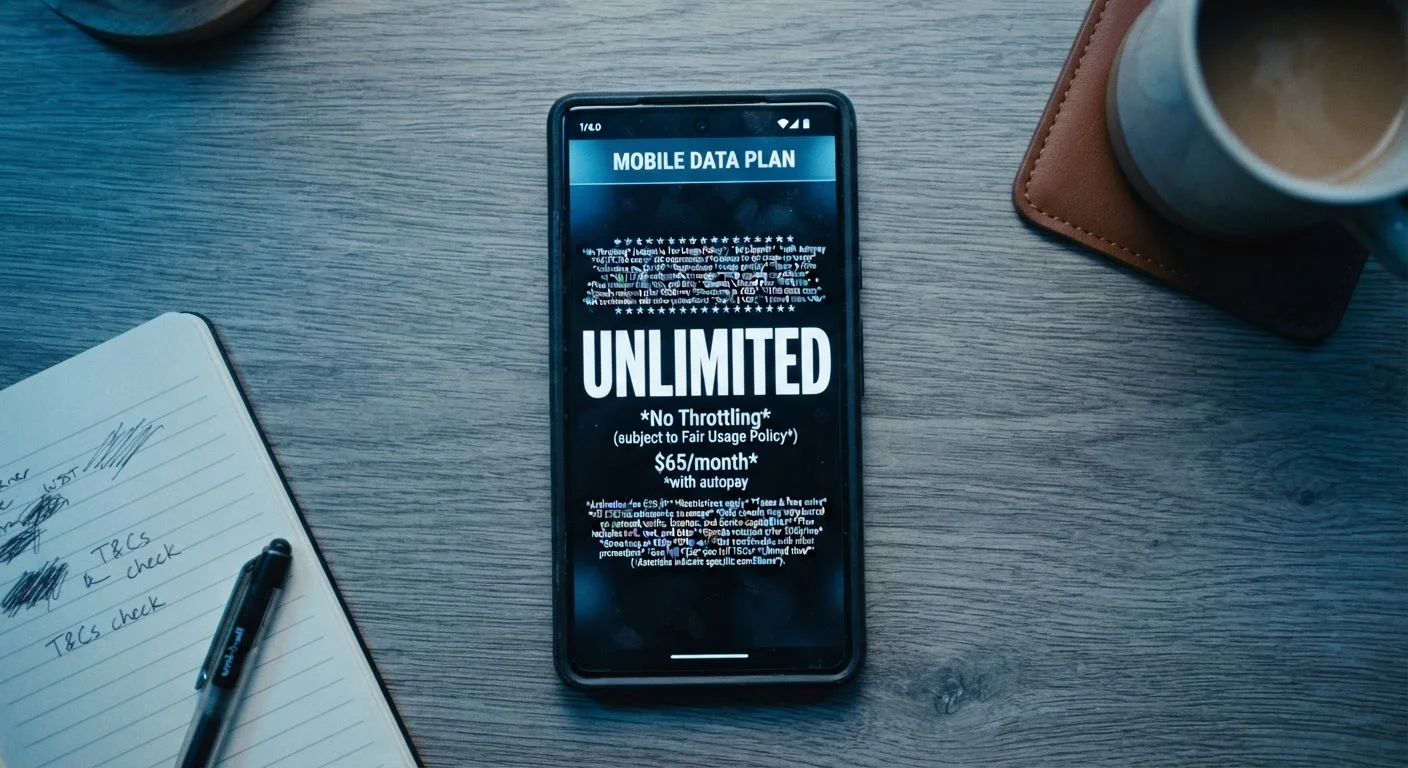
An unlimited data plan is a mobile phone subscription marketed as having no hard data cap - meaning your data connection won't be cut off after a set number of gigabytes. However, 'unlimited' doesn't mean unrestricted. Carriers routinely slow down speeds, restrict certain uses, and apply different rules depending on which tier of 'unlimited' you've purchased.
The FTC and FCC have both taken enforcement actions against carriers for advertising unlimited data while failing to disclose material speed restrictions, making disclosure of throttling and deprioritization practices a regulatory requirement.
The Word 'Unlimited' Has an Asterisk
Phone carriers have built entire advertising campaigns around a single word: unlimited. But the FTC and FCC have both pushed carriers to disclose what that word actually covers - because for most plans, it covers less than the ads suggest.
At its core, an unlimited plan means your data connection won't be hard-cut after a set number of gigabytes. You won't receive a notification that you've used up your data for the month. What happens instead is more nuanced: your speeds change, your traffic gets deprioritized, or your hotspot stops working at a usable pace. The data is technically still there. The experience of using it may not be.
Understanding the gap between the marketing and the mechanics is the first step to evaluating whether a plan actually fits how you use your phone. For a broader look at how data restrictions work across both mobile and home internet, see how data caps work and when they actually affect you.
~50 GB
Typical premium data threshold before deprioritization
Many major U.S. carriers' mid- and premium-tier unlimited plans include roughly 50 GB of high-priority data per line before deprioritization may apply during congestion.
3
Typical number of unlimited plan tiers per major carrier
Major U.S. carriers generally structure their unlimited offerings into entry, mid, and premium tiers, each with meaningfully different data priority, hotspot, and streaming terms.
600 kbps
Common post-threshold hotspot speed on base unlimited plans
Some carriers disclose reduced hotspot speeds as low as 600 kbps after the high-speed allotment is exhausted - too slow for most modern applications.
Throttling vs. Deprioritization: Two Different Speed Problems
These two terms are often used interchangeably, but they describe distinct mechanisms - and understanding the difference helps you evaluate what a plan will actually feel like to use.
Throttling is a predetermined, automatic speed reduction that kicks in after you reach a defined data threshold. It's unconditional: once you hit the limit, every connection slows down for the rest of your billing cycle, regardless of how busy the network is. Some plans throttle video streaming specifically - limiting resolution to 480p or 720p - even if your total data usage is low.
Deprioritization is conditional. It only affects you when the network tower you're connected to is congested. If you've exceeded your plan's high-priority data allotment, you move to the back of the queue when traffic is heavy. On an uncongested tower, you may never notice a difference. In a crowded stadium or dense urban area, the slowdown can be substantial.
Premium unlimited tiers are largely differentiated by how much high-priority data they include before deprioritization applies. The mobile plan terms glossary explains these and other carrier terms in plain language.
A concert venue with tens of thousands of attendees all trying to stream video simultaneously. A subscriber who has used more than their high-priority data allotment that month notices speeds dropping to near-unusable levels, while a subscriber on a premium tier with a larger high-priority allotment maintains a workable connection.
A remote worker using their phone's hotspot to join video calls from a coffee shop. After 15 GB of hotspot use partway through the month, call quality drops sharply and screen sharing becomes impossible, even though their phone still shows a strong LTE connection.
A subscriber on an entry-level unlimited plan streams a movie and notices it plays in noticeably lower resolution than expected, even at home on a strong signal.
The Hotspot Limit Is Where Unlimited Gets Most Restrictive
If you rely on your phone as a mobile hotspot - for a laptop, tablet, or connected device - the limits on unlimited plans become immediately practical. Nearly every unlimited plan caps high-speed hotspot data at a specific gigabyte amount, ranging from as little as 5 GB on entry-tier plans to 50 GB or more on premium tiers.
After that threshold, hotspot speeds typically drop to rates that make most use cases impractical. Some carriers advertise specific reduced speeds for post-threshold hotspot use; others simply say speeds will be "reduced." Either way, the headline "unlimited hotspot" means unlimited access to a connection - not unlimited high-speed access.
For households evaluating whether a phone plan can substitute for home internet, or families considering shared plans, the hotspot data limit is often the most important number on the plan summary. See how family plans and shared lines really work for a detailed breakdown of how these constraints apply across multi-line accounts.
“The word 'unlimited' in wireless marketing has become almost meaningless without context. What consumers need to compare is not whether a plan is called unlimited, but what the specific thresholds, priority policies, and hotspot terms actually are.”
— Consumer Reports Technology Policy Team, Technology policy analysts focused on consumer telecommunications
How to Read What Your Plan Actually Promises
Every carrier is required to disclose its data practices, but those disclosures are rarely found on the same page as the plan pricing. Look for a link labeled "Terms and Conditions," "Plan Details," or "Network Management Policy" on the carrier's site. Key details to locate:
- Premium data allotment: The gigabyte threshold before deprioritization applies.
- Hotspot data allotment: High-speed gigabytes available for tethering.
- Video streaming resolution: Whether the plan caps video quality and at what resolution.
- International data terms: Roaming speeds and whether data abroad is throttled from the start.
Comparing these numbers across tiers - rather than comparing plan names - gives you a much clearer picture of what you're actually buying. For a complete look at what every charge on your bill represents, the anatomy of a phone bill walks through each line item in detail.