

Key Takeaways
Option A
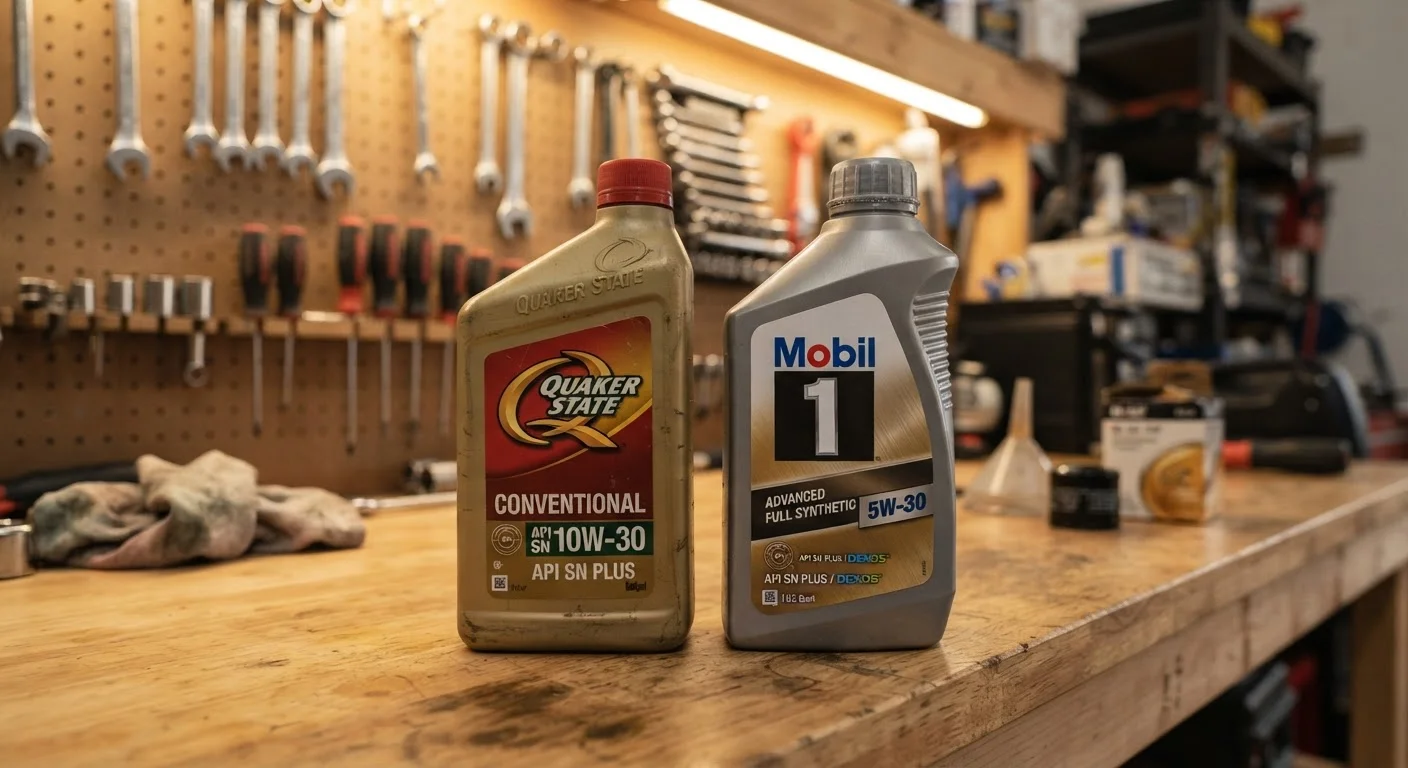
Conventional Motor Oil
The time-tested, widely available standard.
Best for: Older vehicles, low-mileage drivers, and engines with straightforward operating conditions that don't require extended oil change intervals.
Option B
Synthetic Motor Oil
The engineered option built for demanding conditions.
Best for: Modern engines, turbocharged vehicles, extreme climates, and drivers who want longer intervals between oil changes.
If you drive an older vehicle with simple operating conditions
Conventional Motor Oil
Older engines built before synthetic formulations became common often run fine on conventional oil, and the lower upfront cost makes sense if you're maintaining a high-mileage or aging vehicle.
If your vehicle has a turbocharged or high-performance engine
Synthetic Motor Oil
Turbos generate intense heat and require oil that flows quickly at startup and holds up under sustained high temperatures - synthetic formulations are engineered precisely for this.
If you drive in extreme hot or cold climates
Synthetic Motor Oil
Synthetic oil resists thickening in cold weather and breaking down in heat far better than conventional oil, protecting the engine during the most demanding moments.
If you prioritize lower out-of-pocket cost per oil change
Conventional Motor Oil
Conventional oil costs less per quart, though the trade-off is shorter change intervals - making the long-run math less clear-cut than it first appears.
How Each Oil Is Made - and Why It Matters
Conventional motor oil starts as crude oil extracted from the ground. It's refined to remove impurities, then blended with additives to meet viscosity and performance standards. The refining process is effective, but it can't eliminate every irregularity in the base oil's molecular structure.
Synthetic motor oil, by contrast, is chemically engineered from scratch. Manufacturers build the molecules to a precise, uniform structure - which translates into more consistent performance across a wider range of temperatures and operating conditions. Some synthetic oils use a highly refined petroleum base (called Group III), while others are built from chemically synthesized compounds (Group IV PAO). Both are generally sold as "full synthetic" in the U.S. market.
The practical takeaway: synthetic oil's engineered consistency is what gives it an edge in flow, protection, and longevity - not just marketing.
| Criterion | Conventional Oil | Synthetic Oil |
|---|---|---|
| Base material | Refined crude oil | Chemically engineered molecules |
| Cold-weather flow | Slower at startup | Faster, more protective at startup |
| Heat resistance | Degrades faster under high heat | More stable under sustained heat |
| Typical change interval | 3,000-5,000 miles | 7,500-15,000 miles |
| Cost per quart | Lower | Higher |
| Required by modern engines | Rarely | Frequently (check your manual) |
Performance Differences That Actually Affect Your Engine
The most meaningful differences show up at the extremes. In cold weather, conventional oil thickens more than synthetic, which means it takes longer to circulate at startup - the period when most engine wear occurs. Synthetic oil flows faster in low temperatures, coating critical components sooner after you turn the key.
At the other end, heat breaks down conventional oil more quickly. Engines running in stop-and-go traffic, towing, or high-rpm conditions put significant thermal stress on the oil. Synthetic oil's more stable molecular structure resists this breakdown longer, maintaining its protective film where conventional oil may begin to degrade.
Change intervals reflect this gap. Conventional oil is typically changed every 3,000-5,000 miles under normal conditions, while many full synthetic formulations are rated for 7,500-15,000 miles - though your owner's manual and driving conditions should always dictate the actual interval. As our editorial team emphasizes elsewhere, skipping scheduled maintenance adds up to real repair costs over time, regardless of which oil you use.
~40%
Engine wear occurs at cold startup
Engineering research widely cited in automotive literature estimates a disproportionate share of engine wear happens in the first seconds after a cold start, before oil fully circulates.
7,500-15,000 mi
Typical full synthetic change interval
Many full synthetic oil manufacturers rate their products for extended intervals, though actual intervals depend on vehicle type, driving conditions, and manufacturer guidance.
What Your Owner's Manual Actually Says
The single most reliable guide to your oil choice isn't an advertisement or a shop counter recommendation - it's your owner's manual. Manufacturers test their engines extensively and specify the oil viscosity grade (such as 5W-30 or 0W-20) and whether conventional, synthetic, or a synthetic blend is required or recommended.
Some modern engines - particularly turbocharged, direct-injection, and high-compression designs - are built around synthetic oil's properties and may require it to maintain warranty coverage or achieve their rated performance and fuel economy. Using conventional oil in an engine designed for synthetic isn't just a performance compromise; in some cases it may void portions of your powertrain warranty.
If you're unsure how to interpret your manual's specifications, our guide to reading your owner's manual walks through exactly what to look for. For the long-run cost perspective, thinking through cost vs. value trade-offs is worth considering before defaulting to the cheaper option at the counter.
Synthetic Blends: A Middle Ground
Synthetic blend oils mix conventional base oil with a portion of synthetic. They offer some performance advantages over straight conventional oil - particularly in temperature resistance - at a lower price than full synthetic. Blends can be a practical choice for vehicles that don't require full synthetic but operate in moderately demanding conditions. Check your owner's manual to confirm compatibility before switching.