

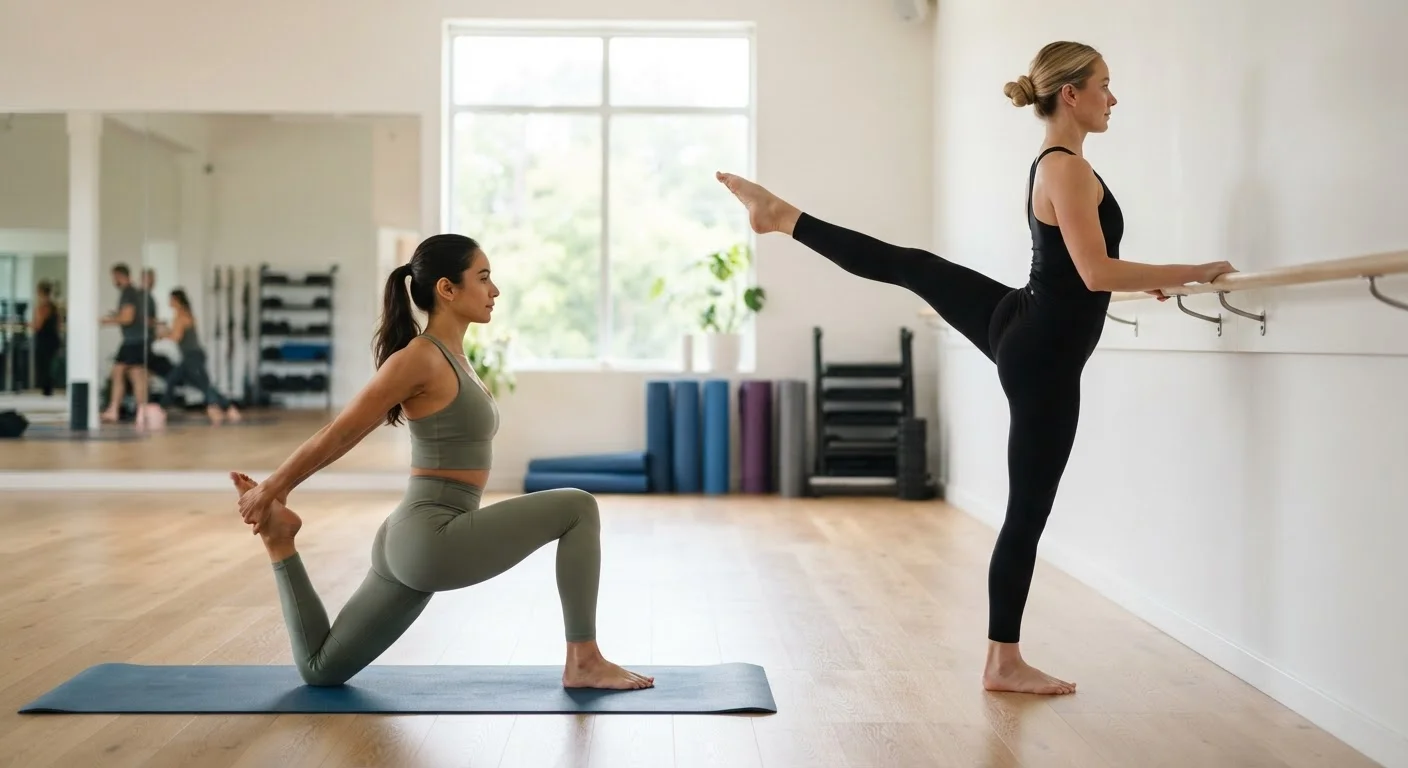
Key Takeaways
Option A
Flexibility
The passive range your muscles can reach.
Best for: Improving the length of muscles and connective tissue, especially after workouts or periods of prolonged sitting.
Option B
Mobility
The active range your joints can control.
Best for: Building functional movement quality, joint stability, and strength through a full range of motion.
If you sit for long hours and feel chronically tight
Flexibility
Static and dynamic stretching can help relieve muscle tension and improve tissue length, making everyday positions more comfortable.
If you want to improve posture, athletic performance, or injury resilience
Mobility
Mobility work trains joints to move well under load, which translates directly to better functional movement patterns.
If you're building or refining a well-rounded movement practice
Flexibility
Combining flexibility and mobility work creates a foundation for sustainable physical health across all activity types and age groups.
Why the Difference Matters
Walk into almost any fitness class and you'll hear the words flexibility and mobility used as if they mean the same thing. They don't - and understanding the distinction can meaningfully change how you approach movement and joint health.
Flexibility describes how far a muscle or group of muscles can lengthen passively - that is, with external assistance or gravity doing the work. Think of a seated hamstring stretch where you reach toward your toes. The muscle is being elongated, but you're not necessarily controlling that range actively.
Mobility, by contrast, refers to how well a joint can move through its full range of motion with active muscular control. It combines flexibility with strength, coordination, and neuromuscular awareness. A mobile hip joint isn't just one that can be pushed wide open - it's one that can be driven there with intention and held with stability.
The practical implication: a person might be quite flexible - able to fold deeply in a forward bend - yet still lack the hip mobility needed to perform a safe, controlled squat. Passive range and active control are related, but they're not the same thing.
| Criterion | Flexibility | Mobility |
|---|---|---|
| Core definition | Passive muscle lengthening | Active joint range with control |
| Who does the work | Gravity or external force | Your own muscles and nervous system |
| Primary training method | Static and dynamic stretching | Controlled articular rotations, end-range loading |
| Effort level | Passive; often relaxing | Active; requires muscular engagement |
| Functional carryover | Tissue length, reduced tension | Joint stability, movement quality |
| Can you have one without the other? | Yes - flexible but not mobile is common | Some mobility possible with limited flexibility |
How Each Is Trained
Because flexibility and mobility involve different physiological demands, they're trained differently.
Flexibility training typically involves static stretching (holding a position for 20-60 seconds) or dynamic stretching (controlled movement through a range). These methods primarily target muscle length and the extensibility of connective tissue. Common examples include yoga poses, foam rolling, and post-workout cool-down stretches.
Mobility training is more active by nature. It often includes controlled articular rotations (moving a joint through its full range under muscular control), strength exercises performed at end-range positions, and movement drills that challenge stability at extremes. Hip 90/90 stretches with active rotation, deep squat holds with heel grounding, and shoulder CARs (controlled articular rotations) are examples commonly used in physical rehabilitation and performance contexts.
This is why mobility work can feel harder than stretching - it requires your muscles to engage, not just lengthen. As the spectrum of beneficial movement is broader than most people assume, even simple daily habits like floor sitting or carrying groceries with proper mechanics can contribute to functional mobility over time.
~30%
Decline in joint range of motion with age
Research in sports medicine and gerontology estimates adults may lose roughly 20-30% of joint range of motion between ages 30 and 70 without targeted movement training.
2-3x/week
Recommended frequency for flexibility training
The American College of Sports Medicine recommends flexibility exercises at least two to three days per week to maintain and improve range of motion in healthy adults.
How Age and Lifestyle Affect Both
Both flexibility and mobility naturally decline with age and inactivity, though mobility tends to become the more pressing concern for functional independence as people get older. Reduced joint range of motion, stiffening connective tissue, and loss of muscle mass all contribute to the movement limitations many adults notice in their 40s, 50s, and beyond.
That said, decline is not inevitable - both qualities respond well to consistent practice at virtually any age. Research in exercise physiology consistently shows that older adults who engage in regular stretching and movement training maintain significantly better joint function than sedentary peers. For a deeper look at how movement needs evolve across decades, see how physical activity needs shift over a lifetime.
Lifestyle factors play a significant role too. Prolonged sitting shortens hip flexors and reduces the nervous system's familiarity with certain joint positions. Repetitive one-dimensional movement - the same gym exercises, the same desk posture - can create flexibility in some directions while eroding mobility in others.
Building a routine that intentionally addresses both is more effective than hoping either one takes care of itself. If your schedule is unpredictable, a flexible weekly movement approach can still carve out space for both stretching and active mobility work without requiring rigid commitment.
This article is for general informational purposes only and does not constitute medical advice. Consult a qualified healthcare professional before starting any new exercise program, especially if you have existing joint conditions, injuries, or other health concerns.