

Key Takeaways
Our Verdict
Neither setting is objectively superior. Home workouts deliver unmatched convenience and privacy, while gyms offer equipment, community, and professional support that's difficult to replicate at home. The most effective environment is the one you'll actually use regularly and that aligns with your current goals, budget, and lifestyle.
| Best for | Recommended |
|---|---|
| Those with tight schedules or limited transportation | Home workouts |
| Those seeking strength equipment variety or professional coaching | Gym membership |
| Those who need social motivation to stay consistent | Gym membership |
| Those wanting maximum flexibility across different training styles | Hybrid approach |
What Each Environment Actually Provides
Choosing where to exercise is more than a logistical question - the environment shapes the type of workout you can do, how often you do it, and how long you stick with it. Understanding what each setting genuinely offers helps you align your choice with your actual routine, not just your intentions.
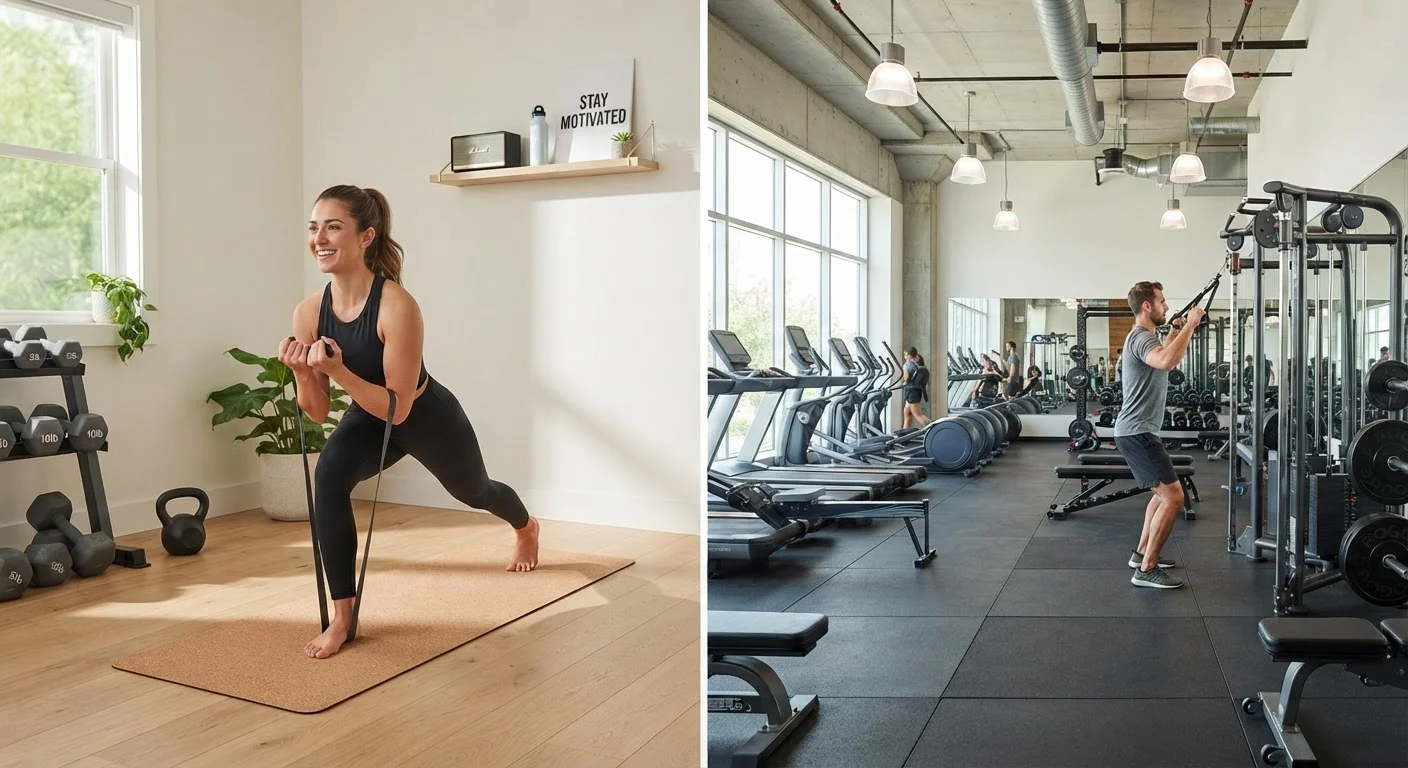
Home workouts center on accessibility. There's no commute, no wait for equipment, and no requirement to fit someone else's schedule. For many people, removing those barriers is what allows exercise to become a habit at all. Bodyweight training, resistance bands, yoga, and streaming fitness classes have expanded what's achievable without a single piece of heavy equipment.
Gym environments provide infrastructure that most home spaces can't match: barbells and weight racks, cardio machines, resistance cable systems, and often access to pools or group exercise studios. Beyond equipment, gyms offer a dedicated space where the sole purpose is exercise - a psychological signal that can help some people shift into a focused mindset more easily. For those pursuing strength training or cardio goals that require specific equipment, this distinction matters considerably.
Cost, Space, and Practical Considerations
Cost comparisons between home and gym training are rarely straightforward. A gym membership might run anywhere from roughly $20 to over $100 per month depending on the facility and location. Home setups range from genuinely free - using bodyweight exercises - to thousands of dollars if you invest in a treadmill, power rack, or smart fitness equipment.
Space is an equally real constraint. Apartment dwellers may have room for a yoga mat and a few dumbbells but nothing more. Homeowners with a garage or spare room have more options, though even modest home gyms require ongoing maintenance and upfront planning.
| Home Workouts | Gym Membership | |
|---|---|---|
| Upfront cost | Low to high (equipment-dependent) | Usually low (joining fee) |
| Ongoing cost | Minimal after setup | Monthly membership fee |
| Equipment variety | Limited by space and budget | Broad range available |
| Convenience | No commute, any time | Requires travel and schedule planning |
| Privacy | Complete | Shared public space |
| Social motivation | Requires self-direction | Ambient community present |
| Professional guidance | Via apps or streaming only | Trainers often available on-site |
| Distraction risk | Higher (household interruptions) | Lower (dedicated exercise space) |
It's also worth noting that gym memberships often go unused after an initial burst of enthusiasm. Research on habit formation consistently suggests that reducing friction - like a shorter commute or a more convenient time window - improves long-term adherence. If a gym is 20 minutes away and your schedule is unpredictable, that friction adds up quickly.
Motivation, Accountability, and Social Dynamics
One of the most underappreciated differences between the two environments is social structure. Gyms provide ambient accountability - being around others who are exercising creates a subtle motivational pull for many people. Group fitness classes, personal trainers, and even just familiar faces at a regular hour can reinforce the habit loop.
Home environments, by contrast, require more internal motivation. That's not a flaw - self-directed exercisers often develop stronger intrinsic motivation over time - but it can be a barrier early on. Distractions at home (household responsibilities, screens, family members) are real and shouldn't be underestimated.
Try a Trial Period Before Committing
Many gyms offer short-term trial memberships or day passes. Using one for two to four weeks can reveal whether the environment genuinely motivates you before you commit to a longer contract. Similarly, attempt a structured home routine for a few weeks first - if you consistently skip it, a gym's built-in structure may serve you better.
For those interested in training formats that work well in either setting, high-intensity interval training (HIIT) is worth exploring - it's effective with minimal equipment and can be adapted to a living room or a gym floor equally well. It's also worth remembering that formal workouts aren't the only path to physical activity; see other forms of movement that count as exercise for a broader perspective on staying active.
Making the Decision Based on Your Situation
Rather than treating this as a permanent either/or choice, consider what your circumstances actually call for right now. Someone rebuilding a fitness routine after a long break may benefit from the low-stakes entry point of home exercise. Someone training for a specific athletic goal may need the equipment and guidance that only a gym provides.
A hybrid approach - using a gym a few times a week while maintaining movement at home on other days - is increasingly common and practical. It balances the equipment access of a gym with the flexibility of home training, and it spreads the cost question differently for different households.
Whatever you decide, consult a qualified healthcare provider or certified fitness professional before beginning a new exercise program, particularly if you have any underlying health conditions, are returning to exercise after injury, or are unsure what intensity or type of training is appropriate for you. The environment is secondary to finding a sustainable, safe routine that fits your life.
This article is for general informational and educational purposes only and does not constitute medical or fitness advice. Always consult a qualified healthcare professional before starting or changing an exercise program.