

Key Takeaways
Option A
Whole Foods
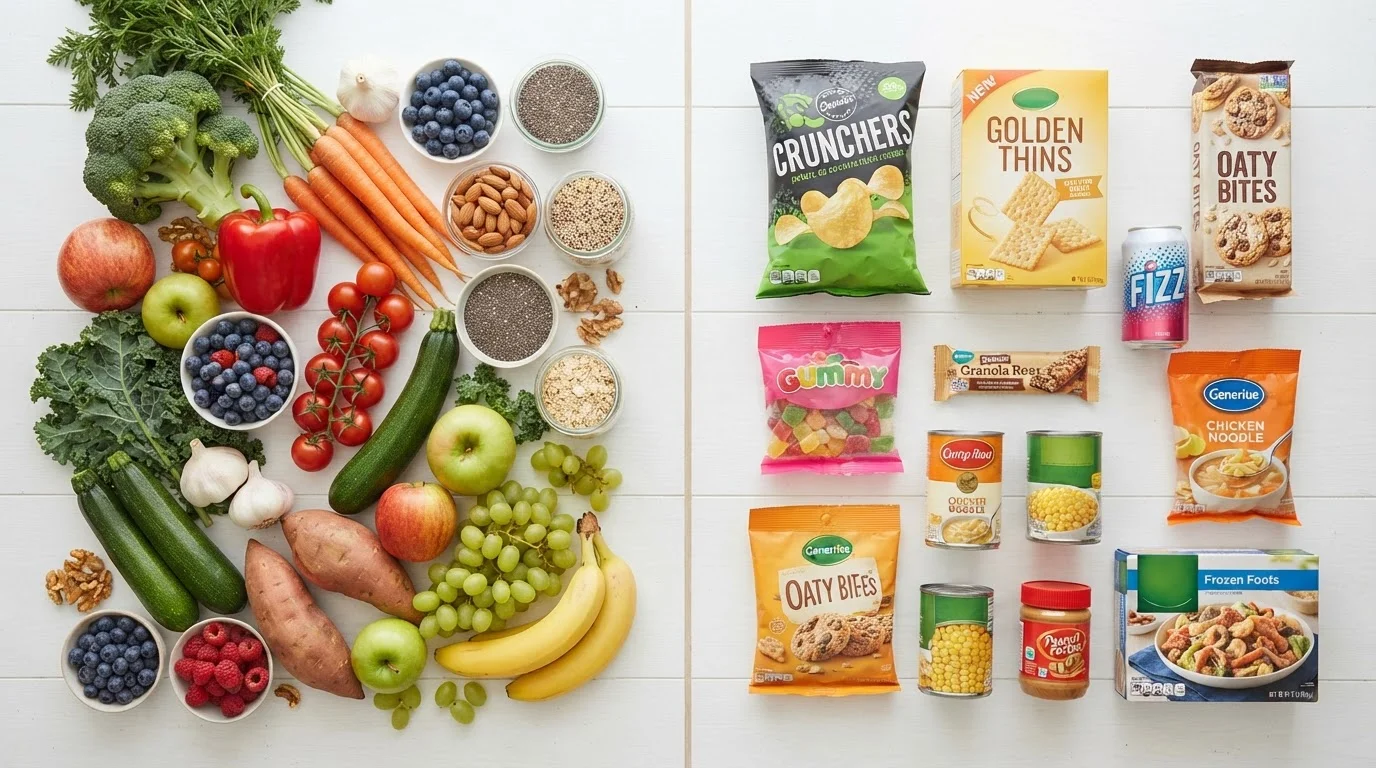
The nutrient-dense, minimally altered foundation of a balanced diet.
Best for: Anyone aiming to maximize fiber, vitamins, and minerals while minimizing added ingredients.
Option B
Processed Foods
A broad spectrum ranging from mildly convenient to heavily reformulated.
Best for: Readers who want to understand where convenience foods fit - and where to draw the line.
If you want to maximize nutrient density with every meal
Whole Foods
Whole foods deliver vitamins, minerals, fiber, and phytonutrients in their most intact form, without additives that can dilute nutritional value.
If convenience is a daily reality and you need practical middle-ground options
Processed Foods
Minimally processed items - such as canned legumes, frozen vegetables, or plain yogurt - can fit a healthy eating pattern when chosen thoughtfully.
If you are trying to reduce added sugar and sodium in your diet
Whole Foods
Whole foods contain little to no added sugar or sodium, making them the clearest path to limiting these nutrients without careful label scrutiny.
Defining the Terms: What Counts as Whole or Processed?
A whole food is one that is consumed close to its natural form - think a raw apple, a handful of walnuts, a dried lentil, or a fillet of fish. Little or no processing has occurred between harvest and your plate. These foods retain their naturally occurring fiber, vitamins, minerals, and beneficial plant compounds (phytonutrients).
Processed food, by contrast, refers to anything that has been deliberately altered before you consume it. The catch: processing is a spectrum, not a switch. The NOVA classification system - developed by nutrition researchers at the University of São Paulo - groups foods into four categories based on the extent and purpose of processing, ranging from unprocessed or minimally processed foods (frozen vegetables, rolled oats) all the way to ultra-processed formulations (packaged snack cakes, instant noodles, sweetened beverages) that combine industrial ingredients rarely found in a home kitchen.
The distinction matters because lumping all processed foods together obscures meaningful nutritional differences. Canned tomatoes and cheese puffs are both "processed," yet they deliver vastly different nutritional profiles.
| Criterion | Whole Foods | Processed Foods |
|---|---|---|
| Definition | Unaltered or minimally altered from natural state | Deliberately modified before consumption |
| Examples | Apples, lentils, oats, fresh fish | Frozen meals, canned soup, snack foods |
| Fiber content | Naturally intact | Often reduced during refining |
| Added sugar | None | Varies widely; often high in ultra-processed items |
| Sodium | Naturally low | Frequently elevated for preservation or flavor |
| Ingredient list length | One ingredient (the food itself) | Can range from a few to dozens of additives |
| Shelf life | Generally shorter | Often extended through preservation methods |
| Nutrient density | Typically high relative to calories | Highly variable; often lower in ultra-processed form |
How Processing Affects Nutritional Value
Processing methods can strip, add, or transform nutrients in ways that shift the overall quality of a food. Refining whole grains into white flour removes the bran and germ - and with them, fiber, B vitamins, and iron. Manufacturers often add some of these back through fortification, but the food's original matrix is altered.
Ultra-processed foods frequently contain high amounts of added sugars, sodium, and saturated fats alongside artificial colors, flavor enhancers, and preservatives. Research published in journals such as The BMJ has found associations between high ultra-processed food consumption and elevated risk of various chronic conditions, though researchers continue to study whether the link is due to the processing itself, the nutrients present, or the displacement of more nutritious foods from the diet.
Whole foods, by comparison, deliver nutrients alongside dietary fiber and a complex food matrix that research suggests may improve nutrient absorption and promote satiety. For a closer look at how individual fats in processed and whole foods compare, see our guide to saturated vs. unsaturated fats.
57%
Share of calories from ultra-processed foods in the average U.S. diet
According to research published in BMJ Open (Martínez Steele et al.) analyzing U.S. dietary intake data from NHANES.
4x
More fiber in whole grains vs. refined grains
The USDA's nutrient data consistently shows whole grains retaining significantly more dietary fiber than their refined counterparts.
10+
Chronic conditions linked to high ultra-processed food intake in observational studies
A 2024 umbrella review in The BMJ summarized associations between ultra-processed food consumption and numerous health outcomes.
Making Practical Choices Without an All-or-Nothing Approach
Few people eat exclusively whole foods - and nutrition science does not demand it. The goal for most people is to build a dietary pattern where whole and minimally processed foods form the foundation, while more heavily processed items are occasional rather than habitual.
Practical strategies include:
- Choosing plain frozen or canned vegetables and legumes (look for no-salt-added or low-sodium options) as convenient whole-food proxies.
- Comparing ingredient lists: a shorter list with recognizable ingredients is generally a reliable indicator of less extensive processing.
- Using the Nutrition Facts label to spot high added-sugar and sodium content - see how to read a Nutrition Facts label for a step-by-step walkthrough.
- Being cautious of foods marketed as "natural" or "healthy" - a claim on the front of a package does not guarantee nutritional quality. Our article on foods often labeled healthy that deserve a closer look examines this in detail.
Understanding the difference between added and natural sugars is another useful lens when evaluating processed food products. For a broader grounding in everyday nutrition principles, Eating for Energy: A Beginner's Look at Balanced Nutrition offers accessible context.
Processing Isn't Always a Red Flag
Some processing genuinely improves safety and access - pasteurization eliminates harmful pathogens in milk, and fortification has helped reduce nutrient deficiencies at a population level. The concern in current nutrition research centers primarily on ultra-processed foods that are engineered for overconsumption. When evaluating any food, context and overall dietary pattern matter more than a single ingredient or product in isolation.
This article provides general nutrition information and education only. It is not a substitute for personalized dietary advice from a registered dietitian or qualified healthcare professional.