

Key Takeaways
Why You Should Know This Before You Need It
A burst pipe, a gas smell, or a sparking outlet doesn't give you time to search YouTube tutorials. In those moments, the difference between a manageable incident and a serious disaster often comes down to one thing: whether someone in your household already knows where the shutoffs are and how to operate them.
This guide walks you through locating, identifying, and testing the main shutoffs for water, natural gas, and electricity in a typical American home. For a broader orientation to how these systems connect, see our plain-language guide to essential home systems.
Before you start this walkthrough, gather the tools listed below and make sure at least one other adult in your household accompanies you.
What you will need
Adjustable pipe wrench or water meter key
Used to turn the main water shutoff valve if it requires a tool rather than a hand-turn handle.
Gas shutoff wrench (or adjustable crescent wrench)
Required to turn the gas meter's flat-stemmed ball valve a quarter-turn to the off position.
Waterproof adhesive labels or a permanent marker
Used to label each shutoff clearly so all household members can identify them at a glance.
Flashlight or headlamp
Illuminates dark utility areas such as crawl spaces, basements, and meter boxes.
Smartphone or camera
Document each shutoff location with a photo for quick reference during an emergency.
Step-by-Step: Shutting Off Each Utility
Work through each utility in order. Once you've located each shutoff, label it with a waterproof marker or adhesive tag so anyone in the house can find it instantly. Take a photo of each location and save it somewhere accessible - a shared family note or a printed card kept near your breaker panel both work well.
Locate Your Main Water Shutoff
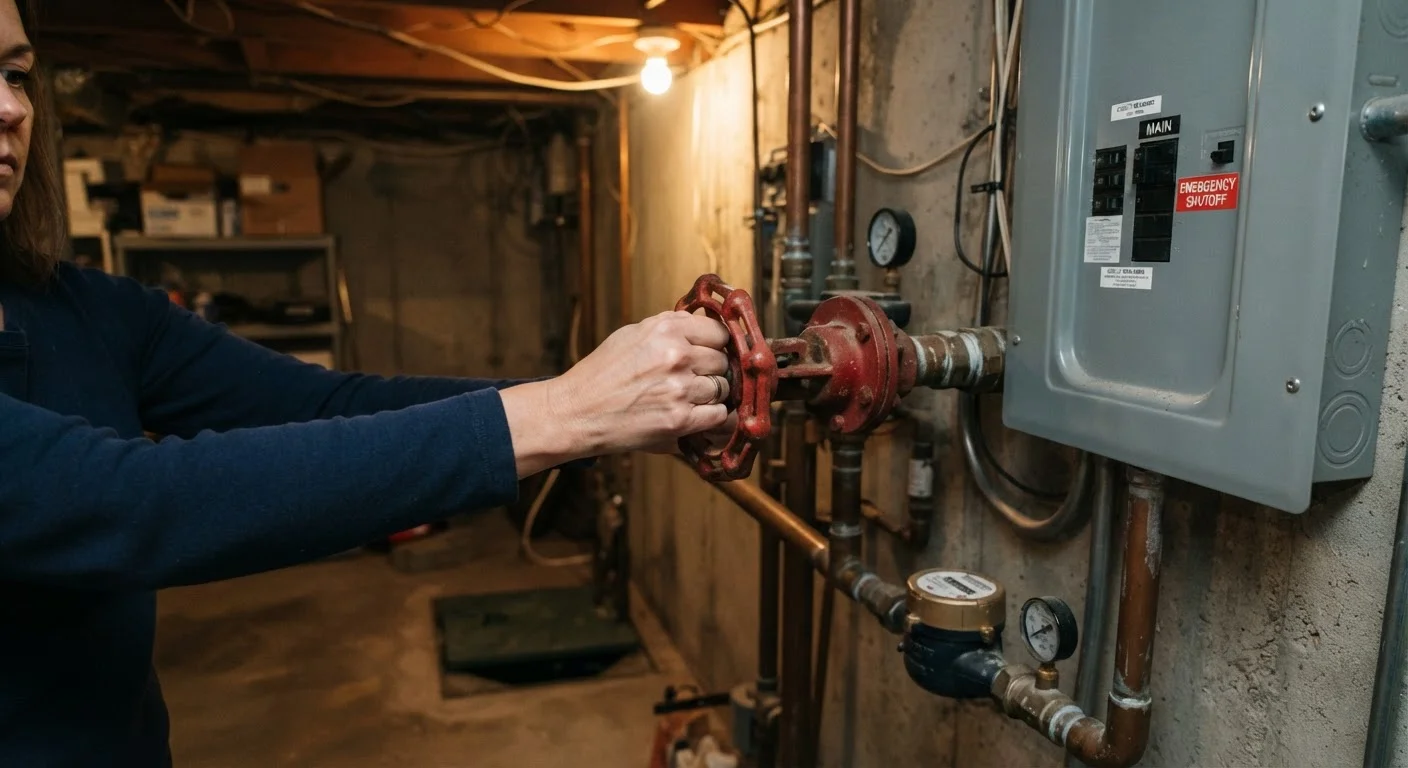
The main water shutoff controls all water entering your home from the municipal supply or a well. In most homes, it sits along the perimeter wall closest to the street - typically in a basement, crawl space, utility room, or garage. In slab-foundation homes, check near the water heater or under a kitchen sink. Some homes have a secondary shutoff inside the meter box at the street curb.
The valve will be one of two types: a gate valve (round wheel handle, turned clockwise to close) or a ball valve (lever handle, turned 90 degrees perpendicular to the pipe to close). Ball valves are faster and more reliable. For a deeper look at how your plumbing is organized, see our room-by-room plumbing guide.
Test the Water Shutoff
Once located, operate the valve slowly. For a gate valve, turn clockwise until snug - do not over-tighten. For a ball valve, rotate the lever 90 degrees so it sits perpendicular to the pipe. Open a cold-water tap in your kitchen or bathroom and verify flow stops within 30 seconds. Then reopen the shutoff fully and confirm flow returns. Label the valve with a tag or marker once confirmed.
Locate Your Natural Gas or Propane Shutoff
The main gas shutoff is located on the gas meter, which is typically mounted on an exterior wall, in a side yard, or in a utility alcove. The shutoff is a flat-stemmed ball valve on the supply pipe entering the meter. When the slot on the stem is parallel to the pipe, gas is flowing. When it is perpendicular (across the pipe), gas is off. You will need a wrench to turn it.
Propane homes typically have a shutoff at the tank itself - a hand-turn valve on top of the tank that closes clockwise.
Practice Identifying - Not Turning - the Gas Valve
For gas, your practice step is visual identification only: locate the meter, find the shutoff stem, and confirm you have a properly sized wrench that fits it. Store that wrench within easy reach of your gas meter - many households zip-tie it directly to the meter pipe. Do not practice turning gas off unless there is a real emergency; unnecessarily cycling a gas valve can disrupt appliance operation.
Locate Your Main Electrical Shutoff
Your main electrical shutoff is the large double-pole breaker at the top of your home's service panel (breaker box), typically labeled MAIN. The panel is most commonly in a basement, utility room, garage, or hallway. Flipping this breaker to the OFF position cuts power to every circuit in the home simultaneously.
Individual circuit breakers below it control separate zones - knowing these is equally valuable. For help decoding what your panel is telling you, see our guide on reading your electrical panel. You may also want to review GFCI and grounding concepts for broader electrical safety context.
Label Every Breaker and Test the Main Shutoff
If your circuit breakers are unlabeled or inaccurately labeled, this is the time to map them. Use the two-person method: one person at the panel, one walking the house confirming which outlets and lights go dark when each breaker is tripped. Write clear labels directly on the panel directory card. Then test the main breaker: flip it to OFF, confirm the panel goes dark, and immediately flip it back ON. Make sure all household members know where the panel is and can operate the main breaker confidently.
Never Re-Enter a Gas-Affected Home Alone
If you smell gas, leave immediately without operating any switches, and call your gas utility's emergency line and 911 from outside. Do not re-enter until emergency responders have cleared the building. After any gas shutoff due to a leak, your utility company must restore and inspect service - attempting to reopen the valve yourself is unsafe and, in many areas, prohibited.
After the Shutoff: What Comes Next
Once utilities are off, your priorities shift to safety and documentation. Evacuate if there is any sign of gas odor, structural damage, or active electrical hazard, and call 911 or your utility company from outside the home. Never re-enter until cleared by emergency responders.
For gas specifically, do not attempt to reopen the main shutoff yourself - your gas utility is required to inspect the system and relight pilots before restoring service. This is a safety requirement, not a courtesy.
Water and electrical systems can typically be restored by the homeowner once the underlying problem has been resolved, but permits and professional inspections may be required depending on the nature of the repair. Always verify local code requirements before doing so.
Make this walkthrough part of your annual home maintenance routine. Our annual home systems checklist covers shutoff checks alongside HVAC, water heater, and plumbing inspections you should perform each year.