

Key Takeaways
Start here
Why Home Systems Matter
Build your knowledge
HVAC: How Your Home Breathes and Stays Comfortable
Go deeper
Plumbing: Water In, Water Out
Keep going
Electrical: Power to Every Outlet and Switch
See the big picture
How the Three Systems Connect
Take action
When to DIY and When to Call a Pro
Why Home Systems Matter
Behind every comfortable morning shower, every flipped light switch, and every room that holds a steady temperature are systems most homeowners never see. HVAC, plumbing, and electrical infrastructure run through your walls, floors, and ceilings - quietly doing their jobs until something goes wrong.
You don't need to become a contractor to own a home successfully. But understanding what each system does, how it works, and what warning signs look like puts you in a far better position to maintain your home, catch problems early, and have informed conversations with professionals when you need them. Think of this guide as your orientation - the foundation for everything that follows.
For a practical next step once you've read through, see our annual home systems walkthrough, which turns this knowledge into a seasonal maintenance routine.
HVAC
Short for Heating, Ventilation, and Air Conditioning - the system that controls your home's temperature and air circulation.
Circuit breaker
A safety switch in your electrical panel that automatically cuts power to a circuit when it detects an overload, preventing wiring damage or fire.
Main water shutoff
A valve that stops all water from entering your home - essential to locate before any plumbing emergency occurs.
Drain-waste-vent (DWV)
The part of your plumbing system that carries wastewater away from fixtures and uses vent pipes to keep the flow clear and prevent sewer gases from entering the home.
GFCI outlet
A special electrical outlet with built-in protection that cuts power instantly if it senses a fault, required in kitchens, bathrooms, and other wet locations.
Forced-air system
The most common type of home HVAC setup, which uses a blower to push heated or cooled air through a network of ducts to each room.
HVAC: How Your Home Breathes and Stays Comfortable
HVAC stands for Heating, Ventilation, and Air Conditioning. The system has three main jobs: warm the house in winter, cool it in summer, and move air throughout the building to maintain air quality.
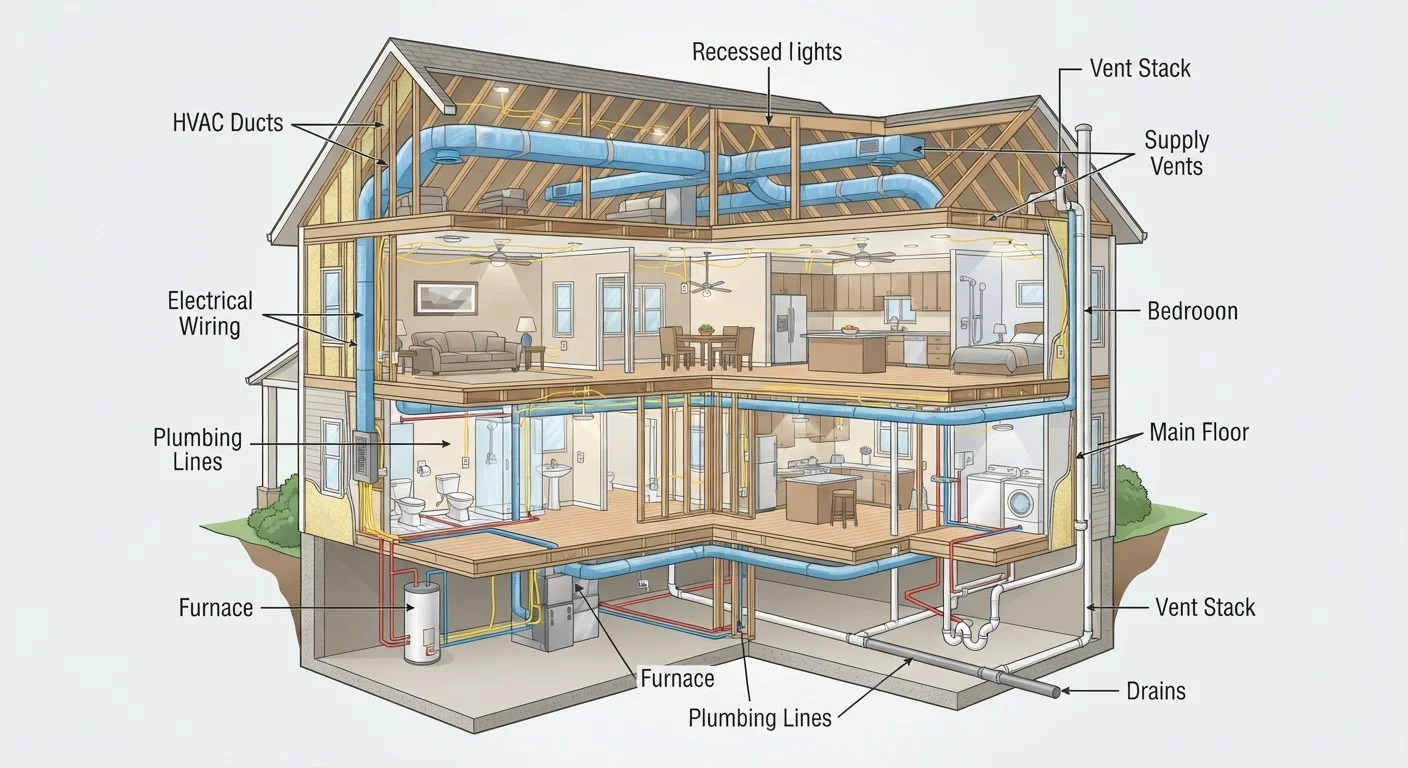
Most American homes use a forced-air system. A furnace or air handler sits in a central location - basement, attic, or utility closet - and pushes conditioned air through a network of ducts. Supply registers deliver air to each room; return vents pull room air back to the unit to be filtered and re-conditioned. The outdoor compressor unit (part of a central air conditioning setup) transfers heat between your home and the outside air.
- Filter: Traps dust, pollen, and particles before air reaches the equipment. Replacing it regularly is the single most impactful maintenance task a homeowner can do.
- Thermostat: Controls when the system runs. Smart thermostats can improve efficiency by learning your schedule.
- Ducts: Leaky or poorly insulated ducts are a common source of energy loss - a licensed HVAC technician can test and seal them.
Warning signs to watch for: uneven temperatures between rooms, unusual sounds from the unit, or a sudden spike in energy bills. Gas furnaces involve combustion - any smell of gas warrants an immediate call to your utility provider and, if needed, evacuation before calling a technician.
Keep a Home Systems Log
Note the make, model, and installation date of your HVAC equipment, water heater, and electrical panel in a single document. Record service visits and filter changes there too. This log takes minutes to start and can save significant time - and money - when troubleshooting or selling your home.
Plumbing: Water In, Water Out
Residential plumbing does two distinct things: delivers clean, pressurized water to fixtures and appliances, then removes wastewater safely. These are called the supply system and the drain-waste-vent (DWV) system.
Supply lines run from the municipal main (or a private well) through a meter and main shutoff valve into your home. From there, lines branch to every sink, toilet, shower, dishwasher, and water heater. Hot-water lines loop back from the water heater to those same fixtures. Knowing where your main shutoff is located is essential - it's the first thing you'd need in a leak emergency.
The DWV system relies on gravity. Drain pipes slope downward toward the sewer main or septic tank. Vent pipes run upward through the roof, allowing air into the drain system so water flows freely and sewer gases don't enter living spaces. The P-trap - the curved pipe under every sink - holds a small amount of water that seals out those gases.
For a room-by-room breakdown of how all this is organized throughout a home, see our plumbing reference guide.
Electrical: Power to Every Outlet and Switch
Electricity enters your home from the utility grid through a service entrance and lands at the main electrical panel - also called a breaker box or load center. From there, individual circuits branch out to serve different areas and appliances. Each circuit is protected by a circuit breaker that automatically shuts off if the circuit is overloaded, preventing overheating and fire.
Circuits are sized for their intended load. A standard 15- or 20-amp circuit powers lights and outlets; large appliances like electric dryers, ranges, and HVAC equipment require dedicated higher-amperage circuits. Outlets in wet locations - kitchens, bathrooms, garages, and outdoors - are required by electrical code to have GFCI protection (Ground Fault Circuit Interrupter), which shuts off power instantly if a fault is detected near water.
Basic homeowner tasks - replacing a light switch, installing a new outlet cover, or resetting a tripped breaker - are generally safe and straightforward. Anything involving the main panel, adding new circuits, or running wiring through walls should be handled by a licensed electrician. Most jurisdictions require permits for this work, and for good reason: faulty wiring is a leading cause of residential fires.
Understanding your energy consumption is also worthwhile. Our complementary piece on always-on devices and home energy use explains how even idle devices affect your electrical load.
Don't Ignore Recurring Breaker Trips
A circuit breaker that trips repeatedly is not just an inconvenience - it's a signal that something is drawing more power than the circuit can safely handle. Repeatedly resetting it without identifying the cause can mask a serious wiring issue. Have a licensed electrician evaluate any circuit that trips more than once without an obvious explanation.
How the Three Systems Connect
HVAC, plumbing, and electrical don't operate in isolation - they're interdependent in ways that matter for maintenance and troubleshooting. Your furnace needs electricity to ignite and run its blower. Your water heater (whether gas or electric) needs either a gas supply or a dedicated electrical circuit, and it connects to both the supply and DWV sides of your plumbing. A heat pump water heater pulls warmth from the surrounding air, making it part of the HVAC conversation too.
This interdependence means a problem in one system can surface as a symptom in another. A tripped breaker might shut down a sump pump, leading to moisture intrusion. A clogged condensate drain on an air conditioner - a plumbing issue - can trigger the unit to shut itself off as a safety measure. Thinking in terms of connected systems, not isolated appliances, helps you diagnose problems more accurately.
When to DIY and When to Call a Pro
Routine maintenance is the most valuable thing a homeowner can do - and most of it is accessible without professional help. Changing HVAC filters, clearing slow drains, testing GFCI outlets, and flushing sediment from a water heater are tasks with straightforward instructions and manageable risk.
Other work crosses into territory where the stakes - safety, code compliance, or system integrity - make professional involvement the right call:
- Gas lines and connections: Always a licensed plumber or HVAC technician.
- Electrical panel work and new circuits: Always a licensed electrician, with permits where required.
- Main sewer line repairs: Licensed plumber; work may require inspection.
- HVAC refrigerant handling: Requires EPA certification - not a DIY task.
If you've recently received or are preparing for a home inspection, our guide on what a home inspection report actually says explains how to read and prioritize the findings about your specific systems. And for ongoing upkeep, explore our Home Improvement resources for practical project guidance.
When in doubt about permit requirements, contact your local building department directly. Requirements vary significantly by jurisdiction, and unpermitted work on major systems can complicate home sales and insurance claims.