

Key Takeaways
Personal Budget
A personal budget is a written or digital plan that maps your expected income against your planned spending over a set period-usually a month. It tells you how much money is coming in, where you intend it to go, and whether you have anything left over. Think of it as a financial roadmap, not a rulebook.
In accounting terms, a personal budget functions as a cash-flow projection at the household level, tracking gross or net income against categorized expenditures and savings targets.
The Core Idea: A Plan for Your Money
At its simplest, a personal budget answers three questions: How much money do I have coming in? Where does it need to go? And what's left over? That's it. There's no complicated formula required and no financial background needed to get started.
The key word is plan. A budget is something you create before the month begins, not a report card you fill out afterward. It gives each dollar a job-rent, groceries, savings, transportation-so that you're making deliberate choices rather than spending reactively and hoping enough remains at the end of the month.
For a deeper look at the vocabulary that comes with budgeting, the budgeting terms glossary covers common concepts in plain English.
Start With One Month of Real Numbers
Before writing a budget, spend one month simply recording every dollar you spend-apps, a spreadsheet, or even a notepad all work. You'll build a far more accurate plan when it's based on what you actually spend rather than what you think you spend. This single step prevents the most common budgeting failure: building a plan that doesn't match reality.
What a Budget Is Not
A lot of people avoid budgeting because they've absorbed the wrong idea of what it means. Here are the most common misconceptions worth clearing up:
- A budget is not a punishment. It doesn't mean cutting everything enjoyable from your life. A well-built budget includes room for the things you value.
- A budget is not only for people in financial trouble. High earners benefit from budgeting just as much-without a plan, income tends to expand to fill whatever space is available, regardless of how large that space is.
- A budget is not set in stone. Life changes. A budget is a living document that gets revised as your income, expenses, and goals evolve.
- A budget is not the same as being cheap. Choosing deliberately is not the same as choosing the least expensive option every time.
Understanding what a budget isn't is often the first step to being willing to try one.
Budgeting Looks Different for Everyone
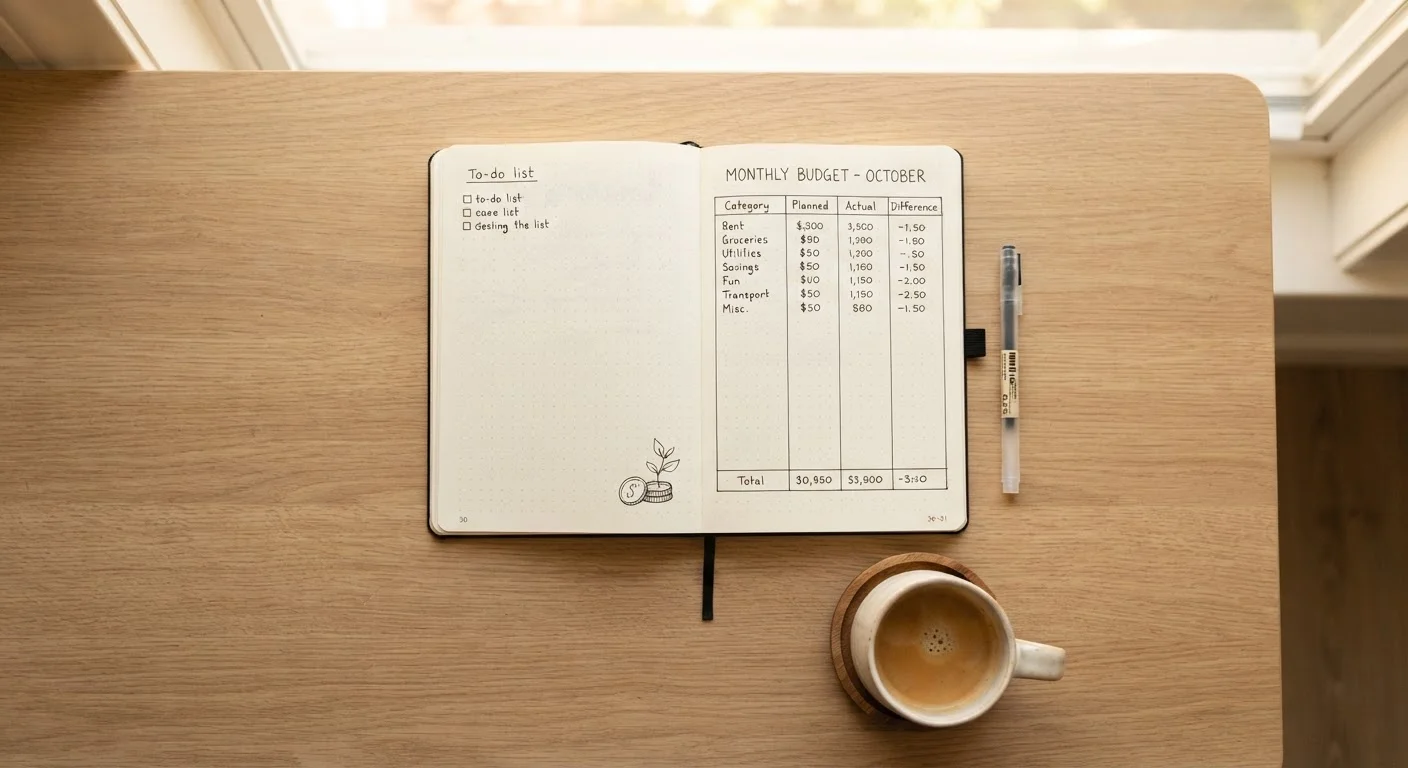
There's no single correct budget format. A monthly spreadsheet, an envelope system, a dedicated app, or even a handwritten list in a notebook can all work. The format matters far less than the habit of planning your spending before it happens. Choose whatever you'll actually use consistently.
The Building Blocks: Income, Expenses, and Savings
Every budget, regardless of format, rests on the same three components:
- Income: This is your take-home pay-the amount actually deposited in your account after taxes and deductions. Using gross income (before deductions) is one of the most common budgeting mistakes and leads to plans that don't survive first contact with reality.
- Expenses: These fall into two categories. Fixed expenses stay the same each month-rent, loan payments, insurance premiums. Variable expenses shift-groceries, gas, utilities, dining out. Both need to be accounted for. See how spending categories work for guidance on organizing these.
- Savings: A functional budget treats savings as an expense-a non-negotiable line item paid first or built in deliberately, not whatever happens to be left over at month's end.
When income minus expenses and savings equals zero-or when every dollar is assigned somewhere-you have what's often called a zero-based budget. But there are other frameworks too. The comparison of budgeting methods walks through the most widely used approaches and their real-world trade-offs.
~33%
Americans with a detailed household budget
Gallup polling has consistently found that roughly one-third of U.S. adults maintain a detailed monthly budget, leaving the majority without a formal spending plan.
$1,000+
Average monthly spending gap when untracked
Consumer financial research suggests many households underestimate their monthly discretionary spending by hundreds of dollars when relying on memory rather than recorded data.
Why Awareness Is the Real Point
The most powerful thing a budget does isn't restrict your spending-it makes you aware of it. Most people, when they first track their money carefully, are surprised by where it actually goes. Small, recurring expenses accumulate into hundreds of dollars a month. Subscriptions auto-renew. Convenience purchases add up.
Awareness doesn't automatically fix those patterns, but it gives you the information to make different choices if you want to. A budget puts you in the driver's seat. Once you know what your money is doing, you can decide whether you're comfortable with it or whether you'd rather redirect some of it toward a goal that matters more to you.
If you're ready to put this into practice, building your first budget provides a practical walkthrough-starting from scratch, using real numbers from your own life. And for full context on how budgeting fits into your broader financial picture, the complete guide to personal budgeting covers every stage from income to long-term habits.
This article is for general informational and educational purposes only and does not constitute personalized financial advice. Consult a qualified financial professional for guidance specific to your circumstances.