

| Legal disclosure required | Minimum payment warning showing payoff timeline and total interest (Credit CARD Act of 2009) |
| Billing cycle length | Typically 28-31 days (Consumer Financial Protection Bureau) |
| Grace period (typical) | At least 21 days after statement closes (Credit CARD Act of 2009) |
| Interest categories on a statement | Purchases, balance transfers, cash advances |
| Time limit to dispute a charge | 60 days from the date of the statement containing the error (Fair Credit Billing Act) |
| Credit utilization impact | Accounts for approximately 30% of a FICO score (FICO) |
What a Credit Card Statement Actually Contains
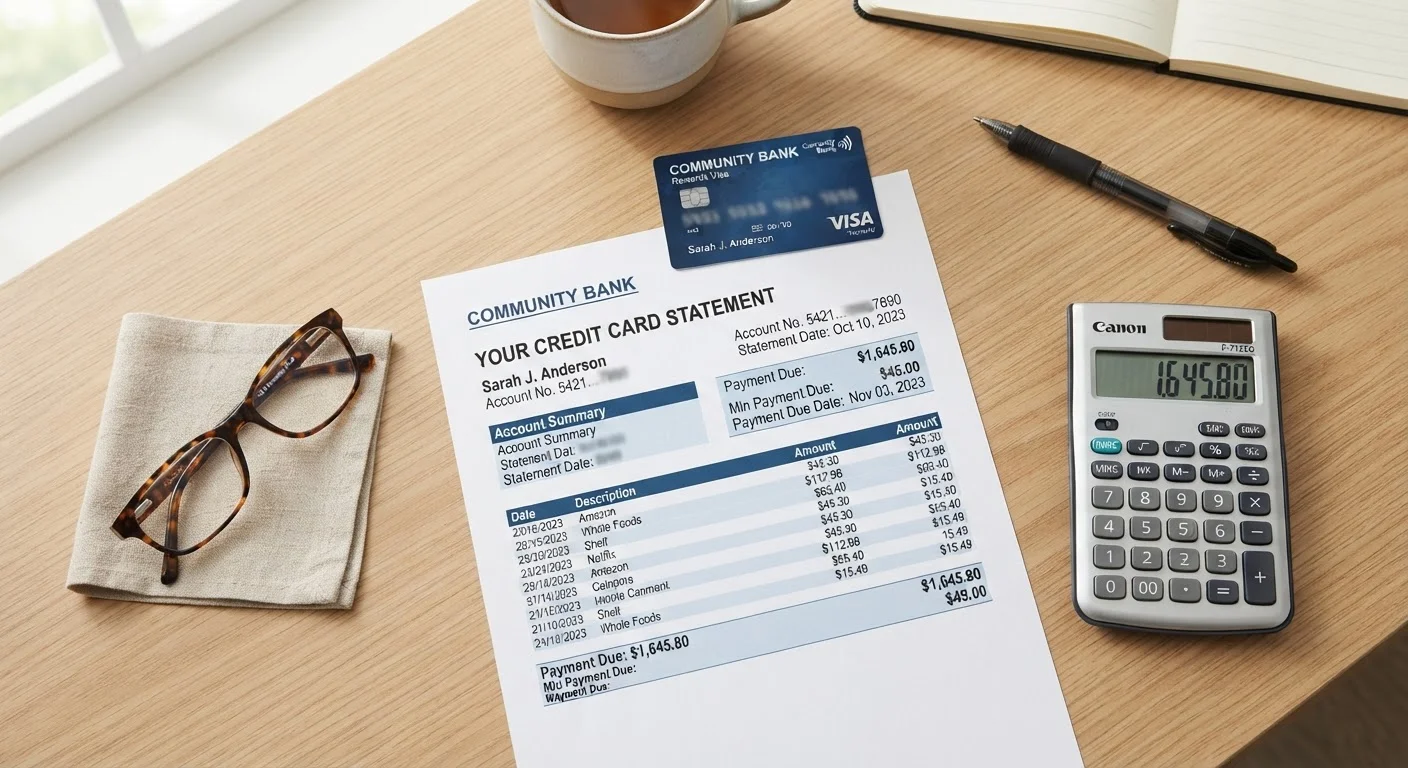
A credit card statement is a monthly document - delivered by mail or digitally - that summarizes all activity on your account during a defined billing cycle. Most cardholders glance at the minimum payment due and total balance, then move on. But every other line on the statement is there for a reason, and skipping it can cost you money or mask errors.
Statements are organized into distinct sections. Understanding what each one measures puts you in control of your account rather than at its mercy. If you also manage a checking or savings account, a related walkthrough - reading a bank statement without getting lost in the details - covers similar ground for deposit accounts.
| Legal disclosure required | Minimum payment warning showing payoff timeline and total interest (Credit CARD Act of 2009) |
| Billing cycle length | Typically 28-31 days (Consumer Financial Protection Bureau) |
| Grace period (typical) | At least 21 days after statement closes (Credit CARD Act of 2009) |
| Interest categories on a statement | Purchases, balance transfers, cash advances |
| Time limit to dispute a charge | 60 days from the date of the statement containing the error (Fair Credit Billing Act) |
| Credit utilization impact | Accounts for approximately 30% of a FICO score (FICO) |
Key Sections Decoded
Account Summary
This block appears near the top and shows your previous balance, any payments or credits applied, new purchases, fees, interest charges, and your new balance. Reading it top to bottom shows exactly how your balance changed during the cycle.
Credit Limit and Available Credit
Your credit limit is the maximum the issuer allows you to carry. Available credit is what remains after your current balance is subtracted. This ratio - called your credit utilization rate - is a significant factor in how your credit score is calculated. Carrying a high balance relative to your limit can lower your score even if you pay on time. For a deeper look, see how credit scores are actually calculated.
Payment Information
This section lists three critical figures: the statement balance (what you owe for the full cycle), the minimum payment due, and the payment due date. Paying the full statement balance by the due date avoids interest. Paying only the minimum keeps the account current but allows interest to accrue on the remaining balance - often at a steep rate. To understand exactly what that means over time, see why minimum payments keep you in debt longer than you think.
Minimum Payment Warning
Federal law (the Credit CARD Act of 2009) requires issuers to include a disclosure showing how long it would take to pay off your current balance making only minimum payments - and how much interest you would pay in total. This warning is not boilerplate; it often reveals a sobering timeline that motivates faster payoff strategies.
Interest Charge Calculation
This section breaks down interest by category - purchases, balance transfers, cash advances - each of which may carry a different APR (Annual Percentage Rate). Interest is typically calculated using your average daily balance multiplied by a daily periodic rate derived from your APR. That math is deliberately complex; a full explanation is available in how interest is actually calculated on a credit card balance. For a broader look at long-term costs, see understanding the true cost of carrying credit card debt.
Transaction List
Every purchase, return, fee, and payment posts here with a date, merchant name, and amount. Review this list every month. Errors, duplicate charges, and unauthorized transactions appear here - and disputing them has time limits. A monthly account review habit can help catch problems early; see what to verify before the statement closes for a practical checklist.
APR (Annual Percentage Rate)
The yearly interest rate charged on unpaid balances, expressed as a percentage. Different transaction types - purchases, cash advances, balance transfers - often carry different APRs on the same card.
Statement Balance
The total amount owed at the end of a billing cycle. Paying this amount in full by the due date generally avoids interest charges on purchases.
Minimum Payment
The smallest amount you must pay by the due date to keep your account in good standing. Paying only the minimum means interest accrues on the remaining balance.
Credit Utilization Rate
The percentage of your available credit that you are currently using. It is calculated by dividing your balance by your credit limit and is a key factor in credit scoring.
Average Daily Balance
A method issuers use to calculate interest. Your balance is tracked each day of the billing cycle, then averaged - that figure is multiplied by the daily periodic rate to determine the interest charge.
Grace Period
The window between your statement closing date and your payment due date. If you pay your statement balance in full during this window, most issuers charge no interest on purchases.
Daily Periodic Rate
Your APR divided by 365 (or sometimes 360). This rate is applied each day to your balance to calculate interest charges over the billing cycle.