

Key Takeaways
Phantom Discount
A phantom discount is a price reduction that appears to offer savings but is measured against an inflated, artificial, or rarely charged 'original' price. The retailer sets - or implies - a high reference price so the sale price looks like a bargain, even when the item has seldom or never sold at that higher amount. The result is the appearance of a deal without the substance of one.
Regulators including the FTC and many state attorneys general have guidelines requiring that advertised 'former' or 'original' prices reflect prices at which the item was actually offered for sale for a reasonable period. Enforcement varies significantly by jurisdiction.
How Price Anchoring Works Against You
Before you evaluate whether a deal is good, your brain has already been primed. That's anchoring - a well-documented cognitive bias in which the first number you encounter establishes a reference point that colors every judgment you make afterward. Retailers understand this, and they design pricing displays around it.
The classic setup: a product listed at $199.99, with a large, bold $89.99 beside it. Even if $89.99 is the item's everyday price across every competitor, the $199.99 sets a ceiling in your mind. The gap between the two numbers feels like your gain - but that gap was engineered, not earned.
Tiered product lineups use the same principle. Placing an overpriced option at the top of a lineup makes the mid-range option seem reasonable by comparison, regardless of whether the mid-range option is priced fairly relative to the broader market. Retailers call this the 'decoy effect,' and it shapes purchasing behavior without the shopper realizing the architecture was intentional.
87%
Shoppers influenced by reference prices
Academic research in behavioral economics consistently finds that the majority of consumers use an initial anchor price to judge the fairness of subsequent prices, even when the anchor is arbitrary.
61%
Black Friday items cheaper before the sale
Analysis of price tracking data by consumer researchers has found that a majority of items promoted during major sale events were available at the same price or lower at some point in the prior six months.
48 hrs
Typical anchor-price window used pre-sale
Consumer journalism investigations have documented cases where retailers list items at inflated prices for as little as 48 hours before a sale event, establishing a 'former price' that meets the minimum threshold of existing while still being misleading.
The Strikethrough Problem: Reference Prices That Aren't Real
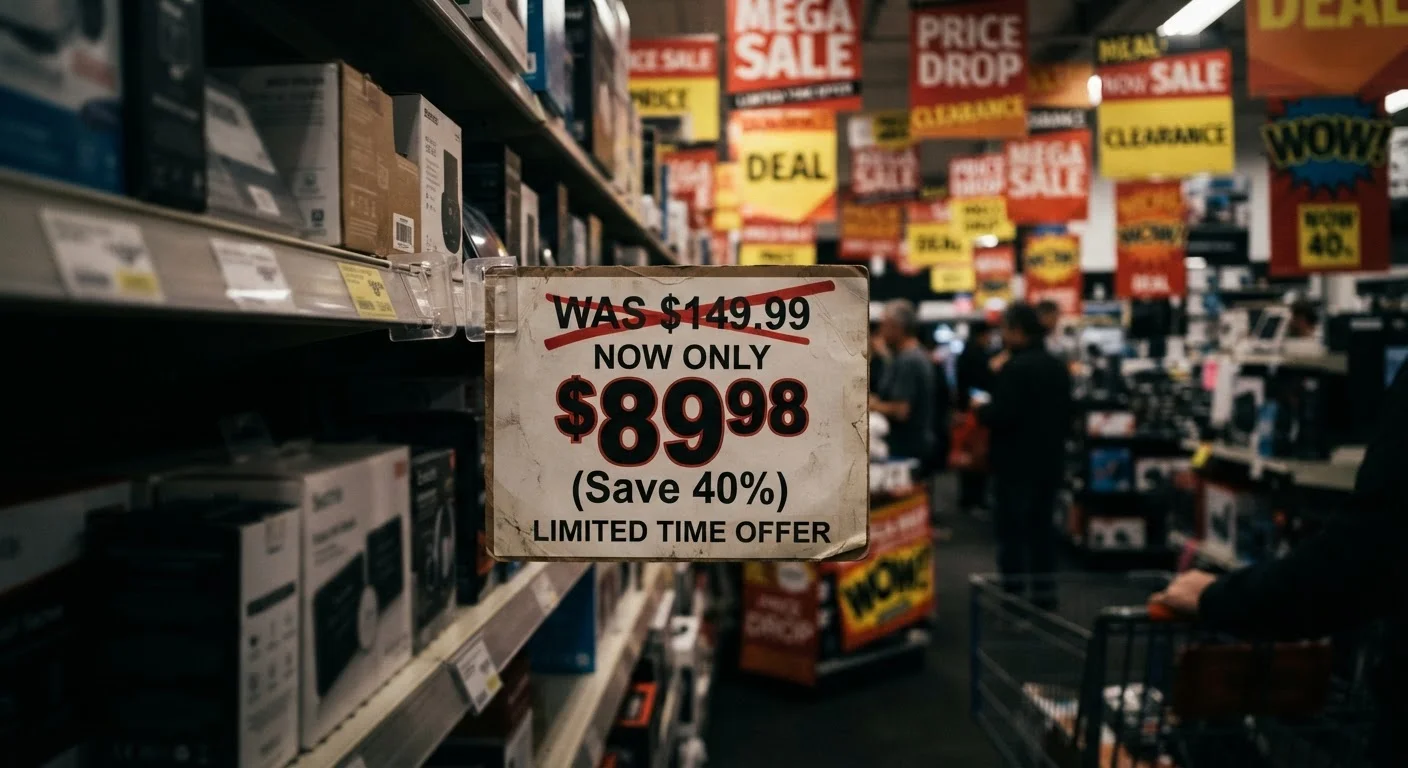
A strikethrough price - the number crossed out next to the sale price - is only meaningful if the item was genuinely offered and sold at that higher price for a reasonable period. In practice, many strikethrough prices function as aspirational fiction: a number set high enough to make the discount look impressive, regardless of what customers actually paid historically.
This practice has drawn scrutiny from regulators. The Federal Trade Commission's pricing guidelines specify that a 'former price' used in advertising should reflect the price at which the item was actually offered for a substantial period. But 'substantial' is vague, enforcement is selective, and online retail has created new opportunities for rapid, automated price manipulation that's difficult to track.
Investigations by consumer journalists have found that major retailers - including some of the largest e-commerce platforms - have listed items at inflated prices for a few days, then run extended 'sales' using those brief high prices as the crossed-out reference. The shopper sees a 40% markdown; the price history tells a different story.
For a broader look at how these tactics connect to genuinely deceptive storefronts, the red flags of fraudulent online stores article covers the full range of warning signs beyond just pricing.
A large online retailer lists a blender at $129.99 with a strikethrough price of $249.99. A price-tracking extension shows the item has sold for $129.99 for the past eight months, with a single 48-hour spike to $249.99 in the weeks before a major sale event.
A clothing retailer consistently shows items with 'original' prices 60-70% higher than the sale price, but the sale price has been the listed price every day for the past year.
An electronics store arranges three TV models side by side - a budget model at $399, a mid-range at $649, and a premium at $1,499. Most customers gravitate toward the $649 model.
A flash sale page shows a kitchen appliance at '50% off - 2 hours remaining,' but the same appliance is available at the same price on a competitor's site with no countdown and no promotional framing.
Manufactured Urgency: The Companion Tactic
Phantom discounts rarely travel alone. They are typically paired with urgency signals - countdown timers, 'only 3 left' notices, or 'today only' labels - specifically to prevent you from pausing to verify the deal. The psychological combination is potent: an apparent bargain, plus a ticking clock, produces purchasing decisions that outpace rational evaluation.
Flash sales and countdown timers are explored in depth in their own article, but the core point is worth stating plainly here: artificial scarcity and artificial discounts are complementary tools in the same psychological toolkit. Each one is more effective when the other is present.
Recognizing the pairing is itself useful. When a 'limited time' alert accompanies a large strikethrough discount, treat it as a reason to slow down, not speed up. A deal that can withstand a 10-minute price check is more likely to be real than one that requires your immediate commitment.
How to Verify Whether a Discount Is Real
The most direct counter to manufactured discounts is price history data. Browser extensions and dedicated price-tracking websites log the sale and list prices of online products over time, making it straightforward to see whether the 'original' price in a strikethrough ever reflected actual market conditions - or was set artificially high.
Beyond price history, these practices are worth building into any evaluation:
- Cross-reference at least two competing retailers before treating a reference price as meaningful. If the item sells for $89 everywhere, a crossed-out $140 tells you nothing useful.
- Search for the model number directly rather than the product name. Retailers sometimes create store-exclusive model numbers that make direct price comparison harder.
- Check whether the 'original' price appears anywhere in third-party listings. If no other source has ever listed it at that price, that's informative.
- Separate the price from the presentation. A deal styled with red fonts, large percentage badges, and countdown timers is not inherently better than a quietly listed price - it's just more aggressively packaged.
For a grounding perspective on when prices genuinely do drop, seasonal discounting patterns explains the real markdown cycles that follow inventory and retail calendars - patterns you can use to time purchases without relying on a retailer's framing.
Understanding sticker-price games also pairs well with learning how to evaluate true cost. The price-per-unit and total cost metrics that reveal a product's real value over time are a natural complement to spotting inflated reference prices.
Use Price History Before Any Major Purchase
Before buying anything with a prominent strikethrough or 'limited time' badge, spend two minutes checking its price history using a free browser extension or price-tracking website. If the 'original' price appears only briefly or not at all in the history, you can treat it as a manufactured anchor rather than a real reference. This single habit eliminates most phantom discount scenarios.