

Key Takeaways
Why Fraudulent Stores Are Getting Harder to Spot
Counterfeit online storefronts have grown dramatically more convincing. Where early scam sites looked obviously rough, today's fraudulent stores can mirror professional design, complete with product photography, customer review sections, and polished branding. The Federal Trade Commission consistently lists online shopping fraud among the top consumer complaint categories, and losses run into the hundreds of millions of dollars annually.
The core lure remains the same: a price that feels like a once-in-a-lifetime find. But deeply discounted prices are just the entry point. Fraudulent stores layer multiple deceptive signals, and learning to read them together is far more protective than reacting to any single red flag. For contrast, see what a legitimate retailer looks like before diving into the warning signs below.
Fraud Can Happen on Legitimate Platforms Too
Marketplaces that host third-party sellers can include fraudulent individual listings even when the platform itself is trustworthy. Always check the specific seller's ratings, history, and return policy - not just the platform's overall reputation. A familiar platform name does not guarantee every seller on it is legitimate.
Red Flags That Signal a Store Is Not Legitimate
Prices that defy market reality
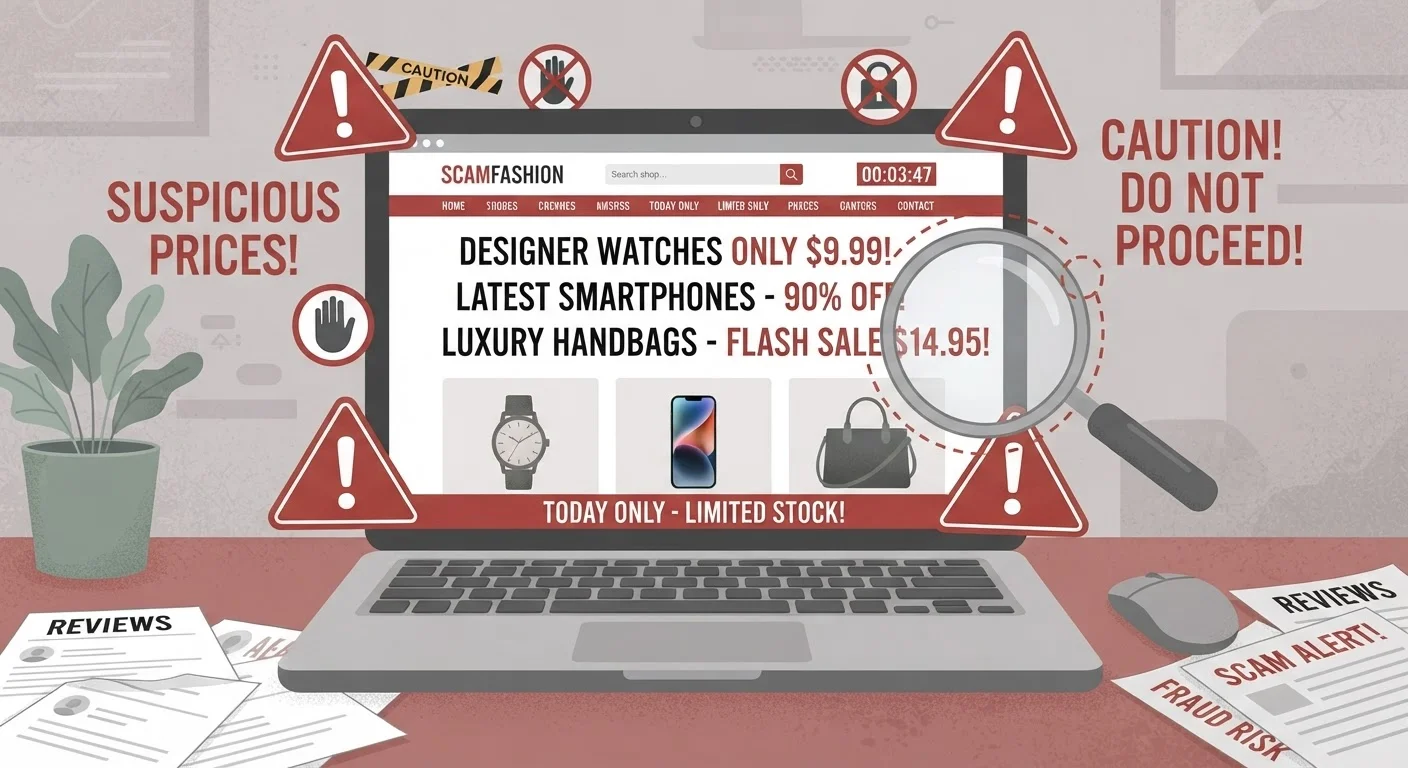
A luxury item at 85% off, or a consumer electronic at a fraction of its standard retail price, should trigger immediate skepticism. Legitimate retailers operate on margins; pricing that makes no business sense usually means the product doesn't exist, is counterfeit, or will never be shipped. Before assuming a deal is real, check what genuine discounts actually look like - real markdowns have a ceiling.
A price that makes no business sense usually means the product doesn't exist or will never arrive.
No verifiable contact information
A trustworthy retailer provides a physical address, a working phone number, and a monitored email address. Fraudulent stores often list a vague city name, a free webmail address, or nothing at all. Try calling any listed number before purchasing - disconnected lines, generic voicemail recordings, or no answer during stated business hours are meaningful signals. A business that cannot be reached before the sale almost certainly cannot be reached after it.
A business that cannot be reached before the sale almost certainly cannot be reached after it.
Vague, missing, or plagiarized policies
Legitimate stores publish clear return, refund, and shipping policies. Fraudulent sites often either skip these entirely or copy boilerplate text from other sites - sometimes so carelessly that a competitor's name appears in the fine print. Read the returns page carefully. If the policy is difficult to find, full of contradictions, or places all the burden on the buyer with no recourse, treat it as a serious warning sign.
Plagiarized or contradictory return policies are a clear sign something is wrong with a store.
Lookalike or suspicious domain names
Fraudsters register domains that closely mimic known brands - swapping a letter, adding a word like "official" or "outlet," or using a different top-level domain (e.g., .net instead of .com). These tactics exploit the speed at which people scan URLs. A domain registered only weeks before a major sale event, or one that substitutes a zero for the letter "O," is a classic impersonation technique. Counterfeit storefronts can mimic real retailers with alarming accuracy - slow down and read the full URL carefully.
A domain registered weeks before a major sale, with subtle letter swaps, is a classic impersonation technique.
Pressure to use untraceable payment methods
Fraudulent stores frequently push wire transfers, cryptocurrency, prepaid gift cards, or payment apps that offer no buyer protection. These payment types are preferred precisely because chargebacks and fraud disputes are nearly impossible. Any store that discourages or surcharges standard credit card payments - which carry federally backed dispute rights in the U.S. - is removing your primary safety net. Stick to payment methods that let you dispute unauthorized charges.
Any store discouraging credit card payment is removing your primary fraud safety net.
Poor grammar, inconsistent branding, and copied content
While not every typo signals a scam, patterns of grammatical errors, mismatched fonts, low-resolution logos, and product descriptions clearly copied from other retailers are reliable fraud indicators. Scam stores are often built quickly using scraped content, and the inconsistencies show. Run a reverse image search on product photos - images lifted from legitimate retail sites appearing on an unfamiliar store is a strong red flag. Also check whether the "About Us" page tells a coherent, specific story, or reads like generic filler text.
Images lifted from legitimate retail sites appearing on an unfamiliar store is a strong fraud signal.
No independent review presence
Authentic retailers accumulate reviews on third-party platforms over time. If a store has no presence on independent review aggregators, no social media history beyond a few weeks, and only glowing five-star testimonials displayed on its own pages, be cautious. Self-published reviews with no dates, no reviewer profiles, and uniformly positive language are easily fabricated. Search for the store name on consumer complaint databases and check whether any Better Business Bureau record exists.
Uniformly five-star, dateless reviews with no third-party presence are easily fabricated and meaningless.
Use a Dedicated Card for Online Purchases
Consider using a single credit card exclusively for online shopping. This limits your exposure if a card number is compromised, makes fraudulent charges easier to spot on your statement, and keeps your primary account insulated. Credit cards also provide stronger dispute protections than debit cards under U.S. consumer law.
What to Do Before You Complete Any Purchase
Spotting individual red flags is useful, but the most protective habit is running a quick pre-purchase check on any unfamiliar store. Search the store's name alongside words like "reviews," "complaints," or "scam" before entering payment details. Check domain registration details using a WHOIS lookup tool - very recently registered domains on stores claiming years of history are a serious warning sign. Decoding the URL bar itself takes less than thirty seconds and can reveal lookalike domains designed to impersonate known retailers.
If you do fall victim to a fraudulent charge, disputing the charge with your card issuer is the fastest route to recovery. Credit cards generally offer stronger fraud protections than debit cards for this reason. And if the "deal" that drew you in felt almost irresistible, understanding how phantom discounts are manufactured can help you stay skeptical the next time a price seems extraordinary.