

Key Takeaways
Urgency Tactics in Online Retail
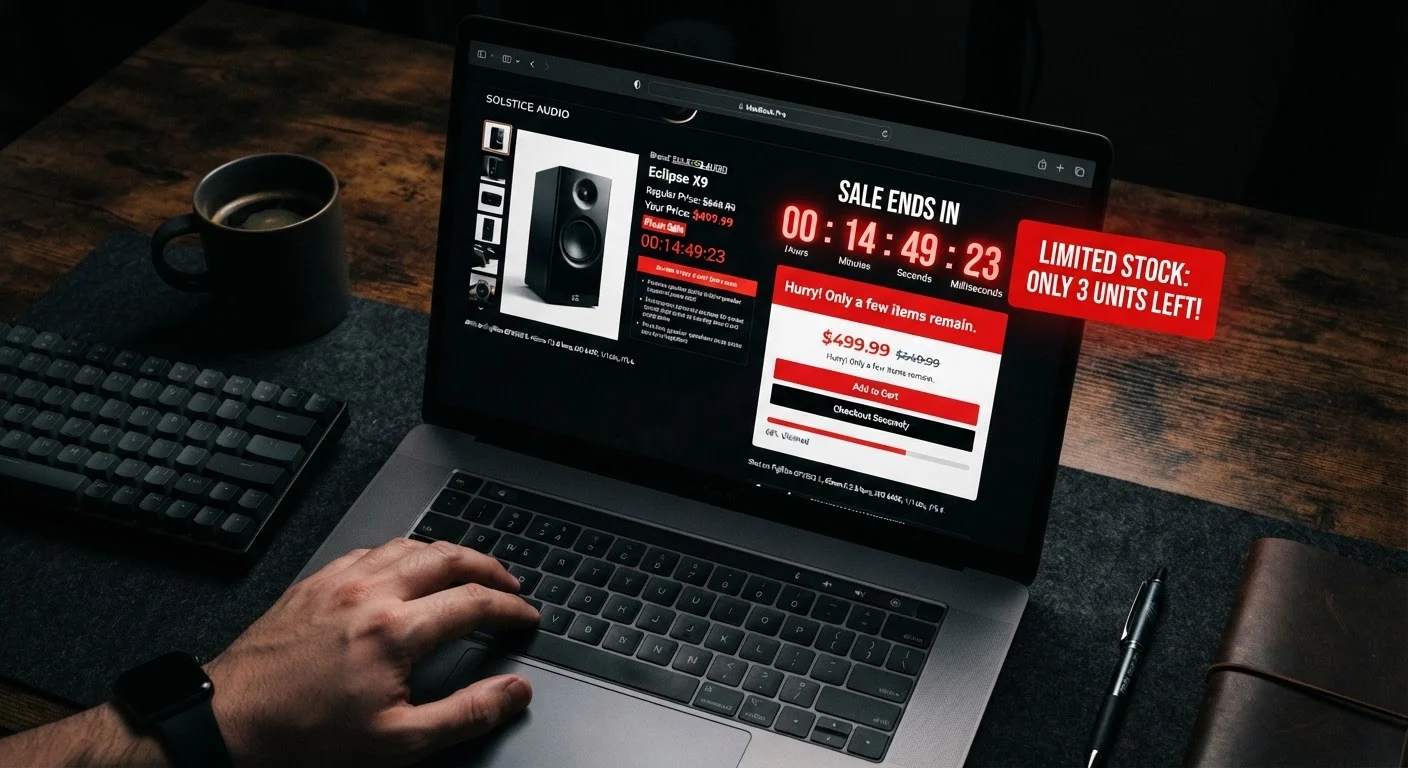
Urgency tactics are design and messaging techniques retailers use to make shoppers feel they must act immediately or risk missing out. Common examples include countdown timers, 'only X left in stock' alerts, and flash sale labels. They are intended to shorten the time a consumer spends evaluating a purchase.
In behavioral economics, these techniques exploit 'loss aversion' - the well-documented tendency for people to fear losing an opportunity more than they value gaining an equivalent one.
Why Urgency Is Built Into the Shopping Experience
When you land on a product page and see a red countdown clock ticking toward zero, your brain does something predictable: it shifts from evaluation mode to action mode. That shift is not accidental. Urgency cues are deliberately engineered features of e-commerce platforms, not incidental design choices.
The psychological mechanism at work is loss aversion - a concept well-established in behavioral economics. Research consistently shows that people are more motivated by the prospect of losing something than by the prospect of gaining something of equivalent value. A countdown timer doesn't add value to a product; it adds the fear of losing access to it.
Understanding this mechanism is the first step to shopping around it. Once you recognize that a timer is designed to trigger a feeling rather than convey accurate information, you can treat it as data about the retailer's marketing strategy rather than data about the deal itself. See how retailers manufacture deals through psychological pricing for the broader context of these tactics.
FTC Guidelines on Deceptive Pricing
The Federal Trade Commission maintains guidance stating that promotional claims must be truthful and not misleading to consumers. This includes urgency claims such as timers and scarcity notices. While enforcement actions are not routine for every instance, persistent deceptive urgency practices can fall within the scope of these standards. Consumers can report deceptive practices at ftc.gov/complaint.
How Countdown Timers Actually Work
Not all timers are the same. Some are tied to server-side logic and reflect a genuine promotion window. Many others are client-side elements - meaning they run in your browser and reset automatically when they reach zero, or when you reload the page.
A reliable test: note the time remaining on a product page's timer, then close the tab and reopen it five minutes later. If the timer has reset to the same starting value, it is almost certainly decorative. Similarly, if a 'flash sale' appears every time you visit a site over several weeks, the sale price is effectively the standard price with a different label.
60%
Consumers who report urgency cues influence purchases
Research published in the Journal of Retailing has found that scarcity and time-pressure messages meaningfully increase purchase likelihood, even when shoppers recognize them as marketing tactics.
3-5x
Frequency multiplier for 'flash sales' on major retail platforms
Consumer advocacy analyses have documented that many items flagged as flash sale merchandise on large e-commerce platforms are promoted at the same or similar prices multiple times per month.
Genuine time-limited offers tend to have specific, verifiable parameters - a start and end date tied to a known event, for example. Vague urgency ('Sale ends soon!') without a specific timestamp is a signal worth noting.
Decoding Low Stock Alerts
'Only 2 left!' is one of the most effective urgency phrases in online retail. It implies not just time pressure but competitive pressure - other shoppers are circling the same product. The reality behind these alerts is more complicated.
On large marketplaces, a low-stock notice may reflect only one seller's inventory while dozens of other sellers carry the same item. In other cases, threshold-based logic triggers the alert automatically once inventory dips below a preset number - a number the retailer sets, not one tied to any objective measure of scarcity.
The practical filter: search for the same product across other platforms. If the item appears readily available elsewhere, the scarcity message on one site is not reflecting a genuine supply shortage. If you consistently find the item sold out across multiple independent retailers, that is a more credible signal of real scarcity.
Be aware that deal-hunting habits driven by artificial urgency can lead to purchases you wouldn't otherwise make - sometimes at prices no better than standard.
Verifying Whether a Flash Sale Price Is Real
The most direct way to evaluate a flash sale is to compare the advertised price against the item's price history. Several browser extensions and dedicated tools maintain rolling price histories for products on major retail platforms, showing you what an item actually sold for over the past 30, 60, or 90 days.
If the 'sale' price sits at or near the historical average, the discount is cosmetic. If the price is genuinely lower than the item's typical range, the promotion may reflect real value - though it still warrants checking whether the discount stems from a permanently lowered price rather than a temporary markdown.
For context on when actual price drops tend to occur, seasonal discounting patterns can help you understand retail markdown cycles. First-time online shoppers can also benefit from a foundational guide to evaluating deals online.
One caution: an unusually steep discount - far below market rate - can also indicate a fraudulent listing rather than a genuine bargain. If prices seem implausibly low, learn the red flags of fraudulent online stores before proceeding.
The 24-Hour Pause Habit
When a countdown timer or low-stock alert creates a sense of pressure, try adding the item to your cart but waiting 24 hours before completing the purchase. If the 'deal' is still available - which it often is - you've confirmed the urgency was manufactured. If it genuinely sells out, you have useful information about real demand.