

Key Takeaways
Option A
Coupon Codes
The manual, shopper-activated discount method.
Best for: Shoppers who research deals in advance and are willing to hunt for working codes before checkout.
Option B
Automatic Discounts
The hands-free, retailer-applied price reduction.
Best for: Shoppers who want guaranteed savings without extra steps or code-hunting friction.
If you want savings with zero effort at checkout
Automatic Discounts
Automatic discounts require no code entry and are less likely to fail at checkout. You get the posted saving without hunting for working codes.
If you're willing to spend time researching for potentially deeper cuts
Coupon Codes
Active coupon hunting can surface discounts that aren't publicly advertised, particularly for first-time customer or email sign-up offers.
If you want to combine multiple discount types
Automatic Discounts
Many automatic discounts layer more predictably with cashback programs than coupon codes do, though retailer policies vary - always verify before assuming stacking is allowed.
If you're buying from a new or unfamiliar retailer
Coupon Codes
New-customer coupon codes are a common retailer acquisition tool and can offer one-time savings larger than any automatic site-wide promotion.
How Each Discount Type Works
At checkout, a discount either arrives automatically or waits for you to activate it. That structural difference shapes how reliable, stackable, and genuinely valuable each type turns out to be.
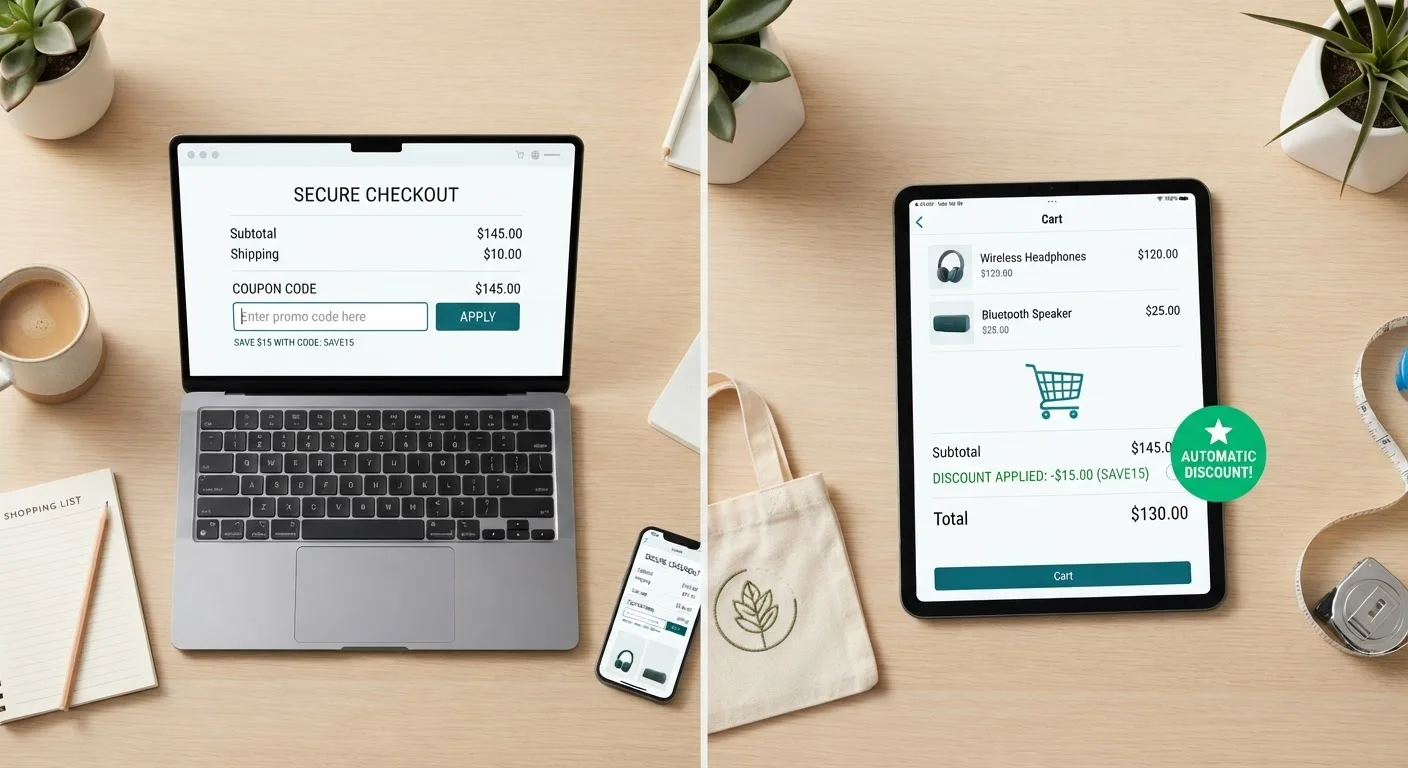
Coupon codes (also called promo codes or discount codes) are alphanumeric strings that shoppers enter at checkout. The retailer's system validates the code against a set of rules - eligibility criteria, expiration dates, minimum spend thresholds, and excluded categories - then applies the discount if all conditions are met. Codes can be distributed via email, third-party coupon aggregator sites, social media, or loyalty programs. They can also be revoked or quietly expired at any time.
Automatic discounts are applied by the retailer's platform without any input from the shopper. When you add qualifying items to your cart, the price reduction appears before you reach checkout. Common formats include sale pricing, buy-one-get-one offers, tiered volume discounts, and member-only pricing triggered by being logged into an account. The retailer controls when these turn on and off, and shoppers generally have no way to independently verify what the pre-discount price was before the promotion began.
| Criterion | Coupon Codes | Automatic Discounts |
|---|---|---|
| Activation | Manual entry at checkout | Applied automatically by retailer |
| Expiration risk | High - codes expire without notice | Lower - sale period is usually posted |
| Transparency | Terms often buried in fine print | Discount is visible in cart before checkout |
| Baseline price reliability | Depends on where code originated | Reference price may be inflated |
| Stackability | Frequently restricted by retailer | Often cannot be combined with codes |
| Effort required | Requires active search and entry | No shopper action needed |
| Potential depth of saving | Can be larger for targeted offers | Typically uniform across eligible items |
Understanding this mechanical difference matters because it affects what you can verify, what can go wrong, and what assumptions are safe to make about the savings you're seeing.
The Hidden Risks of Each Approach
Both formats carry risks that aren't always obvious at the moment of purchase.
With coupon codes, the most common pitfalls are codes that appear valid on aggregator sites but have already expired, codes that don't apply to the specific items in your cart, and restrictions buried in fine print - such as exclusions on already-reduced merchandise. There's also a subtler risk: spending time hunting for a working code can create a sense of commitment that leads to purchases you might otherwise skip. Deal-hunting habits that undermine real savings explores this pattern in more depth.
With automatic discounts, the main risk is assuming the baseline price is accurate. Retailers can inflate a reference price before marking it down, making a discount look more substantial than it actually is. A product shown as "40% off" is only a genuine saving if the original price reflects what the item actually sold for at a consistent prior rate. For a framework on evaluating whether a discount reflects a real price reduction, see The Anatomy of a Legitimate Sale.
Reference Prices Aren't Always What They Seem
Both coupon codes and automatic discounts are calculated against a stated original price. In the U.S., the FTC has guidelines on how retailers should represent reference prices in advertising, but enforcement is complaint-driven and inconsistent. The safest approach is to check the item's price history using a price-tracking tool before deciding whether the "original" price is credible. A discount off an inflated baseline is not a genuine saving.
Neither discount type is inherently more trustworthy. The format of a discount tells you very little about whether the underlying price is competitive. Always compare the final checkout price against current prices at other retailers before concluding you've found genuine savings.
Stacking, Combining, and What Retailers Actually Allow
Many shoppers assume that applying a coupon code on top of an existing automatic discount will compound their savings. In practice, most retailers explicitly prohibit this combination - and their checkout systems are built to enforce it.
The most common policy is that coupon codes cannot be applied to items already subject to an automatic markdown. Some platforms apply the higher of the two discounts and drop the other. Others simply reject the code entry with a vague error message. Either outcome means the shopper doesn't get both discounts simultaneously.
~60%
Shoppers who abandon cart searching for coupon codes
Research from Baymard Institute has found that a significant share of online shoppers leave checkout to search for discount codes, sometimes never returning to complete the purchase.
1 in 3
Coupon codes from aggregator sites that fail at checkout
Consumer advocacy reviews of third-party coupon aggregator sites have consistently found high rates of expired or invalid codes listed as active.
There are exceptions. Some retailers design promotions specifically to layer - for example, a site-wide automatic discount combined with a free-shipping code. However, this is a deliberate retailer choice, not a default behavior shoppers can count on.
Cashback programs and rewards points are a separate category and sometimes do stack with both coupon codes and automatic discounts, depending on the retailer's terms. For a closer look at how these combinations work and which ones tend to be disallowed, Stacking Savings Without Getting Burned covers the mechanics in detail.
The practical takeaway: never assume stacking is allowed. Read the promotion terms before checkout, and if the retailer's site doesn't clearly state the stacking policy, treat the discounts as mutually exclusive.