

Key Takeaways
Start here
Why Online Deal Evaluation Is a Skill
Next
Common Pricing Tactics That Mislead Shoppers
Then
How to Check Whether a Price Is Actually Lower
Watch out for
Red Flags to Watch Before You Buy
Apply it
Building a Simple Deal-Checking Habit
Why Online Deal Evaluation Is a Skill
Spotting a genuine bargain online is not intuitive - it is a learned skill, and retailers know it. The online shopping environment is designed to trigger fast decisions: bold red discount badges, shrinking stock counters, and "limited-time" banners are all engineered to compress the time you spend thinking critically.
First-time shoppers are at a particular disadvantage because they haven't yet built mental models for what a normal price looks like, which retailers are reputable, or how discount language is routinely manipulated. This guide gives you the foundation to evaluate any deal on its actual merits - not on how it is presented.
Reference price
The higher "original" or "was" price displayed next to a sale price. It may be inflated or rarely charged, making the discount look larger than it really is.
Anchor pricing
Placing a high-priced item alongside a mid-priced one so that the mid-priced item feels like a deal by comparison, regardless of its actual market value.
Total landed cost
The full amount you pay to receive an item, including the item price, shipping, taxes, and any mandatory fees - the only figure that matters for comparing deals.
Price history
A record of what a product has sold for over a period of time, used to determine whether a current "sale" price is actually lower than usual.
Urgency cue
A countdown timer, low-stock alert, or similar signal designed to make shoppers act quickly rather than research carefully. These cues often do not reflect real scarcity.
Common Pricing Tactics That Mislead Shoppers
Understanding the mechanics of misleading pricing is the fastest way to defuse it.
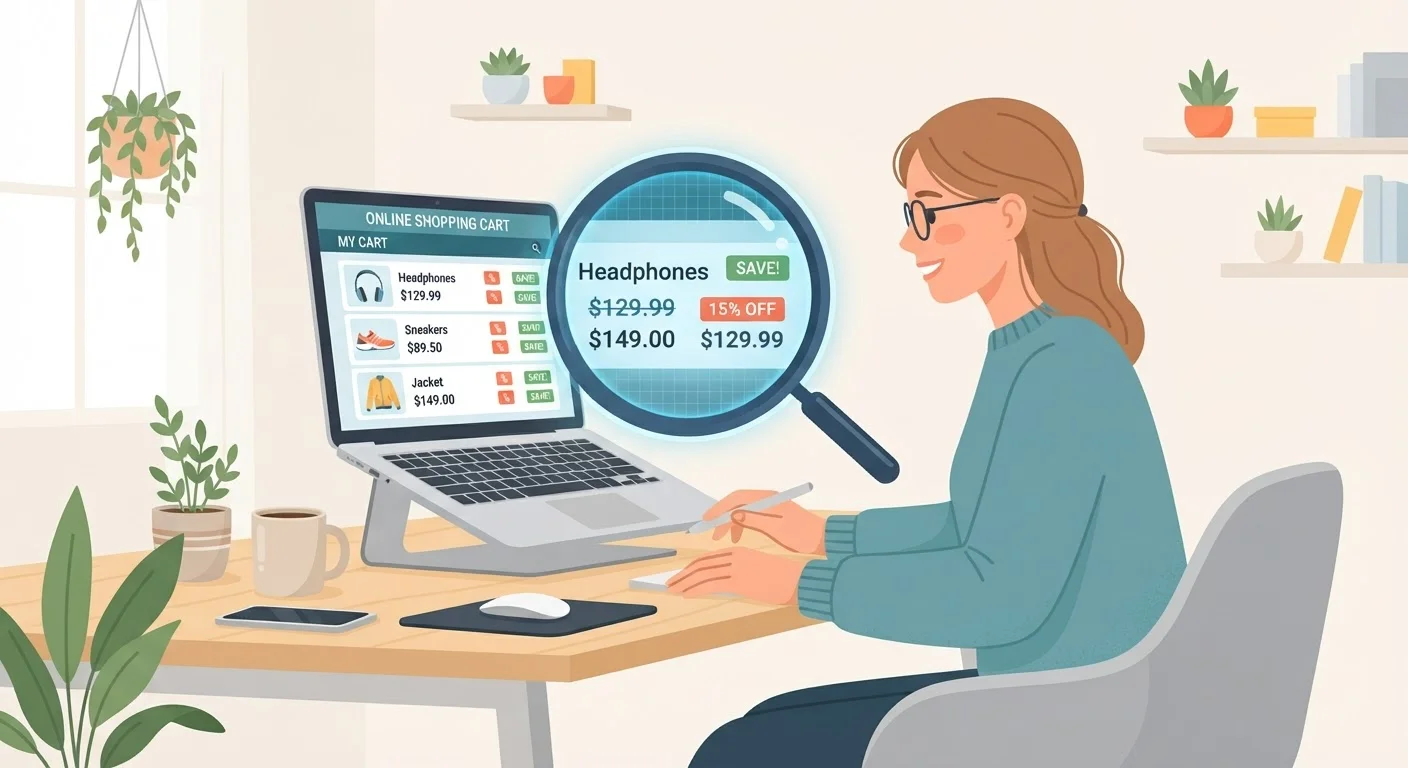
- Inflated reference prices: Showing a crossed-out "original" price that was rarely, if ever, charged makes the current price appear to be a bargain regardless of its actual market value.
- Anchor pricing: Placing an expensive item next to a mid-range one makes the mid-range option feel like a deal by comparison, even if it is fairly priced or overpriced on its own.
- Urgency cues: Countdown timers and "only 3 left" alerts are often automated or reset continuously. Our article on flash sales and countdown timers explains the psychology behind these tools.
- Hidden cost shifting: A low item price offset by high shipping, handling fees, or required add-ons means the headline number is not what you actually pay.
Pause Before You Act on Any Countdown
When you see a timer or low-stock warning, treat it as a prompt to open a new tab and verify the price elsewhere - not as a reason to rush. Most legitimate price drops are not exclusive to one window of time. If the item sells out, the same or comparable product is almost always available elsewhere.
How to Check Whether a Price Is Actually Lower
Verification takes minutes and consistently pays off. Here is a practical sequence:
- Check price history: Browser extensions that track historical pricing on major retail platforms let you see whether the current price is genuinely lower than it has been over the past 30, 60, or 90 days - or whether a "sale" simply reflects the everyday price.
- Compare across retailers: Search the exact product name or model number across at least two or three retailers. Price variation for identical items can be significant. The comparing products hub has guidance on how to do this efficiently.
- Calculate total landed cost: Add shipping, taxes, and any mandatory fees before comparing. Free shipping thresholds that push you toward a larger cart can eliminate savings quickly.
- Check the return policy: A low price with a strict no-returns policy carries hidden risk. Factor in what you would lose if the item does not meet expectations.
For a structured checklist covering all of these steps, see our savings verification checklist.
Red Flags to Watch Before You Buy
Some warning signs indicate not just a poor deal but a potentially fraudulent one. Be cautious when you encounter:
- Prices dramatically below every other retailer - often by 50-70% - with no clear reason
- No verifiable physical address, customer service contact, or clear return policy
- Pressure to complete a purchase through an unsecured payment method (wire transfer, gift cards)
- Newly registered websites with generic branding and no traceable business history
Extreme discounts are a classic lure used by fraudulent stores. Our guide on recognizing fraudulent online stores covers the full spectrum of red flags. For broader safety practices, the online shopping safety guide is worth reading before your first major purchase.
Extremely Low Prices Are Sometimes Bait
A price that seems impossible compared to every other retailer usually signals one of two things: the item is counterfeit, or the store is not legitimate. There is no reliable shortcut around this - if a deal looks too good to be true, verify the retailer's legitimacy independently before entering any payment information.
Building a Simple Deal-Checking Habit
The goal is not to become a professional bargain hunter - it is to make one or two verification steps automatic before any significant purchase. Readers who develop these habits report spending less time second-guessing purchases and experiencing fewer buyer's remorse moments.
A useful mental rule: if a deal requires you to act before you have had time to look it up, that pressure is a feature of the deal, not a property of the item. Genuine savings do not evaporate during a ten-minute price check.
It is also worth being aware of how certain patterns - like habitually clicking every sale notification or fixating on loyalty program points - can lead to buying things you would not otherwise want. Our article on deal-hunting habits that undermine real savings explores this in depth.
Once you are comfortable with these fundamentals, the complete deal-evaluation framework takes you through every layer of analysis - from price history to total cost of ownership - for situations where the stakes are higher.