

Key Takeaways
Percentage-Off Framing
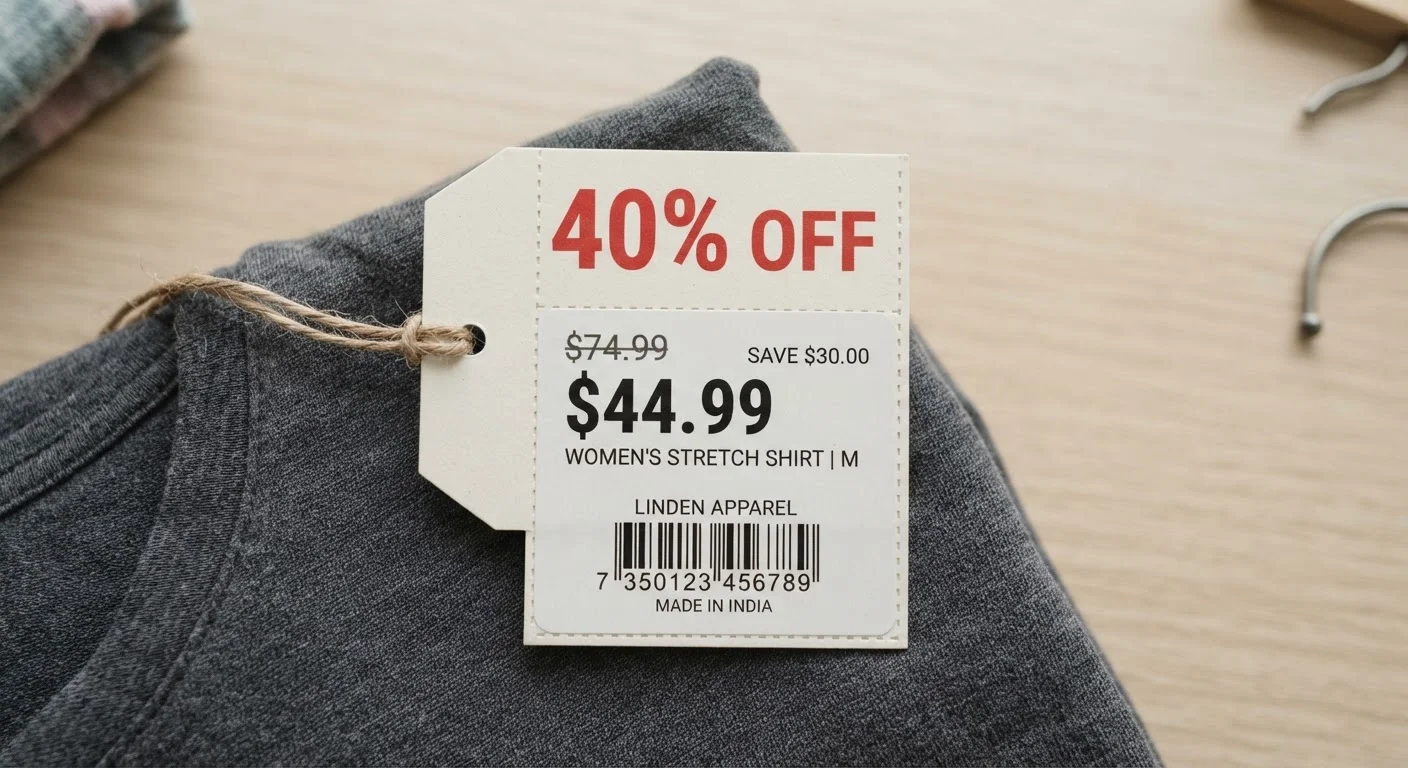
Percentage-off framing is a pricing presentation technique where a discount is expressed as a percentage rather than a flat dollar amount. Retailers use it because large percentages feel more impressive than the equivalent dollar figure, especially on inexpensive items. A "50% off" badge draws attention even when the actual savings amount to only a few cents.
Behavioral economists refer to this as the "ratio bias" - humans are naturally more responsive to relative numbers (ratios and percentages) than to equivalent absolute values, even when the absolute figure is more financially relevant.
The Math Behind the Mirage
Imagine two deals side by side. The first: save $15 on a $30 purchase. The second: save $1.50 on a $3.00 purchase. The discount rate is identical - 50% - but most people instinctively view the first deal as more meaningful. Now reverse the framing: a store advertises "50% off" a $3.00 item. The badge looks identical to the one on the $30 item, yet the savings are a dollar fifty.
This is the core problem with percentage-off framing on low-cost items. The percentage is mathematically accurate but psychologically misleading because it strips out the absolute dollar amount - the figure that actually affects your bank balance. Retailers know this, and they use it.
See how this connects to broader pricing tactics in our article on anchoring, strikethroughs, and phantom discounts.
40%
Discount that saves $2 on a $5 item
Illustrates how a headline-grabbing percentage can translate to a trivial absolute saving on low-cost goods.
~$0.75
Actual saving on a "75% off" $1 product
Demonstrates the gap between how a percentage sounds and how much money it actually puts back in your pocket.
2x
How much larger percentage savings feel vs. dollar savings
Research in behavioral economics consistently shows consumers rate percentage-framed discounts as more attractive than equivalent absolute-dollar discounts.
Why Our Brains Fall for It
Behavioral economists have studied ratio bias - our tendency to favor ratios and percentages over equivalent absolute figures - for decades. In practical terms, it means a "75% off" label triggers a stronger emotional response than "save $0.75," even when both describe the same transaction on a $1.00 item.
Retailers place large percentage badges prominently and in bold typefaces. The absolute price, if shown at all, appears in smaller text. This visual hierarchy reinforces the impression that the percentage is the number worth caring about - when for your budget, the opposite is true.
“People respond to proportions, not magnitudes. Show someone a 50% discount and they feel a gain - show them the same deal as fifty cents saved and the excitement largely disappears.”
— Richard Thaler, Nobel Prize-winning behavioral economist and co-author of 'Nudge'
Understanding this dynamic doesn't require a finance degree. It just requires a habit: before reacting to a percentage, ask how many dollars you are actually keeping in your pocket.
When Percentage Framing Does - and Doesn't - Matter
Percentage framing becomes genuinely useful as a comparison tool when you're evaluating items at similar price points - for example, two versions of the same product where one is discounted. It also carries more weight on high-ticket purchases, where even a modest percentage represents real money.
On low-cost items - think kitchen gadgets under $10, small accessories, or add-on products - the percentage almost never reflects a meaningful savings opportunity. A 40% discount on a $4.99 item saves you $2.00. That's a useful data point, but it shouldn't drive a purchase decision on its own, and it certainly shouldn't be the primary reason you buy something you didn't plan to.
For a framework on telling apart genuine savings from inflated baselines, see what real discounts actually look like.
Practical Ways to Reframe How You Evaluate Discounts
The simplest correction is also the most effective: convert every percentage to a dollar figure before making a decision. If the savings wouldn't motivate you without the percentage label - if seeing "save $1.40" wouldn't have caught your eye - then the percentage is doing emotional work that the actual savings don't justify.
A few habits that help:
- Check the absolute savings first. Mentally calculate or look for the dollar-off figure before registering the percentage.
- Ask whether you needed the item already. A discount on something you weren't planning to buy is not savings - it's spending. Our guide on deal-hunting habits that undermine real savings covers this pattern in depth.
- Compare the savings to something tangible. Is the dollar amount saved enough to matter in your weekly budget? If not, the deal's impact is minimal regardless of the percentage displayed.
For a comprehensive look at evaluating online deals end to end, see how to read an online deal without being misled.