

Key Takeaways
Minimal long-term data stored by the retailer
Without an account, there's no persistent profile for the retailer to retain, analyze, or sell. Your transaction data may still be logged, but it isn't tied to a returnable login that can be exploited later.
Lower breach exposure for your credentials
No username or password means there's nothing for attackers to steal in a credential-focused breach. You're not a target in any credential-stuffing campaign aimed at that retailer.
Faster for one-time purchases
Skipping registration removes friction when you have no intention of returning to the site. You fill in your details once and move on without creating another account to manage.
Limits marketing communications by default
Without an account, retailers have less basis to send ongoing promotional emails, and you haven't opted into a relationship that may require effort to exit.
No order history or easy returns portal
Tracking a shipment or initiating a return often requires hunting through your email for a confirmation number. Registered accounts make these tasks self-service and faster.
Payment and address details re-entered every time
Without saved preferences, every purchase requires filling in the same shipping and billing fields from scratch, which increases the chance of input errors and slows checkout.
Loyalty rewards and purchase-based perks unavailable
Many retailers tie discount programs, reward points, and member pricing to accounts. Guest shoppers typically can't access these, even if they shop frequently.
Our Verdict
Neither guest checkout nor account registration is the universally safer choice-each involves real trade-offs between convenience and data exposure. Guest checkout is the lower-footprint option for one-time or infrequent purchases, while a registered account makes sense at retailers you use regularly, provided you secure it properly. The retailer's own security posture ultimately matters as much as which option you pick.
Guest checkout suits privacy-conscious shoppers making one-off purchases; account creation suits frequent shoppers who use strong, unique passwords and want order-tracking features.
What You're Actually Deciding at Checkout
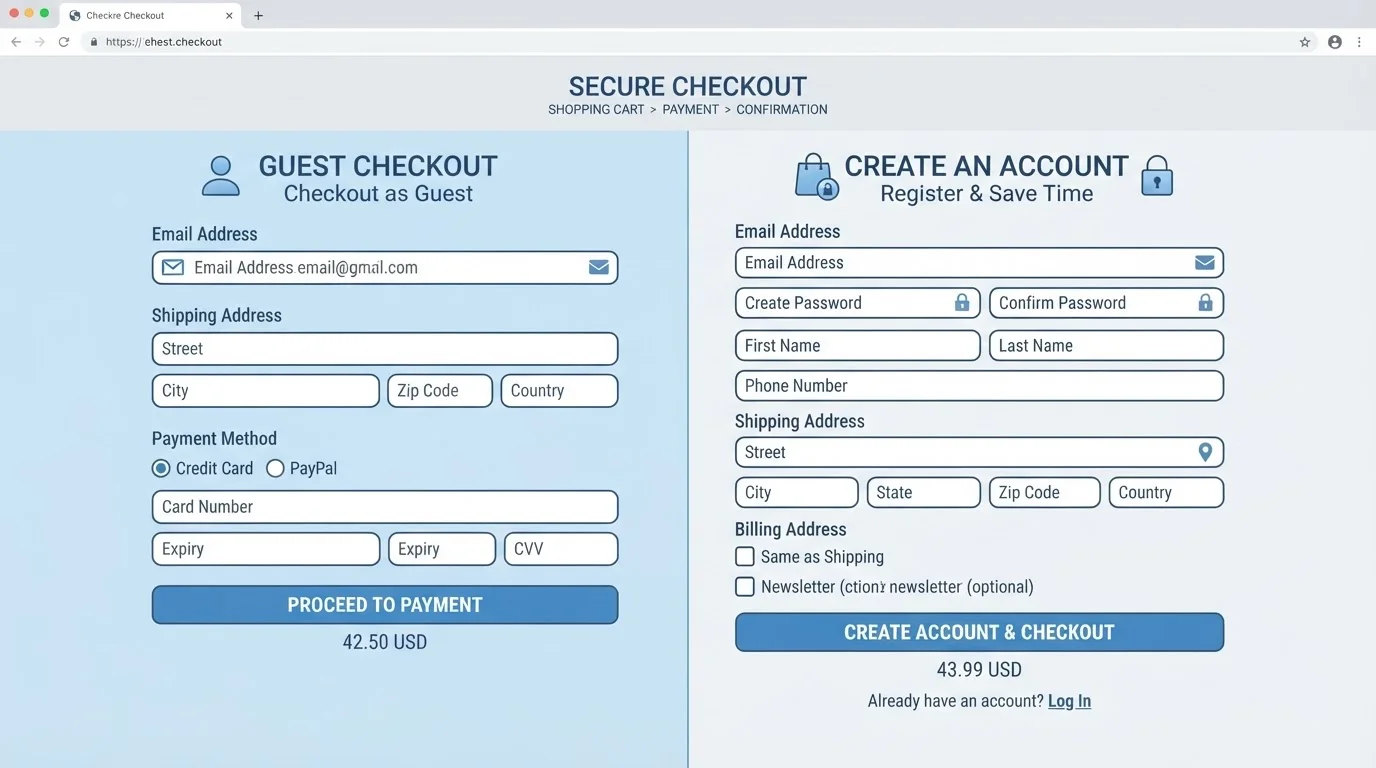
When an online retailer asks whether you'd like to check out as a guest or create an account, the choice feels minor. In practice, it shapes how much personal data is stored, for how long, and what happens to it if the retailer experiences a security breach or shares data with third parties.
Both paths collect the same core information for a given transaction-your name, shipping address, and payment details. The difference is in persistence. An account links that data to an ongoing profile the retailer can access, analyze, and sometimes share. Guest checkout typically results in a transaction record that isn't tied to a returnable login. Understanding how retailers collect and use your personal information is a good first step before making this decision.
Advantages and Disadvantages of Guest Checkout
Guest checkout is often framed as the privacy-forward option, and in meaningful ways it is-but it comes with its own friction.
Minimal long-term data stored by the retailer
Without an account, there's no persistent profile for the retailer to retain, analyze, or sell. Your transaction data may still be logged, but it isn't tied to a returnable login that can be exploited later.
Lower breach exposure for your credentials
No username or password means there's nothing for attackers to steal in a credential-focused breach. You're not a target in any credential-stuffing campaign aimed at that retailer.
Faster for one-time purchases
Skipping registration removes friction when you have no intention of returning to the site. You fill in your details once and move on without creating another account to manage.
Limits marketing communications by default
Without an account, retailers have less basis to send ongoing promotional emails, and you haven't opted into a relationship that may require effort to exit.
On the downside, the convenience gap is real.
No order history or easy returns portal
Tracking a shipment or initiating a return often requires hunting through your email for a confirmation number. Registered accounts make these tasks self-service and faster.
Payment and address details re-entered every time
Without saved preferences, every purchase requires filling in the same shipping and billing fields from scratch, which increases the chance of input errors and slows checkout.
Loyalty rewards and purchase-based perks unavailable
Many retailers tie discount programs, reward points, and member pricing to accounts. Guest shoppers typically can't access these, even if they shop frequently.
Advantages and Disadvantages of Creating an Account
Registered accounts are the default experience most major retailers push consumers toward, and there are legitimate reasons beyond their own data interests.
81%
Data breaches involving stolen credentials
According to Verizon's Data Breach Investigations Report, the majority of hacking-related breaches leverage stolen or weak passwords, underscoring the risk of reused account credentials.
15B+
Stolen credentials available on dark web
Cybersecurity firm Digital Shadows (now Photon Research) estimated over 15 billion stolen credentials were in circulation on criminal marketplaces, making account security a concrete rather than theoretical concern.
Account holders get features that genuinely simplify repeat shopping: saved addresses, stored payment methods (usually tokenized, not raw card numbers), order history, and easier returns. For a retailer you visit more than once or twice a year, those benefits are tangible.
The trade-off is exposure. A stored account is a target. If the retailer suffers a breach, your credentials and profile data are at risk. Credential-stuffing attacks-where leaked username-and-password pairs from one site are automatically tried on others-make reusing passwords particularly dangerous. Our guide on password habits that leave shopping accounts exposed covers exactly why this matters.
Multi-Factor Authentication Changes the Equation
If a retailer offers multi-factor authentication (MFA)-a second verification step sent to your phone or email when you log in-enabling it significantly reduces the risk that a stolen password leads to account takeover. When MFA is available, a registered account at that retailer becomes meaningfully more secure. Check account security settings after registration, not just at signup.
Making the Decision Based on Your Situation
A useful framework: match the option to your relationship with the retailer. For a site you've never used before, or one you're unlikely to return to, guest checkout limits your long-term data footprint without sacrificing anything meaningful. Before entering payment details on any unfamiliar site, running through a pre-purchase safety checklist is a sound habit.
For retailers you shop regularly, an account may make practical sense-especially if the site uses multi-factor authentication (MFA), which adds a second verification step beyond your password. If you create an account, use a password that is both strong and unique to that site. A password manager makes this manageable without requiring you to memorize dozens of credentials.
Also worth reviewing: the retailer's privacy policy. Specifically, look for whether they share or sell data to third-party marketing partners. That disclosure matters regardless of which checkout path you choose, since even guest transactions can feed data to analytics or ad networks embedded on the page. Understanding the broader landscape-such as security differences between marketplaces and dedicated retailers-can also inform where you're comfortable storing an account at all.
Finally, your payment method interacts with this choice. Whether you check out as a guest or as a registered user, using a credit card generally provides stronger fraud-dispute protections than a debit card. See our breakdown of debit card vs. credit card for online purchases for details on why that distinction matters at checkout.