

Key Takeaways
Start here
What Makes a Thermostat "Smart"
Next
How Smart Thermostats Talk to Your HVAC System
Go deeper
Learning Algorithms and Scheduling Logic
Then explore
Connectivity: Wi-Fi, Apps, and Smart Home Platforms
Before you buy
Installation Considerations and Compatibility
What Makes a Thermostat "Smart"
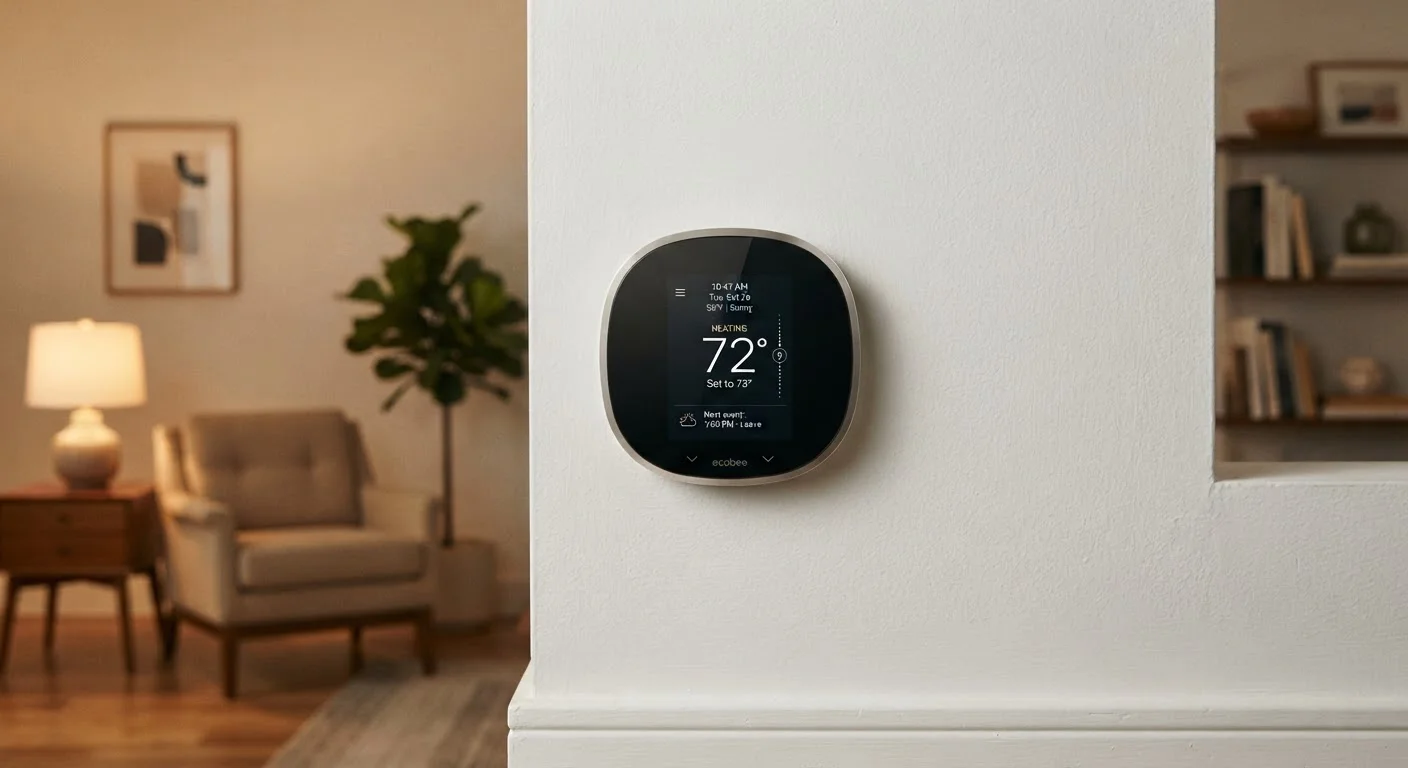
A conventional thermostat does one thing: compare the current room temperature to a set target and switch the heating or cooling on or off accordingly. A smart thermostat does the same fundamental job but adds three layers on top - onboard sensors, a programmable computer processor, and a network radio that connects it to the internet.
Those additions allow it to do things a mechanical or basic digital thermostat cannot: detect occupancy, receive weather forecasts, respond to your phone's location, accept commands from a voice assistant, and in some cases, learn your preferences without you explicitly programming them. For a broader look at how connected devices fit into a home ecosystem, see what truly makes a home smart.
C-wire
The "common" wire in thermostat wiring that provides a continuous 24-volt power supply. Many smart thermostats need it to run their Wi-Fi radio and display without interruption.
Geofencing
A virtual geographic boundary set around your home. When your phone crosses that boundary, it can trigger automatic actions - like switching your thermostat from away mode to home mode.
Low-voltage wiring
The thin wiring running between your thermostat and HVAC equipment, typically carrying 24 volts. It's far lower voltage than household outlets and is what smart thermostats use to signal heating and cooling equipment.
Matter
An open connectivity standard for smart home devices, designed so products from different manufacturers can work together on the same platform without proprietary bridges.
Occupancy sensor
A built-in sensor that detects motion or the presence of people in a room, allowing the thermostat to automatically switch to an energy-saving mode when the home is empty.
Single-stage vs. multi-stage system
A single-stage HVAC system runs at full capacity or not at all. A multi-stage system can operate at lower output levels for more gradual, efficient conditioning - and requires thermostat compatibility to use those stages.
How Smart Thermostats Talk to Your HVAC System
Despite all the software sophistication, a smart thermostat connects to your heating and cooling equipment using the same low-voltage wiring that has been standard for decades. Most residential HVAC systems run a bundle of thin wires - typically 18-gauge - from the air handler or furnace to the thermostat location. Each wire connects to a labeled terminal: R (power), G (fan), Y (cooling), W (heat), and C (common).
The thermostat closes or opens circuits on these terminals to send simple on/off signals to the equipment. When it calls for cooling, it completes the circuit between R and Y; the air handler responds. The smart thermostat does not change this electrical relationship - it just decides when to close those circuits using software logic instead of a bimetallic strip or manual schedule. For a plain-language explanation of the full HVAC system behind that wiring, your home's hidden infrastructure guide covers what each component actually does.
Before You Touch Any Wiring
Always turn off power to your HVAC system at the circuit breaker - not just the thermostat itself - before removing the old unit or connecting new wires. Photograph your existing wiring before disconnecting anything; most smartphone cameras capture enough detail to serve as a reliable reference during reinstallation.
Learning Algorithms and Scheduling Logic
The "learning" capability that some smart thermostats advertise works by observing when you manually adjust the temperature and recording the time, day, and occupancy state when those adjustments occur. After a week or two of observations, the device constructs a schedule that mirrors your apparent preferences - warming up the house before you typically wake, dialing back when you leave for work.
Not all smart thermostats learn automatically. Many rely on a schedule you set manually through an app, which is straightforward and arguably more predictable. Others use geofencing - a virtual perimeter around your home detected by your phone's GPS - to switch between "home" and "away" modes without any fixed schedule at all. Some combine all three approaches. Understanding which method a given device uses matters because the approaches suit different households differently; a household with irregular hours benefits more from geofencing than from a learned schedule.
It's worth noting that learning features are not magic, and expectations should be calibrated accordingly. For a grounded perspective on what these systems actually deliver, common smart home automation misconceptions provides useful context.
Connectivity: Wi-Fi, Apps, and Smart Home Platforms
The Wi-Fi radio inside a smart thermostat enables three categories of capability: remote control via a smartphone app, integration with voice assistants and smart home platforms, and cloud-based features like weather-responsive adjustments. The device connects to your home's 2.4 GHz or 5 GHz Wi-Fi network and communicates with a manufacturer's cloud server, which relays commands between the app and the device.
Smart home platform compatibility - whether a thermostat works with Amazon Alexa, Google Home, Apple HomeKit, or the Matter standard - determines how it fits into any broader automation you may have. Matter, an industry interoperability standard ratified in 2022, is gradually making cross-platform compatibility more reliable, though not all devices or platforms support it equally yet.
Cloud Dependency Is a Real Trade-Off
Many smart thermostat features - remote access, voice commands, weather integration - depend on the manufacturer's cloud servers remaining operational. If a company discontinues a product line or shuts down its servers, cloud-dependent features can stop working even though the hardware is still physically functional. The local scheduling function typically continues to operate independently of the cloud.
Installation Considerations and Compatibility
Before purchasing a smart thermostat, two checks matter most. First, confirm your HVAC system type: most central forced-air systems with a single-stage furnace and central air conditioning are broadly compatible. Heat pumps, multi-stage systems, and zone-controlled systems require careful model matching - not every smart thermostat handles them correctly. Second, check whether your existing wiring includes a C-wire (common wire). The C-wire provides continuous 24V power to run the thermostat's Wi-Fi radio and display. Without it, some devices will not function properly, though some models include adapters or use power-stealing workarounds that have variable reliability.
If you are comfortable reading a wiring diagram and the installation involves a standard single-stage system, many homeowners handle installation themselves. Always shut off power to the HVAC system at the breaker first. If your system is a heat pump, has unusual wiring, or involves multiple zones, having a licensed HVAC technician handle the installation removes the risk of miswiring - which can damage equipment. Before authorizing any HVAC work, knowing which questions to ask contractors helps you evaluate the scope and credentials involved. It's also worth clearing up any common HVAC misconceptions before making decisions about your system.