

Key Takeaways
Why HVAC Myths Are So Costly
Your heating and cooling system typically accounts for roughly half of a home's total energy use. That makes it the single largest variable in your monthly utility bills - and the place where misconceptions do the most financial damage. Many homeowners operate their HVAC systems based on plausible-sounding logic that turns out to be backwards when you understand how these systems actually work.
This article examines the most persistent HVAC myths, explains what's really happening inside your equipment, and gives you a clearer foundation for maintenance and repair decisions. For a broader look at home systems, see our plain-language guide to essential home systems.
Myth
Closing vents in unused rooms saves energy by redirecting airflow where it's needed.
Fact
Closing vents increases static pressure in the duct system, forcing the equipment to work harder and potentially causing duct leaks, coil freezing, or early equipment failure.
Forced-air systems are designed and balanced for a specific total airflow. When you close vents, that air doesn't disappear - it backs up against a pressurized duct system that wasn't built for the restriction. The result is increased strain on the blower motor, reduced efficiency, and in some cases accelerated wear on the heat exchanger. In leaky duct systems, the excess pressure simply pushes conditioned air into unconditioned spaces like attics and crawlspaces - the opposite of what you intended. Keep vents open and consider a professional air balance if certain rooms feel uncomfortable. For more on how airflow moves through your home, see our article on forced-air vs. radiant heating systems.
Myth
You only need to change your air filter once or twice a year.
Fact
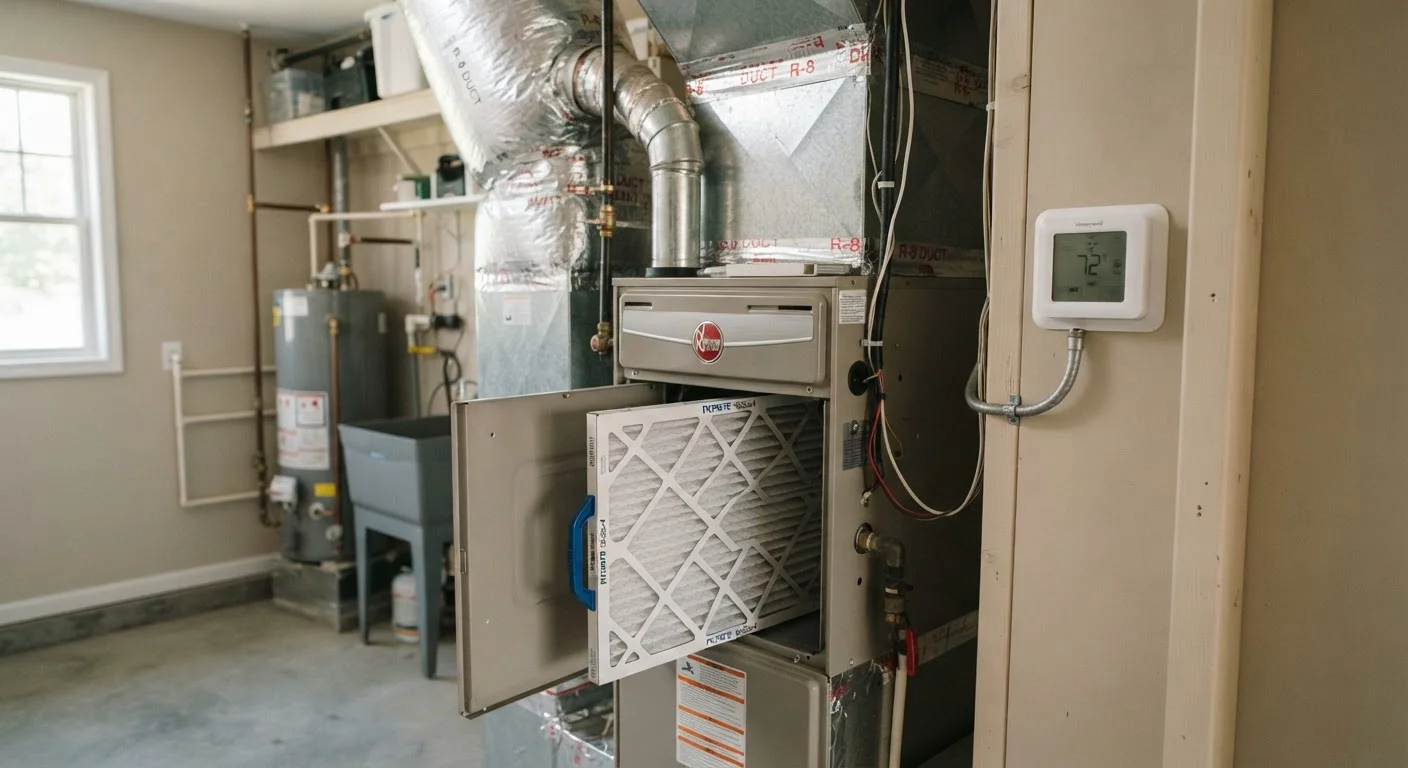
Most filters need replacement every one to three months depending on filter type, household conditions, and system runtime.
A clogged filter is one of the most common causes of HVAC inefficiency and preventable breakdowns. As the filter loads with particles, airflow drops - and restricted airflow leads to the same cascade of problems as closed vents: stressed blower motors, frozen evaporator coils in cooling season, and reduced heat transfer in heating season. Thicker media filters (4-5 inches) can last longer, but fiberglass panel filters and standard 1-inch pleated filters often need monthly checks in homes with pets or allergy sufferers. Write the installation date on the filter frame when you change it so you always know where you stand.
Myth
Setting the thermostat fan to 'ON' improves air circulation and indoor air quality.
Fact
Continuous fan operation circulates air but also pulls unconditioned air through duct leaks and keeps a wet evaporator coil blowing humid air into living spaces.
Running the fan continuously does move air more often, but most duct systems have some leakage. When the system isn't actively conditioning air, the fan can draw in humid or unconditioned air from attics, crawlspaces, or garages. In cooling season, the evaporator coil removes moisture when the compressor runs - but with the fan on 'ON,' that moisture can re-evaporate off the coil between cycles and return to the living space. The 'AUTO' setting allows the coil to drain properly between cycles and is more efficient for most homes. Whole-house ventilation needs are better addressed intentionally - see our guide on mechanical whole-house ventilation.
Myth
A larger HVAC unit will keep the home more comfortable and cool it faster.
Fact
Oversized equipment short-cycles - running in brief, frequent bursts that fail to adequately dehumidify the air and cause uncomfortable temperature swings.
Dehumidification happens during the sustained run time of a cooling cycle. An oversized unit hits the thermostat's temperature setpoint quickly, shuts off, then restarts soon after - never running long enough to pull meaningful moisture from the air. The result is a home that feels clammy even when the thermostat reads the right number. Proper equipment sizing requires a Manual J load calculation performed by a qualified HVAC professional, which accounts for square footage, insulation levels, window area, climate, and other variables. If you're planning changes to your home's layout that could affect load - like removing walls - consider how that interacts with your HVAC system, as explored in our piece on open-concept conversions.
Myth
Cranking the thermostat to a much higher or lower temperature makes the house reach that temperature faster.
Fact
HVAC systems deliver conditioned air at a fixed rate regardless of how far the setpoint is from the current temperature.
A furnace doesn't burn hotter because you set the thermostat to 85°F instead of 70°F. It simply runs at its designed output until it reaches the setpoint, then shuts off. Setting an extreme temperature means the system will overshoot your comfort target before you remember to adjust it, wasting energy in the process. If faster warm-up or cool-down is a consistent need, a programmable or smart thermostat that pre-conditions the home on a schedule is a far more effective solution than thermostat extremes.
What Good HVAC Habits Actually Look Like
Correcting these myths points toward a straightforward maintenance routine. Change filters on a consistent schedule - check your system's documentation and local conditions (pets, dusty environments, and allergies all shorten filter life). Keep all supply and return vents open and unobstructed. Set your fan to 'AUTO' unless you have a specific reason to run it continuously. Schedule a professional tune-up annually so a qualified technician can check refrigerant levels, clean coils, and inspect ductwork.
~50%
Share of home energy use from heating and cooling
The U.S. Department of Energy estimates that heating and cooling account for approximately half of the energy consumed in a typical American home.
25-30%
Energy lost through leaky ductwork
The U.S. Department of Energy notes that duct leakage can account for 25 to 30 percent of conditioned air loss in a typical forced-air system.
5-15%
Efficiency loss from a dirty filter
Industry guidance consistently identifies a clogged air filter as one of the leading causes of reduced HVAC efficiency and avoidable service calls.
If you're thinking about a thermostat upgrade, our companion piece on how smart thermostats work covers the technology without any sales pitch. And if you've been deferring maintenance, it's worth understanding how small HVAC issues compound over time before a minor fix becomes a major repair.
When you do need professional work, knowing the right questions to ask protects you. Our guide on talking to HVAC contractors can help you evaluate scope and credentials before authorizing any job.
Always Hire Licensed Professionals for HVAC Work
Tasks involving refrigerant handling, gas connections, electrical wiring, or ductwork modifications require licensed, qualified HVAC technicians in most jurisdictions. Attempting these jobs without proper credentials can void equipment warranties, violate local codes, create safety hazards, and result in costly repairs. Always verify that any contractor holds the appropriate licenses and permits for your area before authorizing work.