

Key Takeaways
What Defensive Driving Actually Means
Most drivers think of themselves as safe because they follow traffic laws. Defensive driving goes a step further - it's a mental framework that treats unpredictability as the baseline, not the exception. The goal isn't to drive perfectly; it's to stay prepared when everyone else around you doesn't.
The National Safety Council defines defensive driving as driving to save lives, time, and money despite the conditions around you and the actions of others. That framing matters. It places responsibility squarely on the driver - not the road, not other people, not luck.
This is especially relevant because most crashes aren't caused by a single catastrophic error. They're caused by a chain of small failures: a missed signal, a moment of inattention, or misplaced confidence that the car ahead will stop in time. Defensive driving is about interrupting that chain early. It's also worth reading about assumptions drivers think are safe but aren't to understand where even experienced drivers get complacent.
The Core Principles of Defensive Driving
Defensive driving rests on a handful of durable principles that apply on any road, in any vehicle:
- Stay alert. Distraction and fatigue are the enemies of anticipation. You cannot respond to what you haven't noticed.
- Expect the unexpected. Other drivers will change lanes without signaling, brake suddenly, or run red lights. Building this assumption into your mental model keeps you from being caught off guard.
- Control only what you can. You cannot control another driver's behavior, but you can control your following distance, speed, and position on the road.
- Yield the right of way freely. Insisting on your legal right of way when another driver isn't respecting it doesn't make you safer - it makes you a participant in a collision.
- Don't drive impaired or distracted. This includes alcohol, medications that affect alertness, and phone use. No technique compensates for a compromised driver.
When you notice your eyes haven't moved off a fixed point for more than two seconds, consciously shift your gaze to a new reference point - left mirror, right mirror, or the road ahead. Static vision is the earliest sign that your attention is narrowing.
Active eye movement is directly linked to hazard detection. Drivers who scan regularly identify potential conflicts significantly earlier than those who maintain fixed gaze patterns.
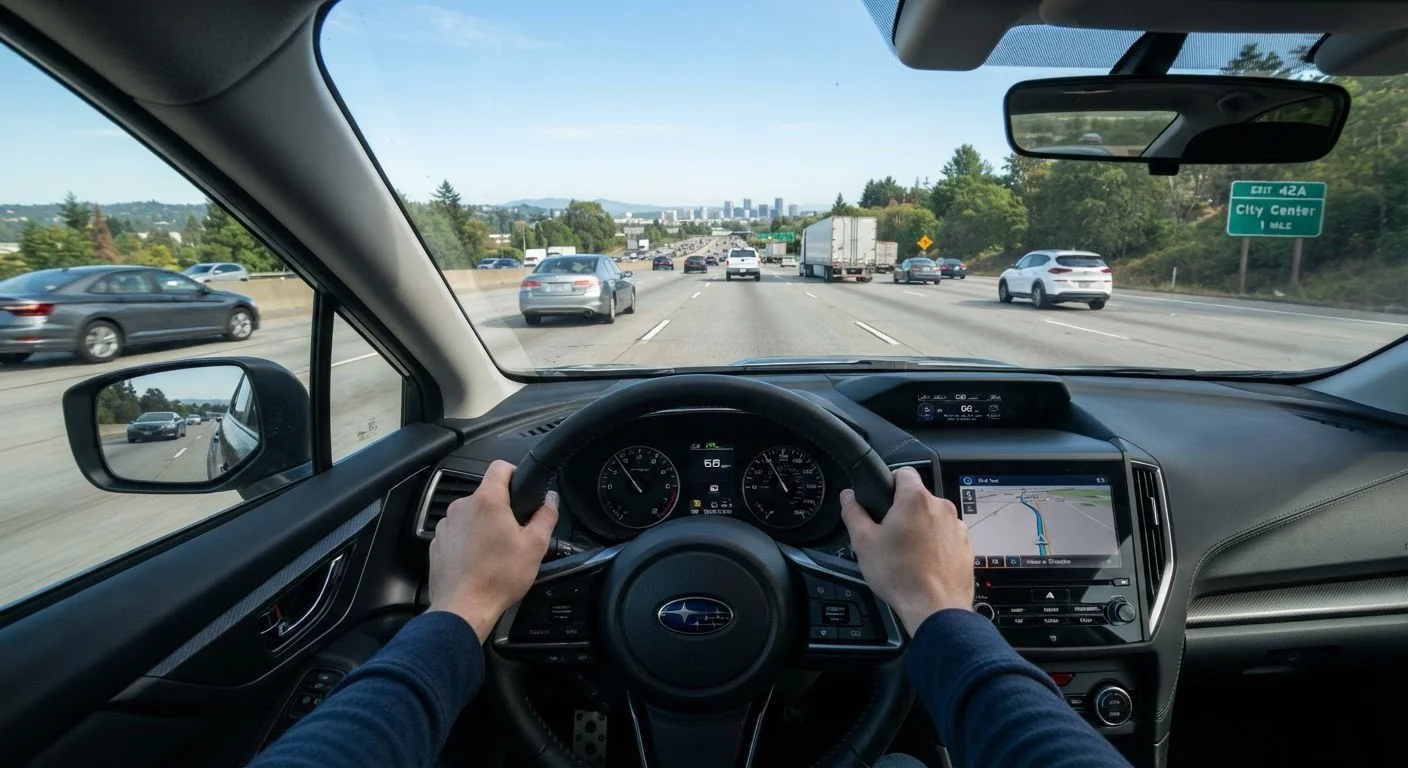
Position your vehicle in the portion of the lane that maximizes your visibility - typically the center-left of a lane on multi-lane highways - so you can see around large vehicles ahead without closing the gap.
Sightlines determine how early you can identify a developing hazard. Lane position costs nothing and consistently pays off in extra reaction time.
Space Management: Your Most Important Buffer
Space is your reaction time made physical. The more distance between your vehicle and the hazard, the more time you have to respond - and more options you have for avoiding it.
The standard recommendation is a following distance of at least three seconds behind the vehicle ahead under normal conditions, increasing to four or more seconds in poor weather, heavy traffic, or when driving at higher speeds. Most drivers dramatically underestimate how quickly that gap closes. Tailgating is more dangerous than most drivers realize - reaction time alone, before braking even begins, consumes a full second or more at highway speeds.
Space management isn't just about following distance. It includes:
- Side buffers: Avoid lingering in another vehicle's blind spot, particularly trucks and large SUVs. Learn more about sharing the road with large trucks.
- Escape routes: At any moment, know where you would go if the car ahead stopped suddenly. An open lane or a paved shoulder changes the outcome of a close call.
- Intersection positioning: Don't enter an intersection the moment a light turns green. A one-second pause lets you confirm cross-traffic has actually stopped.
Anticipating Hazards Before They Develop
Professional drivers and driving instructors commonly teach scanning 12-15 seconds ahead - roughly a quarter mile at highway speeds or about a full city block in urban traffic. The purpose is to shift your awareness from what's happening right now to what's about to happen.
Practical habits that support hazard anticipation include:
- Watching the brake lights of vehicles two or three cars ahead, not just the one directly in front of you.
- Identifying stopped or slow-moving traffic before you reach it, so you can ease off the accelerator early rather than brake hard.
- Noting pedestrians, cyclists, and driveways before they become immediate concerns.
- Adjusting your scan pattern for the environment - rural roads and urban streets demand different awareness.
Conditions that shrink your anticipation window - darkness, rain, fog, or heavy traffic - require a corresponding reduction in speed. Night driving introduces a distinct set of hazards that pure technique alone won't resolve.
“The goal of defensive driving is not to be a perfect driver - it's to compensate for the imperfect drivers around you. Space and time are the two resources that keep you out of trouble.”
— Autos & Driving Editorial Team, Automotive safety writers and editors
Common Situations That Demand Defensive Thinking
Certain road situations consistently produce higher crash rates. Recognizing them in advance changes how you approach them:
- Merging zones
- Adjust your speed to create space for merging vehicles rather than forcing them to slot in behind you. A brief speed adjustment prevents the accordion effect that often precedes rear-end crashes.
- Intersections
- More crashes happen at intersections than anywhere else. Treat a green light as permission to proceed with caution, not a guarantee that cross-traffic has stopped.
- School zones and residential streets
- Children move unpredictably. Slow down well before posted limits require it, and keep your foot near the brake when passing parked vehicles.
- Construction zones
- Lane shifts, uneven surfaces, and distracted workers create compressed hazards. Increased following distance and reduced speed both matter here.
- Highway on-ramps
- Matching highway speed before merging reduces the speed differential that makes on-ramp entries dangerous. Wet-weather misconceptions compound these situations in poor conditions.
Building the Habit: Making It Stick
Defensive driving isn't a skill you practice once and retain forever. It degrades under fatigue, stress, and familiarity. Routes you drive every day are actually higher risk in some respects, because familiarity breeds inattention.
A few practices help keep the mindset active:
- Conduct a brief mental check before driving. Are you tired? Distracted by something off the road? Rushed? Each of these impairs the anticipatory awareness that defensive driving depends on.
- Debrief close calls honestly. If something nearly went wrong, ask why - and what adjustment would have given you more time or space.
- Keep your vehicle in good condition. Worn tires, delayed brake service, and burned-out lights all undercut your ability to act on good decisions. Routine car maintenance is the mechanical foundation of driving safety.
Formal defensive driving courses are offered through various organizations across the country and can reinforce these habits - some insurers also recognize course completion, though specific benefits vary by policy and provider. Whatever path you take, the goal is the same: making safety-conscious thinking automatic rather than effortful.
For those new to these responsibilities, understanding graduated licensing programs is a natural complement to these fundamentals.