

Key Takeaways
No ongoing monthly utility sewer fees
Septic owners avoid recurring municipal sewer charges, which can add up to thousands of dollars over the lifetime of a home.
Independence from municipal infrastructure
A functioning septic system keeps wastewater management on-site and unaffected by utility outages, main line failures, or municipal budget constraints.
Can function well for decades with proper care
Well-maintained septic systems routinely last 25 to 40 years before major components require replacement, making upkeep cost-effective over the long term.
Common and well-understood in rural areas
Licensed septic professionals are widely available in areas where septic systems are standard, making routine maintenance and emergency service accessible.
Regular pumping is a non-negotiable expense
Septic tanks need professional pumping every 3 to 5 years. Ignoring this can lead to drain field failure, which may cost tens of thousands of dollars to remediate.
Drain field failure is costly and disruptive
Replacing a failed drain field requires excavating a significant portion of the yard and represents one of the most expensive home system repairs a property owner may encounter.
Requires ongoing behavioral adjustments
Septic owners must avoid flushing wipes, pouring grease, or overusing antibacterial cleaners - habits that can disrupt the biological process the system depends on.
Subject to local inspection and compliance rules
Many jurisdictions require septic inspections at point of sale or on a periodic schedule, adding a layer of regulatory obligation that sewer-connected properties don't face in the same way.
Our Verdict
Neither system is inherently superior - each suits different property types and owner habits. Septic systems reward attentive, hands-on homeowners in rural or low-density settings, while municipal sewer connections offer convenience and predictability for those who prefer a more hands-off arrangement. Both require ongoing awareness and occasional expense.
Homeowners who want to understand their property's full maintenance picture before purchasing, building, or neglecting routine upkeep.
How Each System Works
Every home produces wastewater - from toilets, sinks, showers, and appliances. Where that water goes after it leaves your pipes defines which system you own.
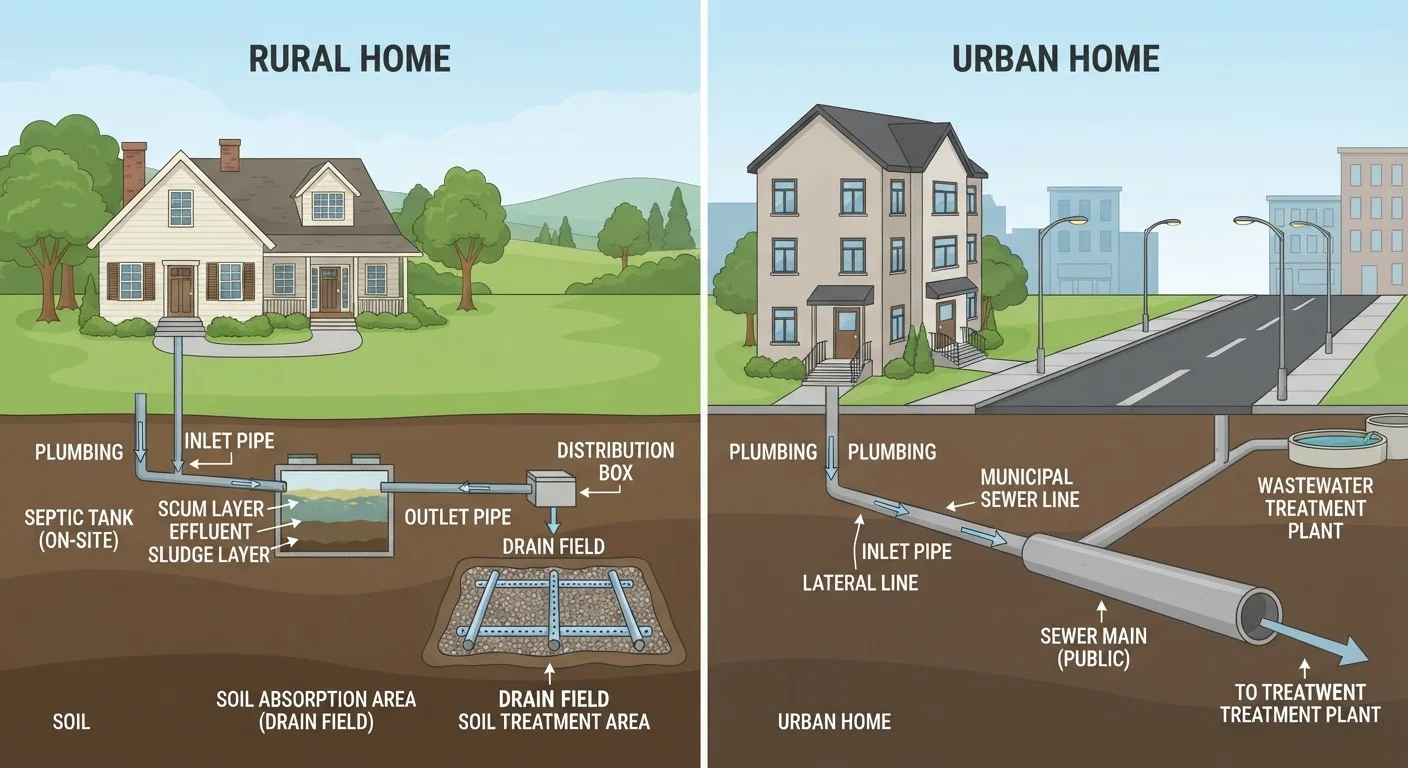
A private septic system keeps wastewater treatment entirely on your property. Wastewater flows into a buried tank where solids settle and partially decompose. Liquid effluent then disperses through a network of perforated pipes called a drain field (or leach field), where soil microbes complete the treatment naturally. The system is self-contained and independent of municipal infrastructure.
A municipal sewer connection routes your wastewater into a public main - typically installed under the street - where it travels to a centrally operated treatment plant. Your responsibility ends at your property's lateral line, the pipe connecting your home to the main. The utility manages everything downstream.
For a broader look at how wastewater fits into your home's overall plumbing layout, see our room-by-room plumbing guide.
The Real Maintenance Demands of a Septic System
Owning a septic system means becoming a steward of a living biological process. Neglect is not neutral - it compounds quickly.
No ongoing monthly utility sewer fees
Septic owners avoid recurring municipal sewer charges, which can add up to thousands of dollars over the lifetime of a home.
Independence from municipal infrastructure
A functioning septic system keeps wastewater management on-site and unaffected by utility outages, main line failures, or municipal budget constraints.
Can function well for decades with proper care
Well-maintained septic systems routinely last 25 to 40 years before major components require replacement, making upkeep cost-effective over the long term.
Common and well-understood in rural areas
Licensed septic professionals are widely available in areas where septic systems are standard, making routine maintenance and emergency service accessible.
The most important routine task is pumping the tank, typically needed every 3 to 5 years depending on household size and usage. Skipping this allows solids to overflow into the drain field, clogging the soil and potentially requiring a full drain field replacement - one of the most expensive home repairs a property owner can face.
Beyond pumping, septic ownership requires behavioral discipline. Flushing wipes (even those labeled "flushable"), pouring cooking grease down drains, or using antibacterial products heavily can disrupt the bacterial balance the system depends on. Harsh chemical drain cleaners can damage the tank's microbial environment.
Regular pumping is a non-negotiable expense
Septic tanks need professional pumping every 3 to 5 years. Ignoring this can lead to drain field failure, which may cost tens of thousands of dollars to remediate.
Drain field failure is costly and disruptive
Replacing a failed drain field requires excavating a significant portion of the yard and represents one of the most expensive home system repairs a property owner may encounter.
Requires ongoing behavioral adjustments
Septic owners must avoid flushing wipes, pouring grease, or overusing antibacterial cleaners - habits that can disrupt the biological process the system depends on.
Subject to local inspection and compliance rules
Many jurisdictions require septic inspections at point of sale or on a periodic schedule, adding a layer of regulatory obligation that sewer-connected properties don't face in the same way.
Homeowners should also know where their tank and drain field are located, and protect that area - heavy vehicles, deep-rooted plants, and construction activity above a drain field can cause serious structural damage. Many jurisdictions require inspections at the point of sale, and some mandate periodic inspections regardless.
This type of attention to home systems parallels what's discussed in our guide to deferred maintenance: small oversights in any home system tend to become expensive problems over time.
What Municipal Sewer Connection Actually Involves
Connecting to a public sewer system removes many day-to-day concerns - but it doesn't eliminate all responsibility or cost.
~21%
U.S. homes relying on septic systems
According to the U.S. Environmental Protection Agency, roughly one in five American homes uses a septic system rather than a public sewer.
$3,000-$7,000+
Typical septic system pumping and repair costs
Routine pumping runs a few hundred dollars every few years, but drain field repairs or replacements commonly range from several thousand dollars to well above that threshold.
Homeowners pay ongoing sewer utility fees, which vary considerably by municipality and are typically billed monthly or quarterly. These fees fund the treatment plant, main line maintenance, and system upgrades. Over decades, these payments represent a substantial cumulative cost, though they are predictable and budget-friendly compared to irregular septic repair bills.
Your responsibility for the lateral line - the pipe connecting your home to the public main - is an important and often misunderstood detail. Most municipalities place maintenance and repair of this lateral squarely on the homeowner, not the utility. Lateral line failures, root intrusion, or collapses are the homeowner's expense to resolve.
Lateral Line Ownership: A Common Blind Spot
Many homeowners on municipal sewer assume the utility maintains all pipes once wastewater leaves the house. In reality, the lateral line - the private pipe connecting your home to the public main - is typically the homeowner's responsibility to repair or replace. This pipe runs under your yard and sometimes under the street, and failures due to root intrusion or age can be costly. Check with your local utility to understand exactly where your responsibility ends.
Sewer-connected homes also have fewer restrictions on what can go down the drain, but this doesn't mean anything goes. Local utilities typically prohibit pouring cooking grease, chemicals, or non-biodegradable materials into the system, and violations can result in fines. Good habits matter regardless of which system you have.
Costs, Regulations, and What You Can Control
Cost comparison between the two systems is genuinely difficult because expenses fall at different times and in different forms. Septic costs tend to be lumpy and irregular - routine pumping every few years, plus the possibility of a significant repair or replacement. Municipal sewer costs are consistent monthly fees plus occasional lateral work.
Regulations play a large role. Local health departments and municipalities govern septic system installation, maintenance standards, and inspection schedules. In some areas, properties within a certain distance of a municipal main may be legally required to connect if the main is extended. Homeowners considering a property in a transitional area - currently on septic but near expanding suburban infrastructure - should investigate local ordinances carefully before purchase.
Understanding both systems is part of knowing your home's complete infrastructure. Our plain-language guide to essential home systems covers how wastewater, HVAC, electrical, and other systems connect and interact. Informed owners - whether on septic or sewer - make better decisions when problems arise and are less likely to be caught off guard by unexpected costs.