

Key Takeaways
Option A
Storage Tank Water Heater
The tried-and-true workhorse of home water heating.
Best for: Households that want lower upfront costs, simpler installation, and straightforward maintenance.
Option B
Tankless Water Heater
The on-demand, energy-efficient alternative for modern homes.
Best for: Households prioritizing long-term energy savings, unlimited hot water flow, and space efficiency.
If you want the lowest possible upfront and installation cost
Storage Tank Water Heater
Tank units have a lower purchase price and simpler installation that rarely requires infrastructure upgrades, making them the budget-friendlier starting point.
If you want to reduce long-term energy bills
Tankless Water Heater
Tankless systems eliminate standby heat loss, which can account for a meaningful portion of home water-heating energy use, particularly in homes that heat water intermittently.
If your household has simultaneous high hot-water demand
Storage Tank Water Heater
A large-capacity tank can supply multiple fixtures at once without flow-rate limitations, provided the tank is appropriately sized for the household.
If you're planning a long-term stay and value durability
Tankless Water Heater
With proper maintenance, tankless units typically outlast tank models by a decade or more, spreading their higher upfront cost over a longer service life.
If your home has limited utility space
Tankless Water Heater
Tankless units mount on a wall and take up a fraction of the floor space that a 40- to 80-gallon storage tank requires.
How Each System Works
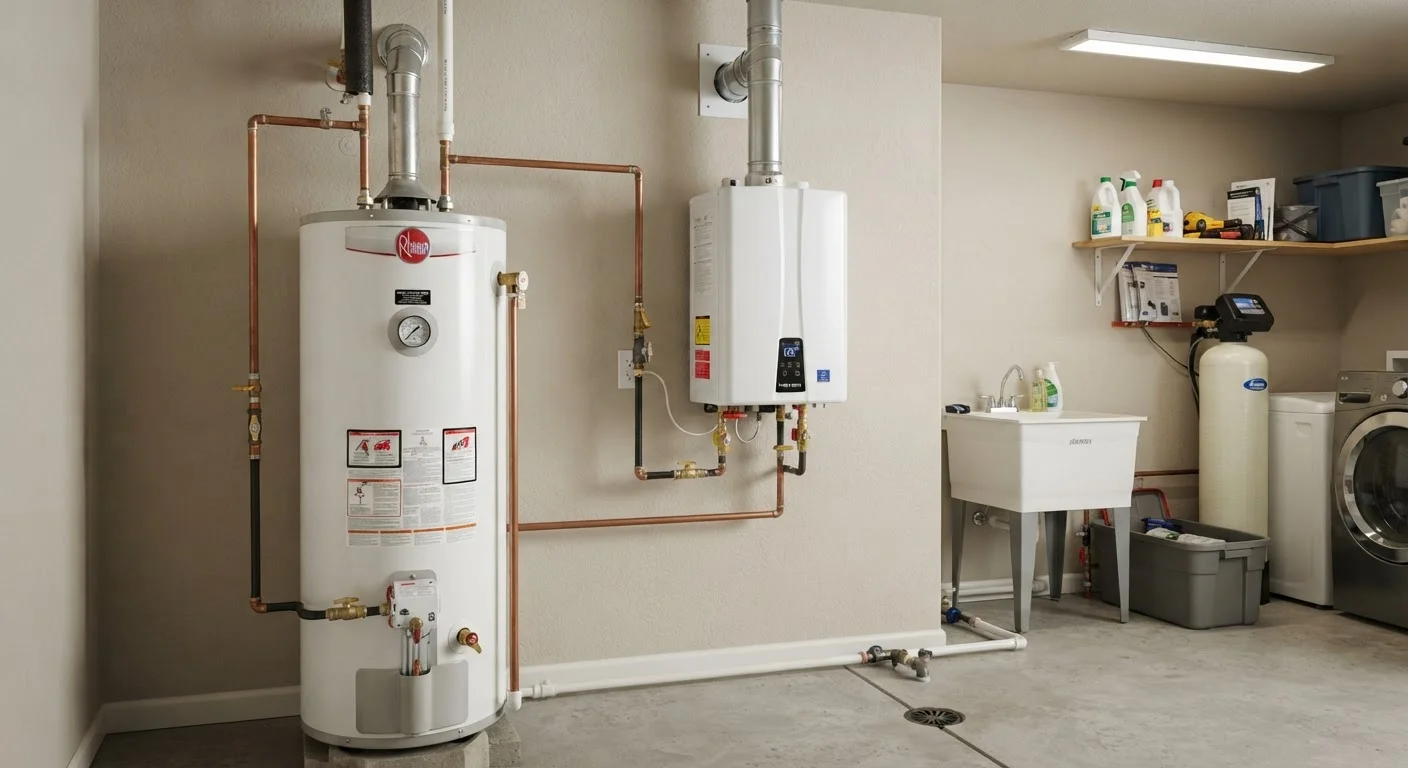
A storage tank water heater keeps a large reservoir - typically 30 to 80 gallons - constantly heated to a set temperature, usually between 120°F and 140°F. Whenever you open a hot-water tap, pre-heated water flows out and cold water refills the tank, which then reheats to maintain temperature. This continuous cycle happens even when no one is using hot water, a phenomenon called standby heat loss.
A tankless (on-demand) water heater has no reservoir. When you turn on a hot-water tap, cold water travels through a pipe and passes over a high-powered gas burner or electric heating element, delivering hot water almost immediately. The unit shuts off the moment the tap closes. Because there is no stored water to keep warm, standby heat loss is effectively eliminated.
Understanding this core mechanical difference is the key to evaluating everything else - cost, efficiency, and fit for your household. For a similar breakdown of how home comfort systems work in practice, see our HVAC myths guide.
Upfront Costs and Installation
Storage tank heaters carry a lower purchase price. A standard gas or electric unit commonly runs between $300 and $900 depending on capacity and fuel type, with installation adding $150 to $500 in most cases - assuming no major modifications are needed.
Tankless units cost more at the outset. Gas-fired tankless heaters often range from $500 to $1,500 or more, while installation can add $500 to $1,500 if your home needs an upgraded gas line, new venting, or a larger electrical panel for electric models. That infrastructure gap is the single biggest sticker-shock factor for homeowners switching from tank to tankless.
| Criterion | Storage Tank | Tankless |
|---|---|---|
| Typical unit cost | $300-$900 | $500-$1,500+ |
| Installation cost | $150-$500 | $500-$1,500+ |
| Standby energy loss | Yes - continuous | None |
| Typical lifespan | 8-12 years | 15-20+ years |
| Hot water supply | Limited by tank size | Continuous (flow-rate limited) |
| Space requirement | Large floor footprint | Wall-mounted, compact |
| Annual maintenance | Flush sediment, check anode rod | Descale heat exchanger |
Thinking about cost beyond the purchase price is essential here. Reasoning through cost versus long-term value is a useful framework any time upfront and lifetime costs diverge significantly - which they do here.
Energy Efficiency and Operating Costs
The U.S. Department of Energy has noted that tankless water heaters can be 24-34% more energy efficient than storage tank models in homes that use 41 gallons or less of hot water daily. That efficiency advantage narrows somewhat in higher-usage households. Your actual savings depend on local utility rates and how your household draws hot water throughout the day.
24-34%
Potential energy savings with tankless
According to the U.S. Department of Energy, tankless heaters can be 24-34% more energy efficient for households using 41 gallons or less of hot water daily.
8-12 yrs
Average tank water heater lifespan
Most storage tank units need replacement within this window, often sooner without regular sediment flushing and anode rod maintenance.
15-20+ yrs
Typical tankless unit lifespan
With annual descaling and routine inspections, tankless water heaters commonly outlast tank models by roughly a decade.
Electric resistance tank heaters tend to be the least efficient option overall, while heat-pump water heaters (a separate category that uses ambient air to heat water) can outperform both tank and standard tankless models on efficiency - worth noting if efficiency is your top priority.
Lifespan, Maintenance, and Reliability
Storage tank water heaters typically last 8 to 12 years. Key maintenance tasks include flushing sediment from the tank annually, inspecting the anode rod every few years, and replacing it when depleted. Neglecting these steps accelerates tank corrosion and shortens service life.
Tankless units generally last 15 to 20 years or longer with proper upkeep. Maintenance centers on descaling the heat exchanger annually in hard-water areas - mineral buildup can significantly reduce efficiency and shorten component life if left unaddressed. Replacement parts are usually available longer than for tank models, which is an advantage if a component fails mid-lifespan.
Both system types should be installed by a licensed plumber, and gas units require inspections of venting and gas connections. Always verify local permit and inspection requirements before replacing a water heater - requirements vary by jurisdiction.
Which Household Scenarios Favor Each Option
Tank heaters make sense when:
- You are replacing a unit on a tight timeline and budget.
- Your home's existing infrastructure (gas line size, electrical panel) matches current tank requirements.
- Hot-water demand is high and simultaneous - for example, running a dishwasher, shower, and laundry at the same time regularly.
- You plan to sell the home within a few years, making payback period a relevant factor.
Tankless heaters make sense when:
- You plan to stay in the home long enough to recoup the higher upfront cost through lower energy bills.
- You want to free up floor space in a utility room or closet.
- Your household draws hot water intermittently rather than in large simultaneous bursts.
- You are doing a broader renovation that allows for infrastructure upgrades without significant added disruption.
Matching the right system to your usage patterns is the same kind of deliberate, trade-off thinking that applies to other home systems. If you're also evaluating connected home upgrades, our smart thermostat explainer walks through a similarly practical framework.