

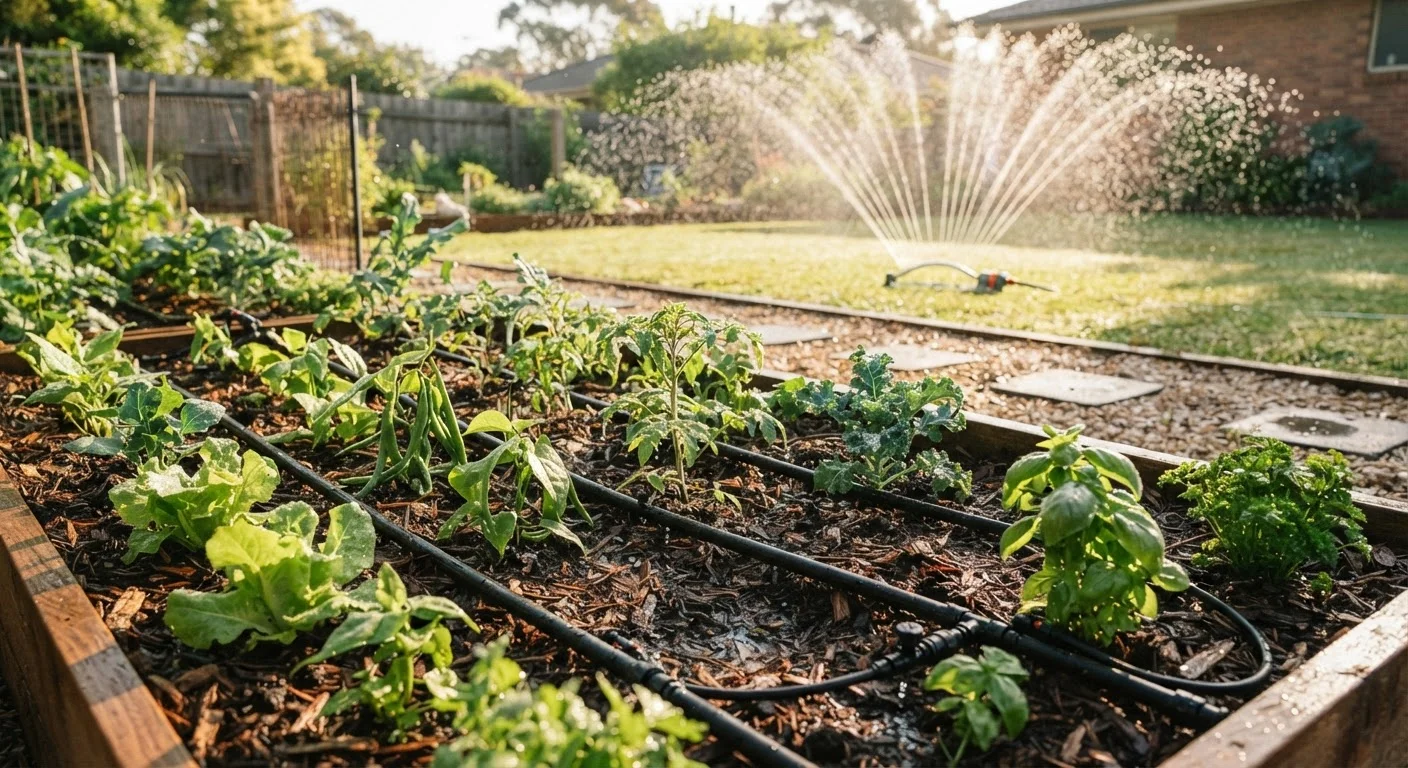
Key Takeaways
Option A
Drip Irrigation
The precision, low-volume solution for targeted watering.
Best for: Garden beds, vegetable plots, shrubs, and any planting area where water should go directly to roots - not foliage.
Option B
Sprinkler Systems
The broad-coverage workhorse for lawns and open landscapes.
Best for: Turf grass, large open areas, and ground covers where uniform overhead coverage is practical and expected.
If you grow vegetables, herbs, or flowering perennials in garden beds
Drip Irrigation
Root-zone delivery minimizes evaporation, keeps foliage dry to reduce disease pressure, and matches the irregular spacing of mixed plantings.
If your primary goal is maintaining a healthy turf grass lawn
Sprinkler Systems
Turf needs uniform overhead coverage across wide areas - a task sprinkler heads handle far more efficiently than point-source drip emitters.
If water conservation and drought resilience are your top priorities
Drip Irrigation
Drip systems lose far less water to evaporation and wind drift, making them the stronger choice in water-restricted regions or during dry summers.
If you have a mixed landscape with both lawn and garden beds
Drip Irrigation
A hybrid approach - drip for beds, sprinklers for turf - is often the most efficient strategy, though it does add upfront planning complexity.
How Each System Actually Delivers Water
Understanding efficiency starts with understanding mechanics. Drip irrigation delivers water through a network of low-pressure tubing and small emitters placed at or just below soil level, releasing water slowly - typically 0.5 to 2 gallons per hour - directly into the root zone. Because water never travels through the air to reach the plant, losses from evaporation and wind drift are minimal.
Sprinkler systems, by contrast, distribute water via pressurized heads that spray or rotate across a defined arc. Water travels through the air before reaching the ground, exposing it to evaporation - especially on warm, windy days. According to the U.S. Environmental Protection Agency, outdoor water use accounts for roughly 30% of total household water consumption, and a significant portion of that is lost through inefficient sprinkler application.
Neither design is inherently superior in every scenario. The real question is matching the system to the landscape it serves. Check out our article on common garden watering misconceptions to separate fact from fiction before you commit to either approach.
| Criterion | Drip Irrigation | Sprinkler Systems |
|---|---|---|
| Water Efficiency | Up to 90%+ distribution efficiency | Typically 70-80% efficiency |
| Best Landscape Use | Beds, shrubs, vegetables, trees | Turf grass, large open areas |
| Foliage Wetness | Keeps leaves dry | Wets foliage during operation |
| Evaporation & Wind Loss | Minimal - water applied at ground level | Moderate to high in heat or wind |
| Installation Complexity | Higher - requires per-plant planning | Moderate - zones cover large areas |
| Maintenance | Emitter checks; filter cleaning needed | Head alignment and seasonal blowouts |
| Scalability | Best for smaller, defined zones | Easily scaled to large properties |
Water Conservation: The Numbers Behind the Claims
Drip irrigation consistently outperforms sprinklers in controlled efficiency comparisons. University extension programs and water agencies generally report that well-maintained drip systems operate at 90% or higher distribution efficiency - meaning 90 cents of every dollar of water reaches plant roots. Standard sprinkler systems, depending on head type and timing, typically range between 70% and 80% efficiency under good conditions, and can drop considerably lower in heat or wind.
90%+
Drip system distribution efficiency
U.S. water conservation resources commonly cite drip irrigation as operating above 90% efficiency when properly maintained.
~30%
Share of household water used outdoors
The U.S. Environmental Protection Agency estimates outdoor watering accounts for roughly 30% of average residential water use.
50%
Potential water savings vs. sprinklers
Cooperative extension research suggests drip irrigation can reduce garden water use by up to 50% compared to overhead sprinkler methods.
That gap matters at the garden level. A raised vegetable bed, a row of shrubs, or a perennial border irrigated by drip can use meaningfully less water over a season compared to the same bed served by overhead spray - without sacrificing plant health. For context on how raised beds interact with irrigation choices, see our overview on raised garden bed pros and cons.
It's worth noting that a poorly designed drip system with clogged emitters or mismatched flow rates can waste water just as readily as a sprinkler on the wrong schedule. Efficiency is never automatic - it requires correct installation and routine maintenance for both systems.
Plant Health, Setup, and Long-Term Practicality
Foliage and disease: Because drip systems deliver water below the canopy, leaves stay dry - a genuine advantage for plants prone to fungal issues like powdery mildew or black spot. Sprinklers wet leaves, which can extend the window for disease development if irrigation runs late in the day. Scheduling sprinklers to run in the early morning allows foliage to dry before temperatures drop at night, which reduces - though doesn't eliminate - this risk.
Setup complexity: Drip systems require more upfront planning. Each plant zone needs emitter placement, flow-rate matching, and pressure regulation. For established garden beds this pays off; for large open turf areas it becomes impractical. Sprinkler systems are more straightforward to zone for wide coverage and are familiar to most irrigation installers, though trenching for underground lines adds cost and disruption.
Pairing with other strategies: Whichever system you choose, layering it with a mulched soil surface can further reduce moisture loss by slowing evaporation from the ground itself. Similarly, incorporating native plants into your landscape reduces overall irrigation demand - making either system work harder for less water.
Smart controllers and soil moisture sensors benefit both systems equally. A timer that overrides scheduled watering when rain is detected can cut water use substantially regardless of whether you're running drip lines or pop-up sprinkler heads.