

Key Takeaways
Option A
Fiber Internet
The dedicated, symmetrical-speed infrastructure option.
Best for: Households that need reliable upload speeds, low latency, and consistent performance during peak hours.
Option B
Cable Internet
The widely available, download-focused broadband option.
Best for: Households in areas where fiber hasn't been deployed and who primarily stream, browse, and download content.
If you work from home and frequently upload large files or join video calls
Fiber Internet
Fiber's symmetrical upload and download speeds eliminate the bottleneck that cable's limited upload capacity creates for remote workers.
If fiber isn't available in your area
Cable Internet
Cable remains a capable broadband option for most download-heavy households and is available in far more U.S. locations than fiber.
If you experience slowdowns every evening on your current connection
Fiber Internet
Fiber's dedicated infrastructure is far less susceptible to the network congestion that causes cable speeds to dip during peak usage windows.
If you primarily stream video, browse, and use social media
Cable Internet
For download-heavy tasks, cable plans often deliver sufficient real-world performance at a range of price points where fiber is unavailable.
How Each Technology Actually Works
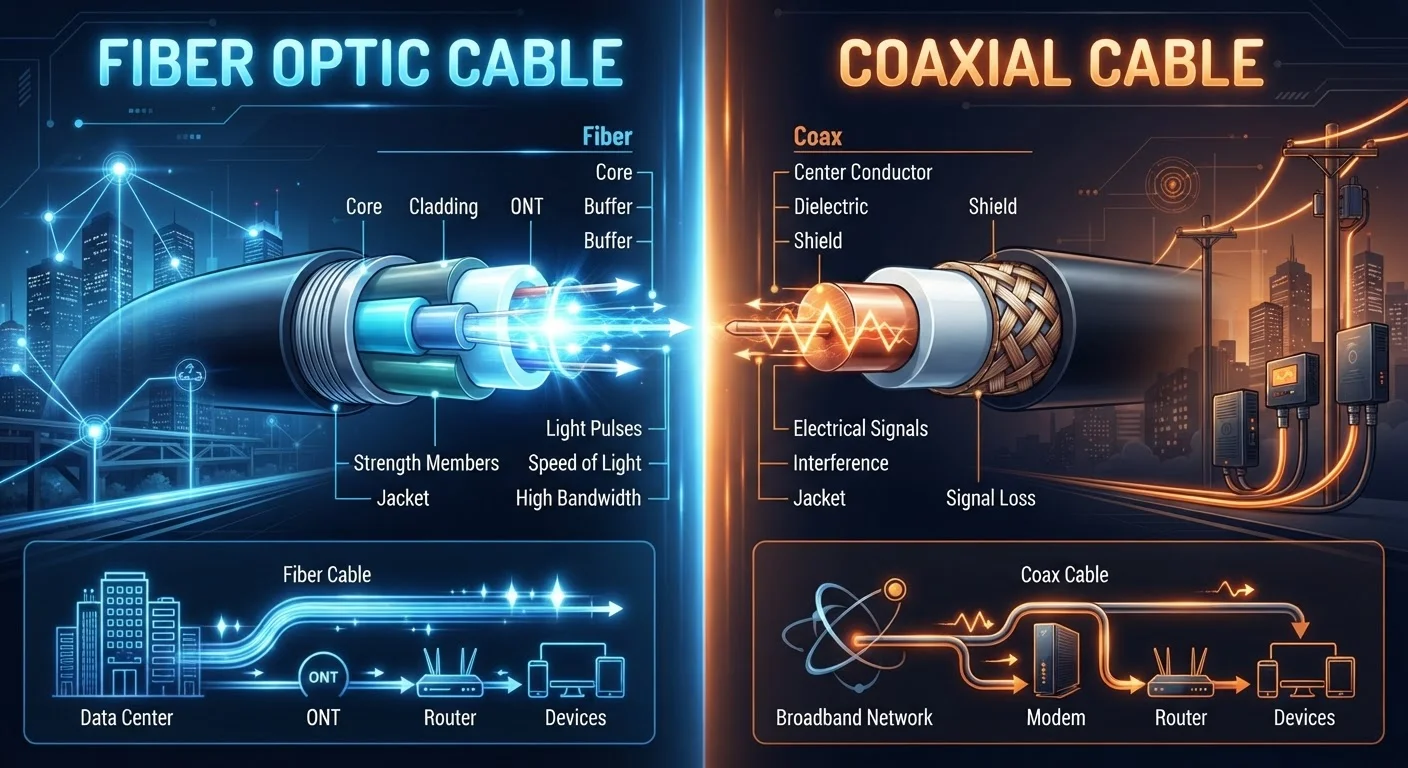
The most important thing to understand about fiber and cable internet is that the speed difference flows from a more fundamental infrastructure difference - the physical medium used to carry data.
Fiber-optic internet transmits data as pulses of light through thin glass or plastic strands. Because light can carry enormous amounts of information with very little signal degradation, fiber supports extremely high bandwidth over long distances. The signal doesn't weaken the way electrical signals do, which means providers can deliver consistent speeds right to your home.
Cable internet runs over coaxial cable - the same copper-based infrastructure originally built to carry cable television signals. Providers have upgraded these networks significantly over the decades using a standard called DOCSIS (Data Over Cable Service Interface Specification), but the fundamental physical medium still imposes limits, particularly for upload traffic. As noted in our guide to shared vs. dedicated connections, cable lines are shared among neighboring households, which means available bandwidth fluctuates with local demand.
| Criterion | Fiber Internet | Cable Internet |
|---|---|---|
| Physical medium | Glass/plastic optical strands | Coaxial copper cable |
| Typical upload speed | Equal to download (symmetrical) | Significantly slower than download |
| Latency | Generally low and consistent | Higher, varies under load |
| Network type | Typically dedicated | Shared with neighbors |
| Peak-hour congestion | Less susceptible | More susceptible |
| U.S. availability | Limited; growing in urban/suburban areas | Widely available nationwide |
| Max download potential | Up to multi-gigabit speeds | Up to 1-2 Gbps on newer DOCSIS networks |
Upload Speed, Latency, and the Metrics That Matter Most
Download speed gets top billing in most plan advertisements, but it's rarely the only number that matters. Upload speed has become increasingly important for video conferencing, cloud backups, live streaming, and remote collaboration tools.
Fiber plans are typically symmetrical - meaning upload and download speeds are equal or very close. A 500 Mbps fiber plan generally delivers 500 Mbps in both directions. Cable plans, by contrast, are heavily asymmetrical. A cable plan advertised at 500 Mbps download may offer only 20-35 Mbps upload, depending on the network tier and technology generation deployed in your area.
Latency - the time it takes data to travel from your device to a server and back - is another area where fiber consistently outperforms cable. Fiber latency typically runs in the single-digit to low double-digit millisecond range. Cable latency tends to be higher and less consistent, particularly under load. For most web browsing, a few extra milliseconds are imperceptible. For real-time applications like video calls or online gaming, however, lower and more consistent latency produces a noticeably better experience.
~43%
U.S. homes with fiber access
According to FCC Broadband Data Collection reports, fiber availability has been expanding but still covers less than half of U.S. locations.
~10-20ms
Typical fiber latency range
Industry benchmarks and ISP technical documentation commonly cite fiber round-trip latency in the low double-digit millisecond range under normal conditions.
3-5x
Cable upload speed gap vs. download
Standard DOCSIS 3.1 cable plans frequently deliver upload speeds that are a fraction of advertised download speeds, depending on the provider tier.
Availability: The Factor That May Decide for You
All of fiber's technical advantages become moot if the infrastructure hasn't reached your address. Fiber deployment in the U.S. has been expanding steadily, driven by both private investment and public broadband funding programs, but it remains concentrated in urban cores and select suburban corridors. Many neighborhoods - even within cities - sit just blocks away from available fiber service without access to it.
Cable internet, carried over the legacy coaxial networks that blanket most of suburban and urban America, is available to a much larger share of U.S. households. For households outside the reach of either technology, other options come into play - our comparison of fixed wireless vs. DSL covers what to consider when fiber and cable aren't on the table.
Understanding why availability varies so sharply - even street by street - comes down to who laid what infrastructure, when, and under what regulatory framework. Our piece on why internet service varies by street explains the infrastructure dynamics behind those gaps. Before evaluating plans, checking actual availability at your specific address is the essential first step.
If you're moving toward a decision, our questions to ask before choosing a home internet plan offers a structured framework covering contract terms, equipment fees, and reliability beyond raw speed tiers.