

Key Takeaways
Our Verdict
No single ventilation approach suits every home. HRVs perform best in cold climates where retaining heat is the priority; ERVs shine in hot, humid regions where managing moisture is equally important. Exhaust-only systems remain a practical entry point for existing homes with limited budgets. The right choice depends on your climate, construction type, and how your home's HVAC system is configured.
| Best for | Recommended |
|---|---|
| Cold-climate new construction or gut renovations | HRV (Heat Recovery Ventilator) |
| Hot, humid climates where summer moisture is a persistent challenge | ERV (Energy Recovery Ventilator) |
| Existing homes on tighter budgets seeking a code-compliant upgrade | Exhaust-Only Ventilation |
| Homes in mixed climates wanting balanced year-round performance | ERV (Energy Recovery Ventilator) |
Why Modern Homes Need Mechanical Ventilation
Decades of energy-efficiency improvements - better insulation, tighter window seals, and vapor barriers - have made homes dramatically less drafty. That's good for heating bills, but it creates a problem: the same envelope that keeps conditioned air in also traps pollutants, excess moisture, carbon dioxide, and volatile organic compounds (VOCs) generated by cooking, cleaning products, and building materials.
The Environmental Protection Agency has consistently noted that indoor air can be significantly more polluted than outdoor air, even in urban environments. Opening a window helps situationally, but it's unreliable: weather, outdoor air quality, noise, security, and seasons all limit when it's practical.
Building codes in most U.S. states now require some form of whole-house mechanical ventilation in new construction, reflecting this shift. If your home was built or substantially renovated after roughly 2012, it likely has - or should have - a dedicated ventilation system. Understanding what type you have, and what your options are, puts you in a stronger position when maintenance or replacement decisions arise. For a broader look at how ventilation fits into the full picture, see our plain-language guide to home systems.
The Three Main Approaches Compared
Whole-house ventilation strategies fall into three categories, each with a distinct mechanism and trade-off profile.
Exhaust-Only Ventilation
A bath fan or dedicated exhaust fan runs on a timer or continuously at low speed, pushing stale air out. Replacement air seeps in through gaps in the building envelope - a process called infiltration. It's the simplest and least expensive approach, but it offers no control over where or how outdoor air enters, and it loses all the energy in the exhausted air.
HRV - Heat Recovery Ventilator
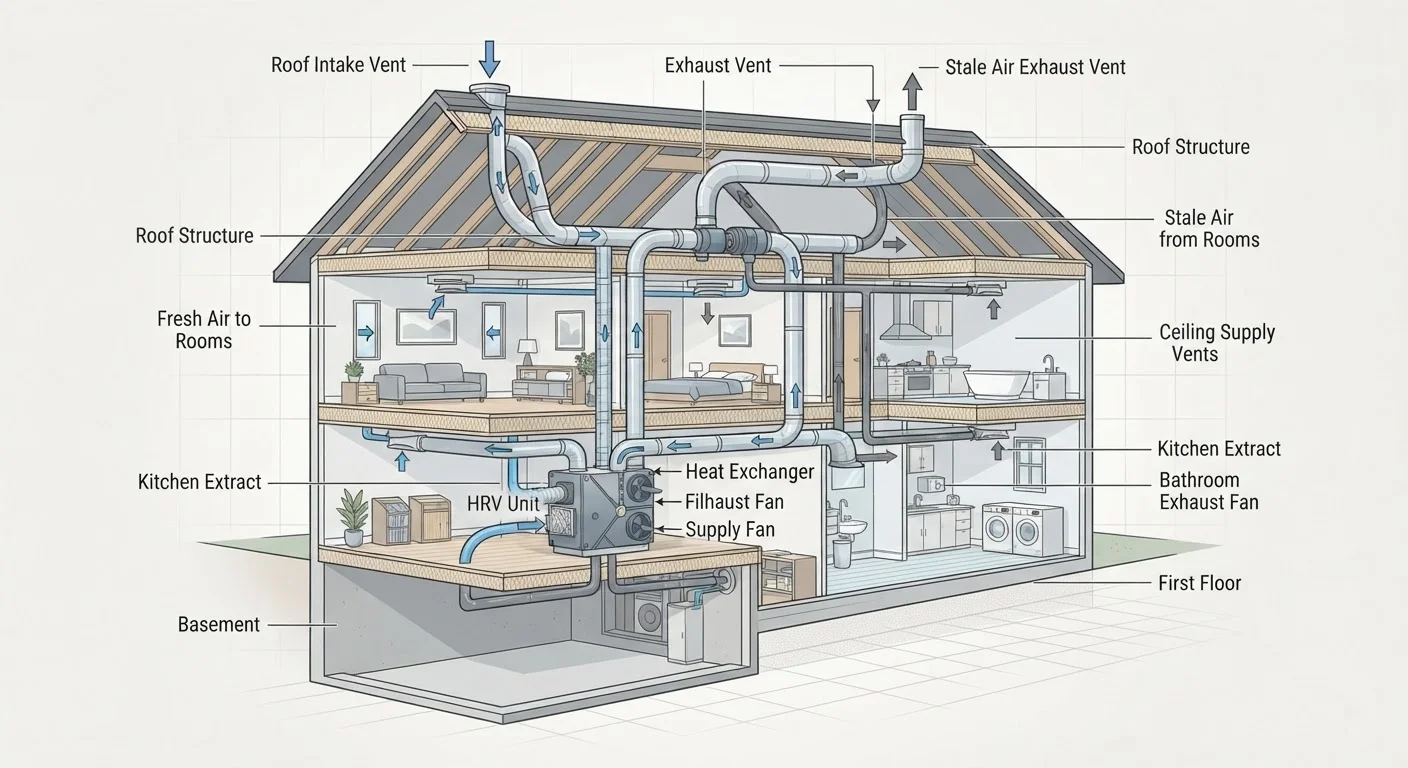
An HRV uses a heat exchanger core to transfer warmth from the outgoing stale air to the incoming fresh air stream, without the two airflows ever mixing. In winter, this means you're not dumping heated air outside; in summer, the process partially reverses, pre-cooling incoming air. HRVs are particularly effective in cold climates. However, they transfer very little moisture, so in a dry-winter climate they can lower indoor humidity further.
ERV - Energy Recovery Ventilator
An ERV works similarly to an HRV but uses a core that also transfers water vapor between airstreams. In winter, it helps retain indoor humidity; in summer, it limits how much outdoor humidity enters the home. This makes ERVs well-suited to both hot-humid climates and mixed climates, though they are generally more expensive than comparable HRVs.
| Exhaust-Only | HRV | ERV | |
|---|---|---|---|
| Mechanism | Fan exhausts air; infiltration supplies fresh air | Heat exchanger recovers warmth from outgoing air | Exchanger recovers heat and transfers moisture |
| Energy efficiency | Low - all conditioned air is lost | High - recovers 70-85% of heat | High - recovers heat and partial humidity energy |
| Moisture control | None | Minimal - can reduce humidity in winter | Good - retains winter humidity, limits summer infiltration |
| Best climate | Any (entry-level option) | Cold and dry (zones 5-8) | Hot-humid or mixed (zones 1-4) |
| Installation complexity | Low | Moderate to high | Moderate to high |
| Relative upfront cost | Lowest | Moderate | Moderate to higher |
| Ongoing maintenance | Minimal (grille cleaning) | Filter cleaning every 3-6 months | Filter cleaning every 3-6 months |
Both HRVs and ERVs can be integrated with existing forced-air ductwork or installed with dedicated duct runs. How they interact with your heating and cooling setup matters - common HVAC misconceptions often stem from treating ventilation and conditioning as a single system when they serve different functions.
Sizing, Installation, and What Can Go Wrong
A ventilation system that is oversized will over-ventilate, wasting energy and potentially creating uncomfortable drafts or humidity imbalances. One that is undersized won't adequately refresh indoor air. Proper sizing follows ASHRAE Standard 62.2, which uses home square footage and the number of bedrooms to calculate a minimum ventilation rate in cubic feet per minute (CFM).
Ask for ASHRAE 62.2 Compliance
When getting quotes for a new or replacement ventilation system, ask the contractor to show their CFM calculation based on ASHRAE 62.2. This standard is widely adopted in U.S. building codes and gives you an objective benchmark to evaluate whether the proposed system is appropriately sized. A contractor who cannot reference it may not be familiar with balanced ventilation design.
Installation quality matters enormously. Poorly sealed duct connections, incorrect fan placement, or missing balancing dampers can undermine performance even in a well-specified system. If you're evaluating contractor proposals, knowing which questions to ask can help you assess whether a bid reflects genuine system knowledge.
Filters in HRVs and ERVs require regular cleaning or replacement - typically every three to six months depending on household conditions. Neglecting this reduces airflow and can allow mold growth inside the core. Exhaust-only fans require periodic cleaning of grilles and, for timer-controlled units, occasional verification that the control settings haven't drifted.
Smart controls are also increasingly available for HRV and ERV systems, allowing ventilation rates to adjust based on occupancy, CO2 levels, or outdoor air quality. If your home already uses a smart thermostat, check compatibility - some platforms can coordinate ventilation and conditioning together. See how smart thermostats interface with HVAC for context on that integration.
Choosing the Right System for Your Home
Climate is the starting point. The U.S. Department of Energy's climate zone map divides the country into regions that generally align with system suitability: colder zones (5-8, covering most of the Midwest, Northeast, and Mountain states) tend to favor HRVs; warmer, humid zones (1-3, covering the Southeast and Gulf Coast) lean toward ERVs; mixed zones often benefit from ERVs as a flexible compromise.
Your home's construction type matters too. A newly built, very tight home needs more deliberate mechanical ventilation than a 1970s ranch with natural infiltration. If your home uses radiant heat rather than forced air - see our comparison of those systems - a standalone HRV or ERV with its own dedicated ducts is typically required, since there's no central air handler to distribute ventilation air.
Budget, available installation space, and access to qualified HVAC technicians familiar with balanced ventilation all factor into a realistic decision. Exhaust-only remains a legitimate starting point for retrofit situations where the alternatives aren't currently feasible, provided the home isn't so tightly sealed that infiltration is insufficient to supply replacement air. A licensed HVAC professional can perform a blower-door test to determine your home's actual air-tightness before recommending a system type.