

Key Takeaways
Electrical Service Panel
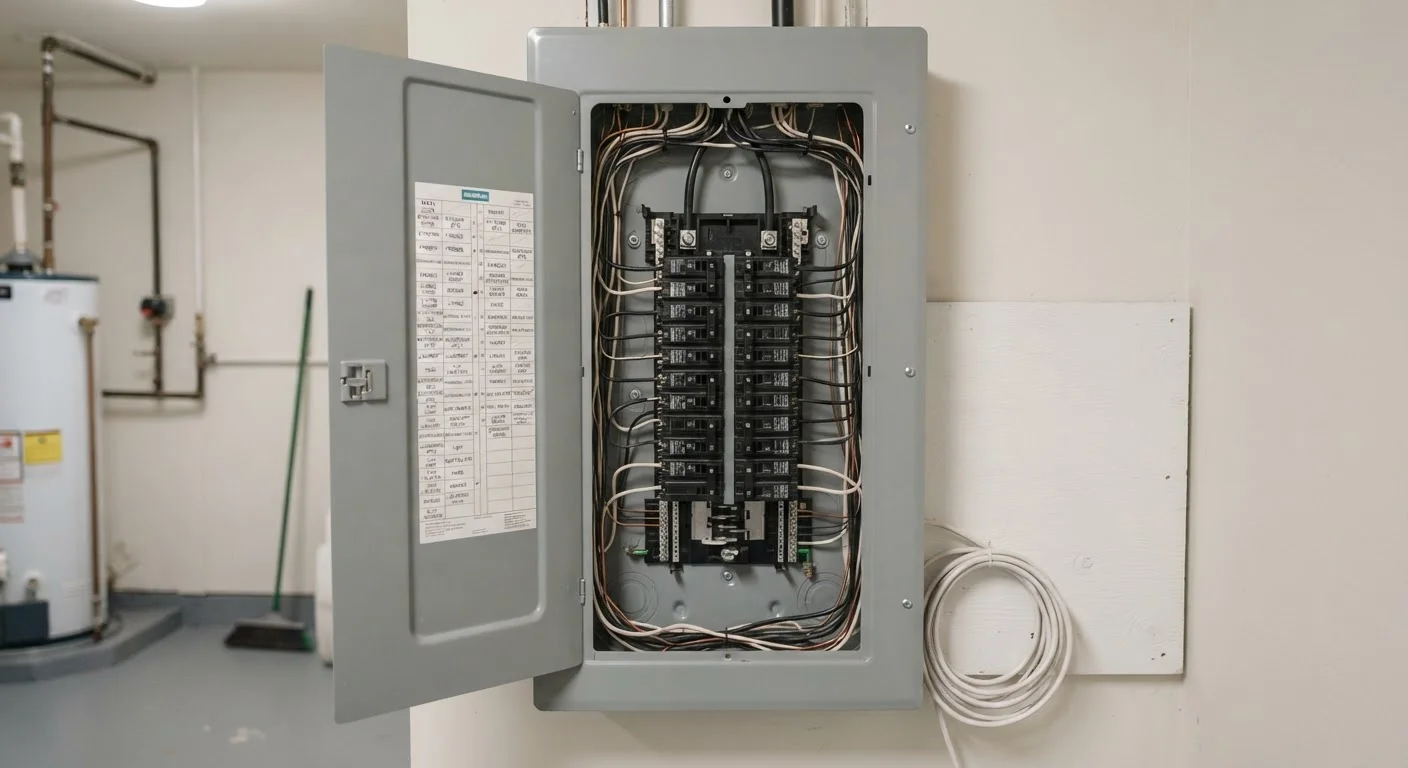
An electrical service panel - also called a breaker box or load center - is the metal cabinet where utility power enters your home and divides into individual circuits. Each circuit is protected by a breaker that automatically shuts off if too much current flows through the wiring. Think of it as your home's electrical traffic controller.
Panels are rated by total amperage capacity (commonly 100A, 150A, or 200A), which represents the maximum current the service entrance conductors and main breaker can safely carry at once.
What You're Actually Looking At
Open your electrical panel door and you'll see a main breaker at the top - the master switch for the entire panel - and two columns of individual circuit breakers below it. The panel is connected to the utility company's service entrance wires, which carry electricity at your home's full service amperage (often 200A in homes built after the 1980s).
Each breaker protects a single circuit - a loop of wiring that runs from the panel to outlets, lights, or appliances and back. The amperage number stamped on the breaker handle (commonly 15A or 20A for general circuits) is the maximum current that circuit is designed to carry. If current exceeds that threshold, the breaker trips and cuts power automatically, protecting the wiring from overheating.
For a broader look at how your electrical system fits into your home's overall infrastructure, see our plain-language guide to essential home systems.
Never Remove the Panel Cover Yourself
The inner panel cover hides bus bars and wiring that remain live even when the main breaker is off - the service entrance cables feeding the top of the panel always carry utility voltage. Opening the cover is dangerous and, in many jurisdictions, restricted to licensed electricians. Everything described in this article can be done safely from the outside of the closed panel.
Single-Pole vs. Double-Pole Breakers
Most breakers in your panel are single-pole - they occupy one slot, control a 120-volt circuit, and are rated between 15 and 20 amps. Bedroom outlets, kitchen counter circuits, and lighting runs are typical single-pole loads.
Double-pole breakers are visibly wider, spanning two slots and connecting to both legs of your 240-volt service. They feed large appliances: electric dryers, electric ranges, central air conditioners, water heaters, and EV chargers. When a double-pole breaker trips, both halves cut simultaneously.
You may also see a tandem breaker (two breakers sharing a single slot) in crowded panels - these are code-compliant only in specific slots your panel manufacturer designates. If you're unsure whether your panel is properly configured, include it in your annual home systems walkthrough.
200A
Typical modern home service capacity
The U.S. National Electrical Code and most utility companies consider 200-amp service standard for new residential construction today.
15-20A
Common single-pole breaker ratings
General-purpose circuits in bedrooms and living areas are typically 15A; kitchen and bathroom circuits are often 20A per NEC requirements.
~40%
U.S. homes with outdated electrical panels
Industry estimates suggest a significant share of existing U.S. homes still have panels originally installed before modern amperage standards became routine.
Labeling, Tripped Breakers, and Warning Signs
Accurate circuit labels are more than a convenience - they allow you to cut power safely before working on an outlet or fixture. If your panel directory is blank or wrong, take an afternoon to map it: plug a lamp into each outlet, then toggle breakers one by one until the lamp goes dark. Write the result in pencil first, then ink it in once confirmed.
A tripped breaker sits visibly between ON and OFF - reset it by pushing firmly to OFF, pausing, then switching back to ON. If it trips again immediately or repeatedly under normal load, that's a signal to investigate rather than keep resetting. See our article on grounding, bonding, and GFCI to understand the broader safety systems your breakers work alongside.
Watch for these warning signs on or near the panel:
- Burning smell or scorch marks - shut the main breaker and call an electrician immediately.
- Breaker handles that feel hot - a sign of overload or a failing breaker.
- Rust or moisture inside the cabinet - indicates a potential water intrusion problem requiring prompt attention.
- Breakers that won't stay on - may signal wiring damage, a faulty device, or a worn breaker.
If a home inspector has flagged panel concerns, our guide on interpreting inspection report language can help you understand the severity and next steps.
What Homeowners Can and Cannot Do
Reading labels, resetting tripped breakers, and visually inspecting the panel exterior are all within a homeowner's reasonable scope. These tasks require no tools and no exposure to live wiring - just the closed panel face.
What stays off-limits: removing the inner cover, touching the wiring compartment, replacing breakers, or adding new circuits. Even with the main breaker off, the service entrance wires feeding the top of the panel remain energized and are extremely dangerous. This work requires a licensed electrician and often a permit.
When you do call a professional, being able to describe what you observed - which breaker trips, how often, what appliances are on that circuit - helps them diagnose efficiently. Our guide on talking to contractors about home systems covers the right questions to ask before any electrical work begins.
Knowing where your main breaker is also matters in emergencies. Make sure every adult in your household can locate and operate it - and review our utility shutoff guide so that knowledge extends to gas and water as well.
This article is for general educational purposes only. Electrical work involves serious safety hazards. Always consult a licensed electrician for any work beyond basic breaker resets, and verify local permit requirements before beginning any electrical project.